








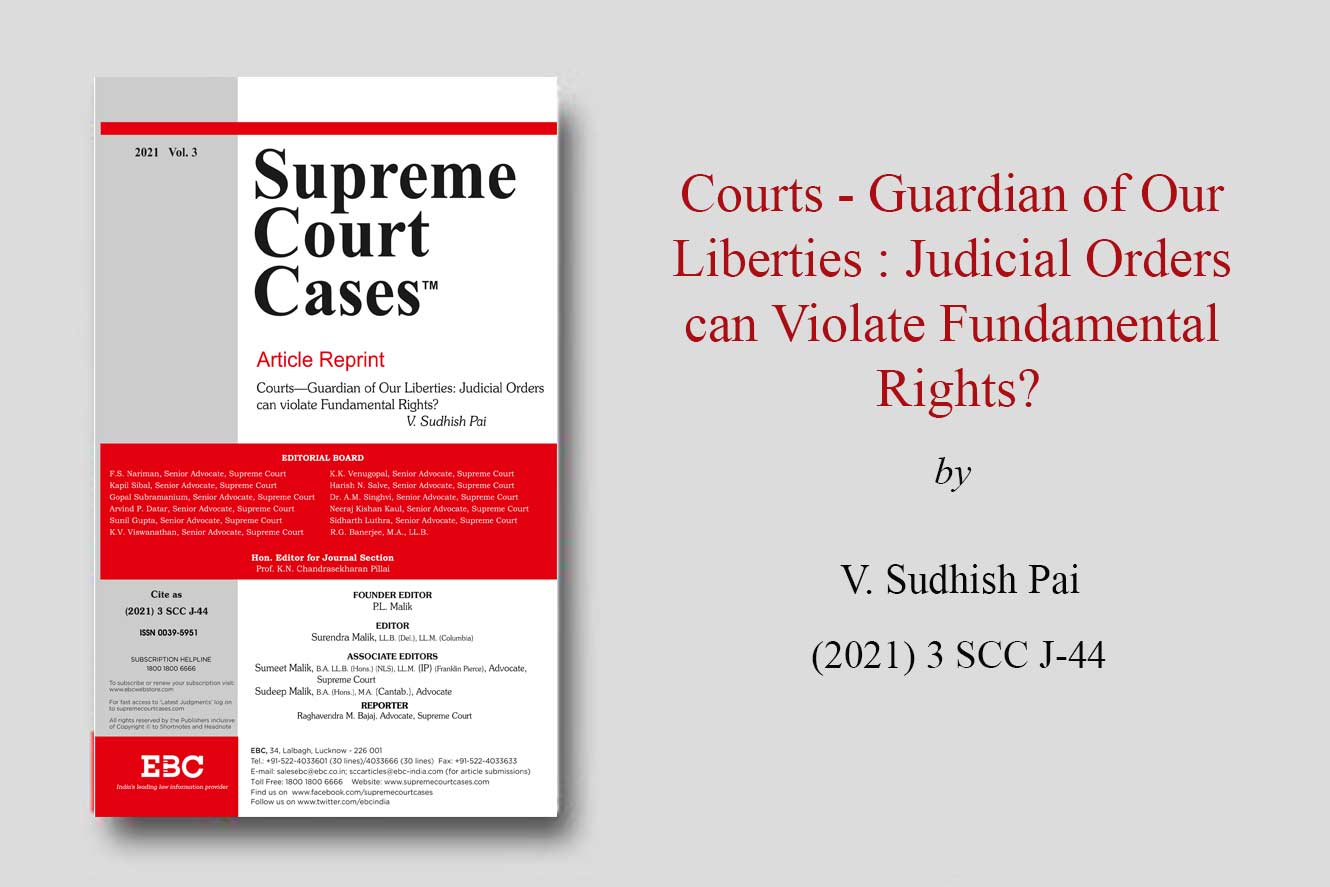
The Constitution of a country is the supreme law. A written Constitution with a Bill of Rights seeks to place certain human rights and fundamental freedoms beyond the reach of ordinary laws. When human rights are incorporated into the municipal law and guaranteed by a written constitution, they are called fundamental rights and are justiciable and enforceable. As the Supreme Court significantly observed in Minerva Mills Ltd. v. Union of India1:
All States, whether democratic or authoritarian, purported to govern for the welfare of the people. What distinguishes a democratic State from a totalitarian one is that a free democratic State respects certain basic human rights or fundamental rights and endeavours to achieve its objectives through the discipline of fundamental freedoms.
We begin with the concept of “State” in Article 12. The constitutional mandate in many of the provisions in the chapter on fundamental rights is to the State not to violate fundamental rights. The State is prohibited from making laws inconsistent with Part III. Fundamental rights are enforceable against the State whose import has been expanded over a period of time.
READ COMPLETE ARTICLE HERE
*The article has been published with kind permission of Eastern Book Company. Cite as (2021) 3 SCC J-44
* Advocate. Author, Working of the Constitution : Checks and Balances (1st Edn. 2014, Eastern Book Company) and Revising Author, V.G. Ramachandran’s Law of Writs [7th Edn. 2021 (In Press), Eastern Book Company].
2[1913] A.C. 417, p. 477 (HL).
3Naresh Shridhar Mirajkar v. State of Maharashtra, AIR 1967 SC 1.
4A.R. Antulay v. R.S. Nayak, (1988) 2 SCC 602.
5Rupa Ashok Hurra v. Ashok Hurra, (2002) 4 SCC 388.
6Kesavananda Bharati v. State of Kerala, (1973) 4 SCC 225.
7Id, pp. 877-78, paras 1703-04.
81948 SCC OnLine US SC 59, para 30 : 92 L.Ed 1161 : 334 US 1 (1948).
91944 SCC OnLine US SC 18 : 88 L Ed 497 : 321 US 1 (1944), p. 16.
10Naresh Shridhar Mirajkar v. State of Maharashtra, AIR 1967 SC 1, p. 34, para 122.
11Snowden v. Hughes, 1944 SCC OnLine US SC 18, para 30 : 88 L Ed 497 : 321 US 1 (1944).
13Snowden case, 1944 SCC OnLine US SC 18, para 30.
16Vinay Chandra Mishra, In re, (1995) 2 SCC 584.
18Afzal v. State of Haryana, (1996) 7 SCC 397.
19(2010) 14 SCC 209, p. 224.
20ADM, Jabalpur v. Shivakant Shukla, (1976) 2 SCC 521.
21Ram Deo Chauhan case, (2010) 14 SCC 209, p. 224, paras 50-52.
23Anjan Kumar Banerjee v. State of W.B., WP (C) 49 of 2009, order dated 9-10-2012 (SC).
24(2016) 9 SCC 746.
25CBI v. Ashiq Hussain Faktoo, (2003) 3 SCC 166.
27Mohd. Arif v. Supreme Court of India, (2014) 9 SCC 737.
28Rajasthan SEB v. Mohan Lal, AIR 1967 SC 1857.
30R. v. Bow Street Metropolitan Stipendiary Magistrate, ex p Pinochet Ugarte (No.2), [2000] 1 A.C. 119 : (1999) 2 WLR 272 (HL).
31[2000] 1 A.C. 61 : (1998) 3 WLR 1456 (HL).
321950 SCR 566 : AIR 1950 SC 163.
35Id, pp. 407-08, para 7.
36K.K. Mathew, Democracy, Equality and Freedom, Eastern Book Company, (1978), p. 21, fn 46.
371940 SCC OnLine PC 10 : AIR 1940 PC 105.
38(1977) 3 SCC 592, p. 646, para 134.





0 replies