








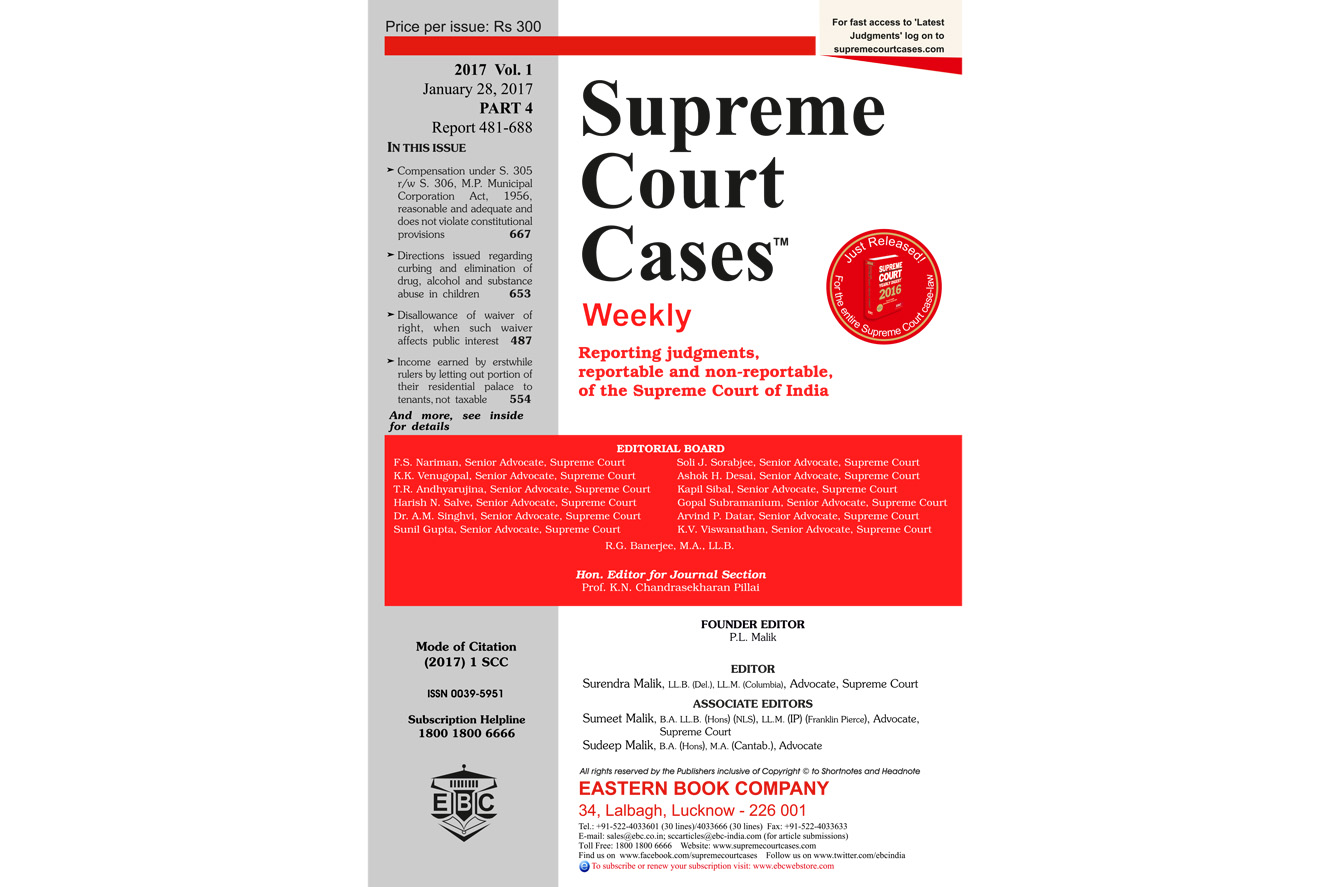
Arbitration Act, 1940 — Ss. 28, 30, 33, 3 and Sch. I, Cl. 3: It is mandatory to complete arbitration proceedings within time stipulated by statute. Time-limit of four months has been prescribed under statute. Strict adherence must be given to the said time-limit, in absence of agreement between parties to extend time for completion of proceedings. [Electrical Mfg. Co. Ltd. v. Power Grid Corpn. of India Ltd., (2016) 8 SCC 667]
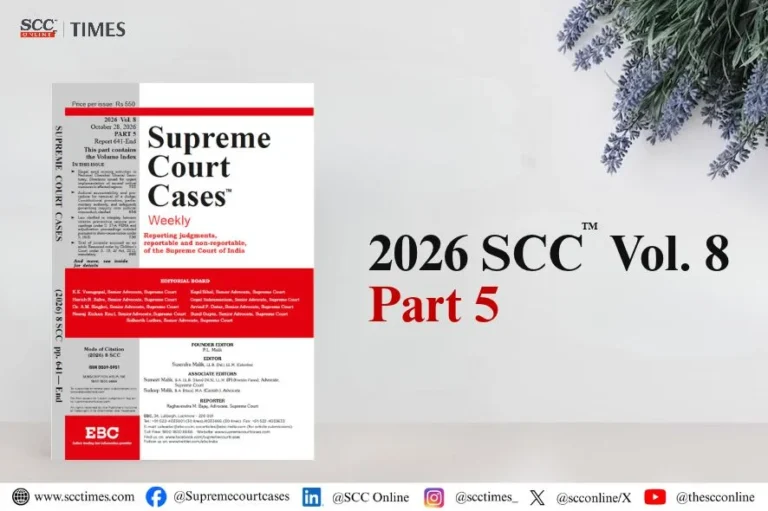
Army Act, 1950 — Ss. 108 to 110, 112 to 116 and 118 to 120: Powers of Commanding Officer (CO) of unit to convene, constitute and complete Summary Court Martial (SCM) to be exercised only rarely when it is absolutely imperative that immediate action is called for. [Union of India v. Vishav Priya Singh, (2016) 8 SCC 641]
Associations, Societies and Clubs — Body discharging public functions but not amounting to “State” — BCCI and State Cricket Associations: Recommendations of Supreme Court appointed three-member committee comprising former Chief Justice of India RM Lodha and retired Supreme Court judges, on reforms in the structure, functioning and membership of BCCI, accepted. [Board of Control for Cricket v. Cricket Assn. of Bihar, (2016) 8 SCC 535]
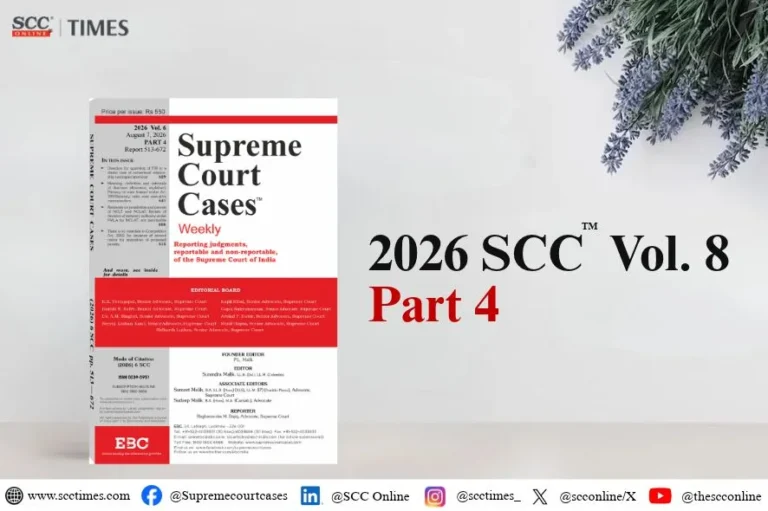
Civil Procedure Code, 1908 — Ss. 9 and 89: Arbitration award/proceedings between government corporations in terms of the “Permanent In-House Administrative Machinery” i.e. dehors Arbitration Act, 1940 or Arbitration and Conciliation Act, 1996, hence, can be challenged by way of civil suit. [Northern Coalfields Ltd v. Heavy Engg. Corpn. Ltd., (2016) 8 SCC 685]
Constitution of India — Arts. 32, 142, 137-A, 21 and 14 — Transfer of civil or criminal case pending in court in State of J&K to court outside that State and vice versa: Even in absence of enabling provision for, under S. 25 CPC, 1908 or S. 409 CrPC, 1973 or under J&K CPC, 1977 or J&K CrPC, 1989, Supreme Court has power under Arts. 32 and 142 to direct such transfer in appropriate case in public interest and to do complete justice, on being satisfied that denial thereof would amount to violation of right to access to justice which forms part of rights guaranteed under Arts. 21 and 14. [Anita Kushwaha v. Pushap Sudan, (2016) 8 SCC 509]
Government Contracts/Tenders — Notice Inviting Tenders (NIT)/ Tender Conditions/Eligibility/RFP conditions: Court must, as far as possible, avoid a construction which would render the words used by the author of the document meaningless and futile or reduce to silence any part of the document and make it altogether inapplicable. Thus, deviation from terms and conditions of NIT is permissible so long as level playing field is maintained and it does not result in any arbitrariness or discrimination. Further, whether a term of NIT is essential or not is a decision taken by the employer, which should be respected, and soundness of that decision cannot be questioned by Court. Applying the principle that “where a power is given to do a certain thing in a certain way the thing must be done in that way or not at all”, if the employer prescribes a particular format of the bank guarantee to be furnished, then a bidder ought to submit the bank guarantee in that particular format only and not in any other format. [Central Coalfields Ltd. v. SLL-SML (Joint Venture Consortium), (2016) 8 SCC 622]
Income Tax Act, 1961 — Ch. XII-G, Ss. 115-V, 115-B, 115-C, 115-D, 115-G(4) & 115-X and S. 2(17) — Assessments relating to income of shipping companies: To be eligible under Tonnage Tax Scheme (TTS), assessee (i) has to be a company having business of operating qualifying ships, (ii) should own at least one qualifying ship, and (iii) exercise option specifically that said income to be computed under Ch. XIII-G. Option so exercised, is in force for ten years from date of exercise of said option. Once said conditions are fulfilled, income from business of operating qualifying ships of a shipping company will be computed as provided under Ch. XII-G and would be treated as income from business chargeable to tax under head “profits and gains of business or profession”. [CIT v. Trans Asian Shipping Services (P) Ltd., (2016) 8 SCC 604]





0 replies