









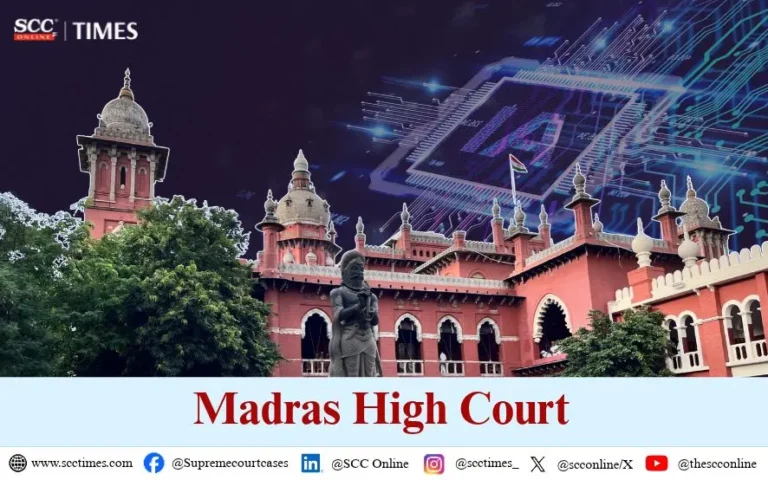
Madras High Court: While deciding that whether the Cane Officer of a Cooperative Sugar Mill comes under the category of ‘public servant’ for the purposes of proceedings under Prevention of Corruption Act, 1988, the Court observed that the Sugar Mills perform a public duty therefore the respondent in his capacity as a Cane Officer of Tiruthani Cooperative Sugar Mills, created under the Tamil Nadu Co-Operative Societies Act, 1983 is a ‘public servant’ within the meaning of Section 2(c) of Prevention of Corruption Act, 1988.
As per the facts of the case, the respondent was suspended on the charges of accepting bribes in lieu of transferring a Cane Assistant. The counsel for the respondent C. Prakasam contended that the respondent does not come under the category of ‘public servant’ as the Tiruthani Cooperative Sugar Mills is not an authority under Article 12 of the Constitution. The petitioner via his counsel S.Sivashanmugam contended that the cooperative sugar mills are performing public duty, therefore its employees come under the category of ‘public servants’ under Section 2(c) of Prevention of Corruption Act, 1988.
Perusing the arguments the Court observed that the Coop. Sugar Mill in question is being partly aided by the Government of Tamil Nadu via the legislation of The Sugarcane (Control) Order, 1966 which defines ‘cooperative society’ and the Essential Commodities Act, 1955 also the Sugar Mills’ service conditions and pay scales are being fixed by the Department of Industries indicating deep control by the Government thus indicating towards performing a public duty. Further referring the decisions by the Supreme Court and various High Courts, the Court observed that the definition of ‘public servant’ in the Prevention of Corruption Act has wider meaning as compared to the provisions of IPC and with the increase in number of corrupt practices by the public servants, the courts are therefore bound to give the term a wider scope in future.
Joint Registrar, M/s Tiruthani Co-op. Sugar Mills Ltd. v. P. Sivakumar, decided on 18.11.2014






0 replies