
Bombay High Court protects “Siyaram” trademark; restrains Dishonest use by interim injunction
“Plaintiff’s reputation and goodwill was such that the plaintiff’s tagline, ‘Come home to Siyaram’ was indelibly etched in public memory.”
“The franchise agreement prima facie indicated acceptance of ownership of the plaintiff in the registered trademarks and permitted use only during subsistence of the agreement.”
The grievance of the plaintiff arose from the manufacture, sale, promotion, and distribution of merchandise such as T-shirts, posters, mugs, keychains, and other products bearing his name, photographs, likeness, and persona, without authorisation.
Explore latest Cases reported in SCC’s High Court Cases (HCC) shaping Intellectual property Laws which covers trademark infringement, patentability, passing off and Brand name disputes. A holistic view of evolving jurisprudence on intellectual property laws in India.
The Court opined that a party seeking interim injunction in a passing-off action must produce concrete evidence of use, goodwill, and business turnover.
The defendants were engaged in providing taxi services across Dehradun and Delhi and were marketing themselves as an inter-state national level service, using the name ‘JIO’.
“Relevant consumer base for the products which are deodorizers, air purifiers etc would be an average educated class with the ability to differentiate between the rival marks especially when there is no resemblance apart from a phonetic similarity between the two when viewed as a whole.”
“It is clear that whilst selling counterfeit products, these listings display marks/trademarks that are deceptively similar to the Plaintiff’s marks, thereby infringing the Plaintiff’s trade marks and constituting an act of passing off as well.
There is no absolute bar on the Trial Court to consider the subsequent developments and condone the delay if justifiable grounds are made out in the Application for condonation of delay.
The plaintiff stated that on 22-01-2025, the defendant announced on various social media platforms that the Assigned Film will be released on 27-03-2025. He stated that the theatrical release of the Assigned Film is proposed in the Southern States of India i.e., Tamil Nadu, Karnataka, Kerala and Andhra Pradesh, Telangana and Pondicherry in original language – Tamil as well as overseas (except Nepal).
The Court found that the respondents’ label is a near replica of the appellant’s trademark and design, including the “Swastik” symbol, which has been consistently used by Rajani Products since 1983.
The infringing materials found on the site of the defendant are counterfeit goods of the plaintiff’s products, affixed with the plaintiff’s registered marks. A clear indicative of the counterfeiting activity towards the plaintiff’s products, are the observations and photographs as attached by the Local Commissioner in its report.
It is manifest that defendant 1 had direct knowledge of the plaintiffs’ RAMADA brand at the time of adoption of the impugned mark. The defendant’s justification for adopting the mark ‘RAMADA’ is an afterthought, and lacks bona fide intent, as it fails to provide any tenable rationale for its selection.
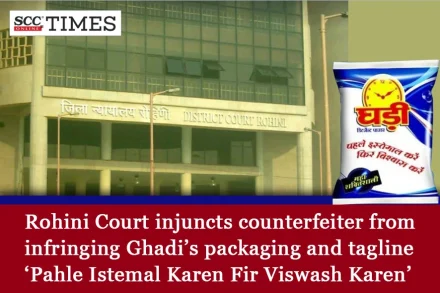
The Court held that the defendant had no real prospect of successfully defending their claim for tagline “Hamesha Istemaal Kare or Kapde Me Chamak Paaye”; and there was no other compelling reason as to why the Ghadi’s claim should not be disposed of before recording of oral evidence vide a summary judgment.
The comparison of images of both names makes it abundantly clear that defendant 1 has copied the most distinctive part of the plaintiff’s mark, which is ‘Evergreen’. In the case of the defendant 1, the word ‘Evergreen’ has the prefix “JV” and the suffix “Sweets and Treats”, whereas in the plaintiff’s case, the word ‘Evergreen’ is followed by the word “Sweet House”.
Lenovo has satisfied the requirements of Section 57 of the Trade Marks Act for cancelling RPD Workstations trade mark ‘THINBOOK’.
Delhi High Court held that the defendants have taken unfair advantage of the reputation and goodwill of Louis Vuitton’s trade mark and deceived unwary consumers by dishonestly adopting Louis Vuitton’s registered marks.
“Private Respondents are free to reuse generic beer bottles manufactured by third parties which do not violate the label, trademark/brand/logo of another entity.”
A quick legal roundup to cover important stories from all High Courts this week
It is not necessary for a registered owner of a trademark to proceed against all entities using similar marks in order to proceed against any one of them. There may be a myriad reasons why a proprietor of a registered trademark may refrain from proceeding against entities that it considers are using infringing marks.