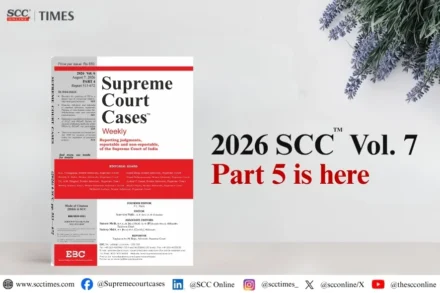
2026 SCC Vol. 7 Part 5: Key Supreme Court Cases on Constitution, GST, Criminal Law and more
Key Supreme Court rulings on Article 227, RTE, Teachers Eligibility Test, custody, GST rebate, etc.

Bringing you the Best Analytical Legal News


Key Supreme Court rulings on Article 227, RTE, Teachers Eligibility Test, custody, GST rebate, etc.

A GST classification dispute arose over the licensing of copyright in cinematographic films and whether such film content could fall within “information technology software” for taxation purposes.
Delhi High Court held that an advocate acting as an Insolvency Professional is liable to pay GST under the forward charge mechanism and cannot claim the reverse charge benefit available to advocates rendering legal services.
The Court held that although allegations of fraudulent availment of Input Tax Credit under the CGST Act constitute serious economic offences, arrest cannot be made as a matter of course. Where the investigation is primarily based on documentary evidence already in the custody of the authorities and custodial interrogation is not shown to be indispensable, anticipatory bail deserves to be granted subject to appropriate safeguards.
The Court held that once a company ceases to exist pursuant to amalgamation, proceedings cannot be continued and an assessment order cannot be passed in its name.
The Allahabad High Court quashed the FIR holding that an advocate who files a statutory GST appeal for a client — even if the legal position taken on pre-deposit is wrong cannot be held a co-conspirator in the client’s alleged tax evasion.
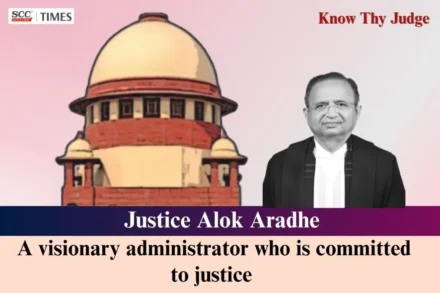
Prior to being elevated to the Supreme Court, Justice Alok Aradhe served as Chief Justice for the Telangana and Bombay High Courts and also as Judge in Karnataka, Jammu and Kashmir and Madhya Pradesh High Courts.
Explore the latest Supreme Court Cases in 2026 SCC Vol. 2 Part 5 on arbitrability of dispute, Polluter Pays Principle, Registration of documents, detention and seizure of goods, and more.
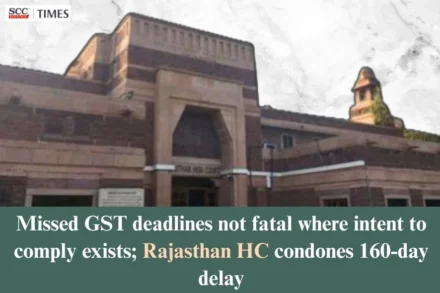
“Cancellation of GST registration or missed appellate deadlines should not permanently debar a taxpayer from the GST framework, especially where the taxpayer intends to comply by filing returns, paying taxes, interest, and penalties, and rectifying defaults. In such cases, denial of opportunity to an assessee undermines the inclusive and facilitative objective of the GST regime.”
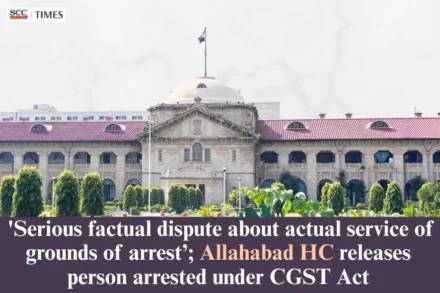
The Court noted that “reasons to believe” are mandatory to be recorded; however, they need not be supplied along with the arrest memo to the accused, unlike the “grounds of arrest”, which must be supplied.
Read the perspectives of experts from Shardul Amarchand Mangaldas and Lakshmikumaran & Sridharan Attorneys highlight how Budget 2026—27 strengthens sectoral momentum and introduces clearer, simpler tax rules.
“The transaction pertained exclusively to transfer of benefits arising out of immovable property and had no nexus with the business of the petitioner company.”
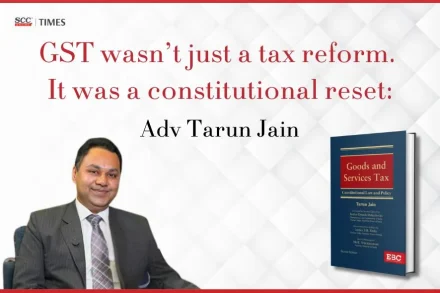
In this episode of Masterclass by EBC Authors, Advocate Tarun Jain, Supreme Court of India unpacks GST not merely as a tax reform but as a constitutional re-engineering of India’s federal structure. From the 101st Constitutional Amendment to Supreme Court rulings and the institutional design of the GST Council, this masterclass explores how GST has transformed legislative power, Centre–State relations, and cooperative federalism.
by Shivam Kumar* and Utkarsh Pandey**
Vide this amendment, the electronic grant of GST registration will be given in 3 working days.
Reaffirming the principle that transactions in securities fall outside the ambit of GST, the Gujarat Appellate Authority for Advance Ruling held that ITC on share buyback expenses is inadmissible and must be reversed under Section 17(3) of the CGST Act, 2017.
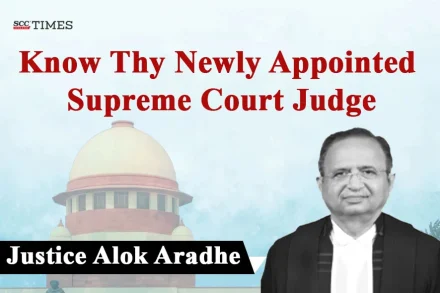
Prior to being elevated to the Supreme Court, Justice Alok Aradhe served as Chief Justice for the High Courts of Telangana and Bombay and also as Judge in Karnataka, Jammu and Kashmir and Madhya Pradesh High Courts.