From Form to Substance: Reinterpreting Electronic Evidence under Section 138-C, Customs Act, 1962
by Rachit Jain*, Harshdeep Khurana** and Dhanur Gupta***

Bringing you the Best Analytical Legal News


by Rachit Jain*, Harshdeep Khurana** and Dhanur Gupta***
The new rules streamline procedures for declaring accompanied and unaccompanied baggage, temporary import or re-import of personal items, baggage examination, transit between customs stations, and custody or disposal of detained goods.
The Ministry of Finance has notified the new Baggage Rules, 2026, effective from 2-2-2026, replacing the earlier 2016 rules. These rules outline the duty-free allowances and conditions for passengers, tourists, returning residents, foreigners transferring residence, and crew members.

When interpreting a tariff heading involved in a classification dispute, the tribunal or court may need to invoke and rely on the common or trade parlance test to understand the meaning and scope of the terms used in that tariff heading.
The Tribunal stated that simply failing to disclose facts is not enough to extend the limitation period. Suppression must be deliberate and intended to evade duty and since no such intent is shown in the present case, the extended period cannot apply.
“Judicial decorum and legal propriety mandates that where a Single Bench or Division Bench does not agree with the decision of the Bench of co-ordinate jurisdiction, the matter should be referred to a Larger Bench.”
The Court considered how the timing of a Show Cause Notice by Customs Department impacts the owner’s liability.
The Court stated that it must balance the right of the investigating agency, and the right of the person facing prosecution to travel in India and abroad.
“The customs officer can reject the transaction value as the assessable value and re-determine it as per the Valuation Rules for the purpose of imposing duty, but this would not change the transaction value for the purpose of receiving foreign remittance.”
Criminal Procedure Code, 1973 — S. 438 — Anticipatory bail — In corruption offences: Law clarified on grant of anticipatory bail in
Bona fide tourists/travellers, travelling for social engagements in India with gold, which could be of a much higher value than the permissible limits, cannot to be expected to file detailed declarations, as this can make the entire process of entering India and exiting from airports extremely unfriendly or onerous.
Section 129-E of Customs Act, 1962 makes it obligatory to deposit the duty/penalty pending the appeal and if a party does not comply either with the main Section or with any order that might be passed under the proviso, the Appellate Authority is fully competent to reject the appeal for non-compliance.
“Once the petitioner had paid the duties as contemplated under Section 3 of the Tariff Act, 1975, it could not be possibly contended that the goods were imported ‘duty free’.”
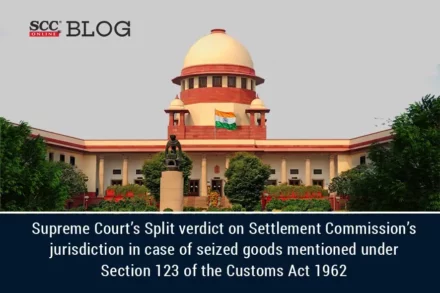
Supreme Court was called upon to decide whether a settlement remedy under Section 127B of the Customs Act, 1962, would be available for the seized goods, which are specified under Section 123 of the said Act, the bench of Krishna Murari and Sanjay Karol, JJ gave a spilt verdict and referred the matter to a larger bench.