can advertisement create binding contract
Law made Easy

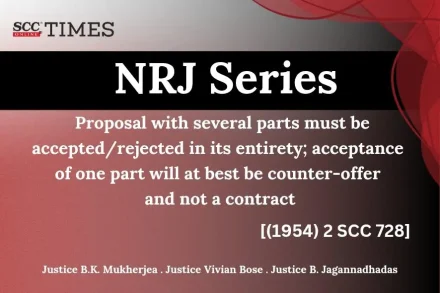
Cases That Made Law is a series by SCC Times that revisits the judgments that built Indian law — tracing the facts, the arguments, and the reasoning that turned a single dispute into settled law. This edition examines a question that reshaped contract law for generations: Can a public advertisement create a legally binding contract, and how exactly does a unilateral contract work in practice? We dive into the historic ruling of Carlill v. Carbolic Smoke Ball Co. to find out.
Arbitration Act 1940 award compound interest
Case BriefsSupreme Court

“There is no dispute as to the power of the courts to award interest on interest or compound interest in a given case subject to the power conferred under the statutes or under the terms and conditions of the contract; but where no such power is conferred ordinarily, the courts do not award interest on interest”.

Sikkim High Court
Case BriefsHigh Courts

Relying on UN Krishnamurthy v. AM Krishnamurthy, the Court stated that the appellant failed to indicate willingness to perform their part of the transaction, as they neither showed nor proved the availability of sufficient funds required to make the payments per the contract

delhi high court
Case BriefsHigh Courts

In 2001, the appellant, Director of Education under the aegis of the Directorate of Education created by the Government of NCT of Delhi, floated a tender for the implementation of the Computer Education Project (“CEP-II”) for various government/ government aided Senior Secondary Schools, and Educomp Solutions a provider of technology-based educational products and services was awarded the contract.

delhi high court
Case BriefsHigh Courts

A party cannot simply raise an objection on the ground of patent illegality if the Award is against them. Patent illegality requires a distinct transgression of law, the clear lack of which makes the petition a pointless effort of objection towards an Award passed by a competent Arbitral Tribunal.

delhi high court
Case BriefsHigh Courts

Sections 20-A and 41(ha) of the Specific Relief Act, 1963 expresses the legislative intent to not grant injunctions relating to infrastructure projects where delay may be caused by such an injunction. Thus, the role of Courts in this exercise is to interfere to the minimum extent so that public work projects are not impeded or stalled.

delhi high court
Case BriefsHigh Courts

Section 52 of the Transfer of Property Act is an expression of the principle “pending a litigation nothing new should be introduced”. It provides that pendente lite, neither party to the litigation, in which any right to immovable property is in question, can alienate or otherwise deal with such property so as to affect his appointment