Contract Act 1872
Landmark Judgment Series| Mohori Bibee v. Dharmodas Ghose: Can a Minor Enter Into a Binding Contract?
Watch Mohori Bibee v. Dharmodas Ghose [1903 SCC OnLine PC 4], the Privy Council decision that established that a minor’s agreement is
Cases That Made Law | Can an Advertisement Create a Binding Contract? Revisiting Carlill v. Carbolic Smoke Ball Co. [1892 2 Q.B. 484]
Cases That Made Law is a series by SCC Times that revisits the judgments that built Indian law — tracing the facts, the arguments, and the reasoning that turned a single dispute into settled law. This edition examines a question that reshaped contract law for generations: Can a public advertisement create a legally binding contract, and how exactly does a unilateral contract work in practice? We dive into the historic ruling of Carlill v. Carbolic Smoke Ball Co. to find out.
Cases That Made Law| Can a Minor Enter into a Binding Contract? Understanding Mohori Bibee v. Dharmodas Ghose [1903 SCC OnLine PC 4]
Cases That Made Law is a series by SCC Times that revisits the judgments that built Indian law — tracing the facts, the arguments, and the reasoning that turned a single dispute into settled law. This edition examines a question that appears simple on the surface but carries consequences that run through contract law to this day: can a minor enter into a binding contract?
Cheque for Time-Barred Debt Revives Enforceability Under S. 25(3) Contract Act; Dishonour attracts Section 138 NI Act: Rajasthan High Court
“A meaningful reading of Sections 20, 118 and 139 of the NI Act makes it clear that a person who signs a cheque and delivers it to the payee remains liable unless he successfully rebuts the statutory presumptions.”
Share apportioned by a Family Settlement Agreement cannot be modified by Builder’s Agreement: Delhi High Court
“Once, by virtue of the Memorandum of Family Settlement, the respective shares of the family members were identified, the Builders’ Agreement, which is essentially an agreement to construct the building, will not result in its modification or novation.”

MRL Compliances for Indian Agricultural Products Exported to the European Union
by Yogendra Aldak*, Pranav Mundra** and Balraaj Singh***
Monthly rent payment cannot be accepted as sale consideration, without proper justification: Delhi High Court
The Court presumed that the absence of a reason for not disclosing the higher amount in the Agreement to Sell (‘ATS’), and the lack of explanation for payment of sale consideration disguised as rent is likely to evade taxes. This suppression made the 1982 ATS illegal, and against the public policy as per, Section 23 of the Contract Act, 1872.
Assessing “Loss of Profits or Profitability” in Construction Contracts — Evolution through Judicial Narratives
by Sumit Gehlot* and Vaishnavi Agrawal**
Allowing Modification of Arbitral Award by Court — A Retrograde Step?
by Dr G.B. Reddy* and Dr S.B. Md. Irfan Ali Abbas**
The Enforceability of Arbitration Clauses in Draft Agreements
by Abhinav Agrawal* and Deepali Poddar**
Doctrine of Damages in India: A Comprehensive Legal Analysis of Recent Trends
by Abhishek Bhushan Singh* and Khushi Bansal**
NRJ Series| Proposal with several parts must be accepted/rejected in its entirety; acceptance of one part will at best be counter-offer and not a contract [(1954) 2 SCC 728]
This report covers the Supreme Court’s Never Reported Judgment on what constitutes as a contract, dating back to the year 1954.
Never Reported Judgment| Seller must prove readiness and willingness to perform his part of contract to sustain his claim for damages for breach of contract [(1953) 2 SCC 52]
This report covers the Supreme Court’s Never Reported Judgment dating back to the year 1953 on damages for breach of contract.
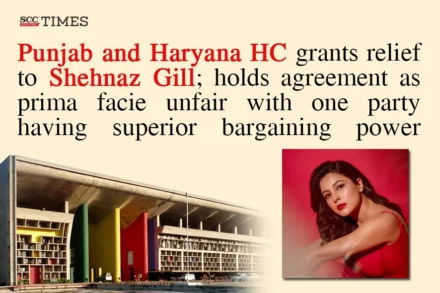
Punjab and Haryana HC grants relief to Shehnaz Gill; holds agreement as prima facie unfair with one party having superior bargaining power
Freedom of contract must be founded upon equality and bargaining power between the contracting parties. The party having less bargaining power is left with little or no choice but to accept the unfair and unreasonable terms imposed upon it by the party with superior bargaining power.
Never Reported Judgment | Rules of Stock Exchange are mere rules for regulation of business and do not affect general law of contract [(1952) 1 SCC 481]
This report covers the Supreme Court’s Never Reported Judgment dating back to the year 1952 on reciprocal promises in share transactions under the Contract Act, 1872.
Illustrations to Statutory Provisions and their Treatment by the Courts in India
by Dormaan Jamshid Dalal*