Navigating “Twilight Issues” in International Arbitration: Professor George A. Bermann at the ICDR India Conference
This report summarizes the insights from the Keynote Address delivered by Professor George A. Bermann at the ICDR India Conference.
‘Courts, while evaluating a challenge under Section 34, would not be justified in faulting an award merely because an alternative view was possible or that, in their opinion, a more just conclusion could have been reached.’
by Vasanth Rajasekaran* and Harshvardhan Korada**
“The legislative intent of inserting Section 29-A of the Act is only for expeditious disposal of the arbitration proceedings and not to confer a new defence upon an unsuccessful party to challenge the award and to reopen the entire proceedings.”
“Deletion of party is an issue to be decided by the Arbitral Tribunal, it cannot be looked into by the Court under Section 11(6) of the Arbitration Act”
by Abhisaar Bairagi*, Milind Sharma** and Ausaf Ayyub***
The Court emphasized the necessity of adhering to the specific terms and limitations outlined in contractual clauses. This decision underscores the importance of clear contractual provisions and their binding nature on arbitral tribunals, reaffirming that such limitations must be respected and enforced in arbitral awards.
“When the Arbitral Tribunal is in seisin of disputes between parties, there is the pernicious possibility of any observation being made by the Court influencing the proceedings before the Arbitral Tribunal”
“Consequent on introduction of sub-Section 6(A) in Section 11, the Supreme Court has in several decisions held that the jurisdiction of the referral Court is now circumscribed.”
Section 29A of the Arbitration and Conciliation Act, 1996, empowers Courts to extend mandate of arbitral tribunals beyond the specified limitation.
The Delhi High Court said that the petitioner had no prima facie right, title, and interest in the allotted units, and a case was not made out to restrain the respondents from creating any third-party interest.
“The abandonment of the claim can be either express or implied. The abandonment cannot be readily inferred. There is an implied abandonment when admitted or proved facts are so clinching that the only inference which can be drawn is of the abandonment.”
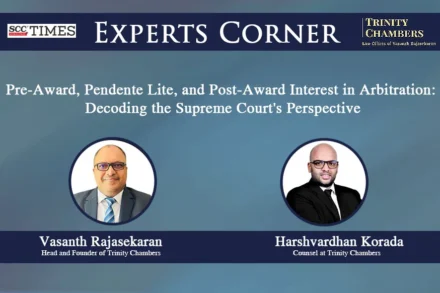
by Vasanth Rajasekaran† and Harshvardhan Korada††
Arbitration and Conciliation Act, 1996 — Ss. 11(14) & Expln. thereto [as they stood prior to the 2019 Amendment Act], 31(8), 31-A,
“When a Coordinate Bench issues a judgment on a particular legal issue, that judgment becomes binding precedent for subsequent cases involving a similar issue before another Coordinate Bench”
“The Court’s jurisdiction at the pre-reference stage is only to determine the prime facie existence of an arbitration agreement and the final adjudication, even on the question of limitation, is to be left to the arbitral tribunal, being the parties’ chosen forum.”
by Vasanth Rajasekaran† and Harshvardhan Korada††
“When no opportunity is given to deal with an argument which goes to the root of the case based on evidence which go behind the back of the party and results in a denial of justice to the prejudice of the party, the same would amount to violation of principle of natural justice.”
Supreme Court has applied the standard of a ‘grave miscarriage of justice’ in the exceptional circumstances of this case where the process of arbitration has been perverted by the arbitral tribunal to provide an undeserved windfall to DAMEPL.