


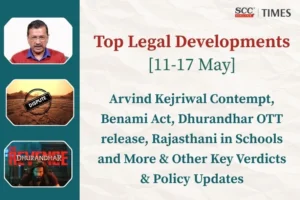
This roundup of weekly legal developments India covers the most significant Supreme Court and High Court rulings, including Arvind Kejriwal Contempt proceedings, Landmark Benami Act Ruling, Senior Advocate Yatin Oza’s contempt conviction, Dhurandhar OTT release, SC’s Directions for Installation of Vehicle Tracking Devices and Emergency Panic Buttons in Public Transits, Toyota’s “ALPHARD” declared a well-known trade mark and others
TOP STORIES OF THE WEEK
Supreme Court’s Landmark Benami Act Ruling Explained: Why the 2016 Amendment Is Retrospective, What ‘Fiduciary Capacity’ Means, and When Confiscation Follows
In Manjula v. D.A. Srinivas, 2026 SCC OnLine SC 831 while hearing an appeal against the order rejecting Order 7 Rule 11 application seeking rejection of plaint for being barred by law as benami transaction, the Division Bench noted that that although the suit was presented as one based on a will and inheritance, the actual claim was that the properties had been purchased by the deceased using the respondent-plaintiff’s money and thereafter kept it for his benefit; the Court held that the present matter attracted the provisions of the Prohibition of Benami Property Transactions Act, 1988 (Benami Act). Read more about Benami Act Ruling HERE
Supreme Court Extends ‘A Final Act of Forgiveness’ to Senior Advocate Yatin Oza; Suspends His Contempt Conviction
In Yatin Narendra Oza v. Suo Motu, High Court of Gujarat, 2026 SCC OnLine SC 835, wherein a criminal appeal arose from controversy stemmed from a live press conference held on 5 June 2020 during the COVID-19 pandemic, wherein, appellant-senior advocate and former President of the Gujarat High Court Advocates’ Association (GHCAA) made severe allegations against the functioning of the Gujarat High Court and its Registry and the High Court considered the remark “gambling den” made against it as scandalous and damaging to the institution of judiciary and by order dated 6 October 2020 convicted the appellant for criminal contempt under Section 2(c)(i), Contempt of Courts Act, 1971 (Contempt of Courts Act). While holding that the Gujarat High Court’s findings and reasons in convicting the appellant for criminal contempt did not require interference, the Division Bench as a final act of forgiveness, exercised its powers under Article 142 of the Constitution to indefinitely suspend Senior Advocate Yatin Oza’s contempt conviction and sentence. Read more about SC’s Final Act of Forgiveness to Senior Advocate Yatin Oza HERE
“Power and Popularity Do Not Confer Constitutional Immunity”: Delhi HC’s Criminal Contempt Order Against Kejriwal and Others Explained
In CBI v. Kuldeep Singh1, a significant pronouncement on the scope of criminal contempt, judicial independence, and the limits of public criticism against courts in the age of social media, in the backdrop of coordinated social media campaigns, edited videos, public speeches, and repeated allegations questioning the integrity and impartiality of a sitting Judge who rejected the prayer of the litigants, Arvind Kejriwal and others, in a proceedings arising out of the Delhi Excise Policy case, the Single Judge Bench initiated the contempt proceeding against the respondents, holding that statements and conduct of the respondents, including Arvind Kejriwal, Manish Sisodia, Durgesh Pathak, Sanjay Singh, Devesh Vishwakarma, Saurabh Bharadwaj and others, prima facie amounted to scandalizing the Court, lowering its authority, and obstructing administration of justice and fell within the ambit of criminal contempt under Section 2(c), Contempt of Courts Act, 1971 (the Act). Read more about contempt proceedings against Against Kejriwal HERE
Also Read: NEET 2026 Paper Leak Controversy: What Happened, Why It Matters, and What Must Change
SUPREME COURT HIGHLIGHTS OF THE WEEK
Contractual Property Dispute| IBC Cannot Be Invoked as a Coercive Recovery Tool in Individual Contractual Property Dispute Pending before DRT
In Dhanlaxmi Bank Ltd. v. Mohd. Javed Sultan, 2026 SCC OnLine SC 820, a civil appeal was filed challenging the judgment dated 2 August 2022 passed by the National Company Law Appellate Tribunal (NCLAT), wherein the National Company Law Tribunal’s (NCLT) order admitting the application under Section 7, Insolvency and Bankruptcy Code, 2016 (IBC) was set aside, the Division Bench affirmed the impugned order holding that present case does not involve a straightforward “financial debt-default” scenario warranting initiation of Corporate Insolvency Resolution Process (CIRP) and IBC cannot be invoked as a coercive recovery tool in individual contractual property dispute pending before Debt Recovery Tribunal (DRT). Read about invoking IBC as a Coercive Recovery Tool in Individual Contractual Property Dispute HERE
Depreciation Claim| Supreme Court Refuses TPDDL’s Depreciation Claim
In Delhi Electricity Regulatory Commission v. Tata Power Delhi Distribution Ltd., 2026 SCC OnLine SC 819, an appeal under Section 125, Electricity Act, 2003, the Delhi Electricity Regulatory Commission assailing the Appellate Tribunal for Electricity order, whereby it permitted the respondent to recover the entire capital cost of the Rithala Combined Cycle Power Plant at Delhi (the Plant) through depreciation over a period of 15 years, even though the Plant ceased to supply electricity to the consumers from and after March 2018, the Division Bench allowed the appeal. The Court further stated that the true-up proceedings are intended to give effect to the tariff framework and not to reopen or reconfigure it. Accordingly, it held that Appellate Tribunal for Electricity (APTEL) erred in disregarding the regulatory framework and the conditions governing approval. Read more about SC refusal to TPDDL HERE
Environmental Clearance| Formaldehyde Units in Rajasthan and Haryana permitted to Continue Operations Pending Environmental Clearance
In Neetu Solvents v. Vineet Nagar, 2026 SCC OnLine SC 811, while hearing a batch of appeals concerning formaldehyde manufacturing units operating in the States of Rajasthan and Haryana without prior environmental clearance (EC) under the Environment Impact Assessment Notification, 2006 (EIA Notification, 2006), a Division Bench set aside the closure directions issued by the National Green Tribunal (NGT) and permitted the industries to continue operations. The Court held that the appellant-units, having been established and operated pursuant to valid consent to establish (CTE) and consent to operate (CTO) granted by the respective State Pollution Control Boards (PCBs), could not be shut down merely because the requirement of prior EC had not been earlier appreciated even by the regulatory authorities themselves. Read more HERE
Motor Vehicles Act, 1988| Supreme Court’s Strong Push for Installation of Vehicle Tracking Devices and Emergency Panic Buttons in Public Transits
In S. Rajaseekaran v. Union of India2, the Division Bench issued series of directives aiming to improve vehicle tracking for the purposes of swift emergency response for passengers and pedestrians alike. The Court strongly opined that all vehicle manufacturers are duty-bound to fit speed limiting devices (SLDs) at the time of manufacture. The Court issued important directions for mandatory installation of vehicle location tracking devices and panic buttons in public service vehicles. Read more about SC’s Directions HERE
Right to Education| Supreme Court Directs Rajasthan to Introduce Rajasthani in Schools
In Padam Mehta v. State of Rajasthan, 2026 SCC OnLine SC 849, while giving a significant judgment concerning linguistic rights and the constitutional promise of meaningful education, the Division Bench held that the right to receive education in one’s mother tongue found its normative basis in Article 19(1)(a) of the Constitution and that “true value of this freedom lies not merely in the ability to communicate, but in the ability to understand, internalise, and process information so as to make informed choices”. The Court set aside the impugned judgment of the Rajasthan High Court and issued following directions to the State of Rajasthan. Read more about SC’s directions HERE
SC/ST Act| Caste-Based Abuse Inside House Not an Offence Under SC/ST Act Absent ‘Public Gaze’
In Gunjan v. State (NCT of Delhi), 2026 SCC OnLine SC 834, an appeal arose from the Delhi High Court’s judgment dated 22 August 2024 whereby the High Court dismissed criminal revision and upheld the trial court’s orders framing charges against the appellants under Sections 3(1)(r) and 3(1)(s), Scheduled Castes and Scheduled Tribes (Prevention of Atrocities) Act, 1989 (SC/ST Act) as well as under Section 506 read with Section 34, Penal Code, 1860 (IPC), the Division Bench set aside the judgment of the Delhi High Court, quashed the trial Court’s orders and quashed the FIR along with the charge-sheet filed against the appellants, holding that alleged caste abuse inside residential house not “within public view” under Sections 3(1)(r) and 3(1)(s) of the SC/ST Act. The Court held that the occurrence of the incident of insult or abuse, towards the member of the Scheduled Caste or Scheduled Tribe has to be in “a place within public view”, thereby making the same a sine qua non for constituting the offence under the SC/ST Act. Read more about Offence Under SC/ST Act HERE
Signed Order| Signed order prevails over oral dictation
In Fakir Mamad Suleman Sameja v. Adani Ports and Special Economic Zones Ltd., 2026 SCC OnLine SC 842, a miscellaneous application filed in a disposed of civil appeal seeking clarification and correction of the order dictated in open court vis-à-vis the digitally signed order subsequently uploaded, a Division Bench dismissed the application as wholly misconceived and not maintainable, holding that the applicants were in substance seeking a review and rewriting of the final signed order of the Court. The Court reiterated that the digitally signed order alone constitutes the final and binding expression of the Court’s opinion and that corrections, refinements and enhancements made to a dictated draft order before signing are permissible so long as they do not result in material changes requiring rehearing of parties. Read more about signed order prevails over oral dictation HERE
MAJOR HIGH COURT RULINGS THIS WEEK
BAIL| Sushanta Dhalasamanta released on Bail in 2004 Murder Case After a Decade of Incarceration
In Sushanta Dhalasamanta v. State of Orissa3, while hearing a bail application filed under Section 483, Nagarik Suraksha Sanhita, 2023 (BNSS), seeking release in connection with a sessions trial involving charges under the Sections 302, 120-B and 34, Penal Code, 1860 (IPC) and Sections 25 and 27, Arms Act, 1959 (Arms Act) provisions, a Single Judge Bench of G. Satapathy, J., held that the petitioner was entitled to bail after spending more than 10 years in custody without conclusion of trial. The Court emphasised that denial of a speedy trial infringes the fundamental right guaranteed under Article 21 of the Constitution, and however grave the offence, an accused cannot be kept in jail indefinitely. Read more about Sushanta Dhalasamanta bail HERE
CLAT UG 2026 | Order Directing Revision of Merit List set aside
In Consortium of National Law Universities v. Avneesh Gupta, 2026 SCC OnLine All 5488, wherein a set of appeals filed against the Single Judge’s decision directing revision of the CLAT UG 2026 merit list, the Division Bench allowed the appeal filed by the Consortium of National Law Universities (Consortium), holding that no interference was warranted regarding the answer key of the three contested questions as the answers indicated by the examiner were plausible and reasonable interpretations of the questions. The Court further held that submissions as well as records could not demonstrate that the answers suffered from any patent error or that they were such that no reasonable expert could have arrived at them. Read more about CLAT UG 2026 Answer Key Challenge fail HERE
Children’s Rights| Bombay HC Directs Maharashtra to Frame Salary Grant Policy for NGO-Run children’s homes
In Yuvraj v. State of Maharashtra, 2026 SCC OnLine Bom 2853, writ petitions filed by employees of children’s homes managed by unaided NGOs, seeking salary grants and pay scales equivalent to those of government employees, the Division Bench of Bombay High Court held that such employees are entitled to salary support. The Court emphasised that the State cannot evade its constitutional obligations under Articles 14, 21 and 39(f) of the Constitution and directed the Government to frame, within six months, a policy for providing salary grants to deserving NGOs functioning strictly in compliance with the Juvenile Justice (Care and Protection of Children) Act, 2015 (2015 Act). Read more about directions to Frame Salary Grant Policy for NGO-Run children’s homes HERE
Copyright | Delhi HC Refuses Injunction Over Remixed “Tirchi Topiwale” in Dhurandhar 2
In Trimurti Films (P) Ltd. v. B62 Studios (P) Ltd.4, while hearing an application under Order 39 Rules 1 and 2, Civil Procedure Code, 1908 (CPC) seeking interim injunction in a copyright infringement dispute concerning the iconic song “Tirchi Topiwale” from the film Tridev, a Single Judge Bench declined to restrain the defendants from further use and exploitation of the remixed version of the song in the cinematograph film Dhurandhar: The Revenge. The Court held that a party invoking equitable and discretionary jurisdiction must approach the Court with clean hands and cannot suppress material facts having a bearing on the grant of interim relief. Read more about denial on stay for OTT release of Dhurandhar 2 HERE
Marriage| No Embassy NOC Needed for Marriage with Foreign National
In X v. State of Kerala, 2026 SCC OnLine Ker 4528, a writ petition challenging the refusal of Sub-Registrar (Marriage) to process and solemnise an intended marriage under the Special Marriage Act, 1954 (1954 Act), a Single Judge Bench held that a no-objection certificate (NOC) from the Embassy is not required for solemnising a marriage with a foreign national under the 1954 Act. The Court directed the Sub-Registrar to solemnise the marriage without insisting on an Embassy-issued NOC or any additional documents. Read more about requirement of Embassy NOC Needed for Marriage with Foreign National HERE
Pendency of cases| Allahabad HC issues directions to Police and State for curing pendency of cases
In Mevalal Prajapati v. State of U.P., 2026 SCC OnLine All 4981, while hearing a bail application in which the Court noted negligence in the police’s execution of the forensic process, the Single Judge Bench delved into the various reasons for the pendency of criminal cases and issued detailed directions for the police and State functionaries. Read more about directions issued for curing pendency of cases HERE
Preventive Detention| Right to Make Representation Must Be Communicated When Grounds of Detention Are Served, Not Weeks Later
In Wahengbam Bimal Meitei v. District Magistrate,Imphal5, while hearing a writ of habeas corpus, a Division Bench of Manipur HC, set aside the impugned preventive detention order issued against the petitioner under Section 3(3), National Security Act, 1980 (NSA), as the grounds of detention issued to the petitioner by the detaining authority, did not state the petitioner’s right to make a representation to detaining authority and Central Government, thus violating Section 14 NSA and Article 22(5) of the Constitution. The Court applied the principles pertaining to Article 22(5) to preventive detention order under the NSA and held that the order stands vitiated for non-communication of his right to make a representation. Read more about what Manipur HC said about Right to Make Representation HERE
Right of Residence| Daughter-in-Law’s Right of Residence in Shared Household
In Ritu Taneja v. State (NCT of Delhi), 2026 SCC OnLine Del 3199, while hearing a writ petition challenging an eviction order passed under the Maintenance and Welfare of Parents and Senior Citizens Act, 2007 (Senior Citizens Act, 2007), a Single Judge Bench dismissed the plea filed by a widow and her son against eviction from their in-laws’ property, holding that proceedings under the Senior Citizens Act,2007 are intended to secure peaceful residence and dignity of senior citizens and cannot be converted into a forum for adjudication of complex civil disputes relating to inheritance, ancestral property, ownership rights or financial entitlements. The Court reiterated that although a daughter-in-law may possess a right of residence in a “shared household” under the Protection of Women from Domestic Violence Act, 2005, such right is merely protective in nature and does not create any proprietary interest in the property of the in-laws, particularly where continued cohabitation has become unworkable and the senior citizens’ right to peaceful enjoyment of their property stands affected. Read more HERE
Raid| Raid Within Days of AAP-BJP Switch Was Political Vendetta, Not Environmental Urgency
In Trident Ltd. v. State of Punjab6, while considering a petition seeking direction restraining the respondents from taking coercive steps against the petitioner-Company pursuant to the raid conducted, on 30 April 2026, by a team of officers of Respondent 2-Punjab Pollution Control Board (PPCB), the Division Bench held that the timing of the raid conducted by PPCB, which was in close proximity to the switching of political allegiance of the Chairman Emeritus of the petitioner-Company from Aam Aadmi Party (AAP) to Bhartiya Janta Party (BJP), stemmed from political vendetta and appeared reasonably palpable. Read more about P&H HC’s Applicaion of Wednesbury to Restrain PPCB HERE
Trademark| Toyota’s “ALPHARD” declared a well-known trade mark in India
In Toyota Jidosha Kabushiki Kaisha v. Tech Square Engg. (P) Ltd., 2026 SCC OnLine Del 2617, a Letters Patent Appeal arising from the dismissal of rectification petitions under Section 57, Trade Marks Act, 1999 (TMA), concerning the trade mark “ALPHARD”, the Division Bench reversed the decision of the Single Judge and held that Toyota had successfully established prior adoption, transborder reputation, and spillover goodwill of the mark in India prior to Respondent 1’s registration. The Court further held that the mark “ALPHARD” had acquired the status of a well-known trade mark in India and that Respondent 1’s adoption of an identical mark in relation to allied and cognate goods lacked bona fides and was likely to cause confusion. Consequently, the Court declared the impugned registrations invalid and directed their removal from the Register of Trade Marks. Read more about Toyota’s “ALPHARD” a well-known trade mark HERE
Also Read: Mother’s Custody Best for Child Under Five: Allahabad HC| SCC Times
Also Read: Deliberate Public parading of accused violates Article 21: MP HC | SCC Times
THIS WEEK’S KEY LEGISLATIVE UPDATE
-
IFSC (TechFin and Ancillary Services) (Amendment) Regulations, 2026
-
Occupational Safety, Health and Working Conditions (Central) Rules, 2026
-
CGPDTM Circular 2026: Promoting EV Adoption & Sustainable Commuting
-
Bar Council of India Bans 9 Law Colleges from Admissions for 2026—27 Session Due to Deficiencies
OTHER DEVELOPMENTS OF THIS WEEK
LAW MADE EASY
OP.ED.
-
No Claims Certificate 99 Problems in Commencing Disputes? — No Claims Certificate is Not One of Them! by Shalaka Patil and Ankit Pathak
KNOW THY JUDGE
Also Read:
-
Top Weekly Legal Developments India: 4 – 10 May 2026 | SCC Times
-
SC Collegium recommends 9 Advocates as Calcutta HC Judges | SCC Times
-
Sunjay Kapur ₹30,000-Cr Dispute: SC Blocks RIPL Board Changes | SCC Times
-
NRJ Series: Power of Supreme Court to transfer cases |SCC Times
-
S. 498-A case quashed after mutual divorce as no cruelty or dowry demand made out: HP HC | SCC Times
1. RL.REV.P. 134 of 2026 & CRL.M.A. 6853 of 2026
2. Writ Petition (Civil) No. 295/2012
3. BLAPL No. 8474 of 2025
4. CS(COMM) 378 of 2026
5. WP(Crl.) No. 8 of 2026
6. CWP-13613-2026 (O&M)