


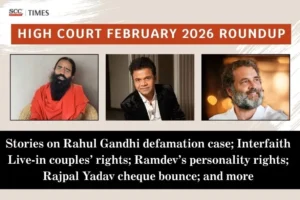
February’s roundup traverses various important legal issues dealt with by the High Courts, such as, CGLE paper, DJSE 2023 evaluation, Lawyer’s safety directives, Tibetan woman passport, Sanitation rights, Interfaith Live-in couples’ rights, Delhi Metro cable theft, MP cough syrup death, IPS Amitabh Yash and Rahul Gandhi defamation case, Malabar Gold and Diamond bank account freezing, 136 Crore Poppy Seeds Import, CLAT 2026 merit list, DNA test in adultery-based divorce, Ramdev’s personality rights, Chacha trade mark, Rajpal Yadav cheque bounce, Namaz at restricted place, etc.
ADMINISTRATIVE LAW
Two-child norm disqualification upheld; protective proviso inapplicable to Panchayat membership termination
In Maheswar Jena v. Madhusudan Dalai, 2026 SCC OnLine Ori 386, the Orissa High Court upheld the termination of a Grama Panchayat member on the ground of disqualification under Section 25(1)(v) of the Odisha Grama Panchayats Act, 1964. The Court held that the statutory protection under the proviso to the two-child norm was inapplicable, thereby attracting the disqualification clause and warranting termination of membership. Read Two-child norm disqualification case HERE
SSC rapped for serious lapses in administration of CGLE question papers and answer keys
In Devyanshu Suryavanshi v. Staff Selection Commission, 2026 SCC OnLine Del 443, the Delhi High Court expressed concern over serious lapses in the administrative diligence of the Staff Selection Commission in conducting the Combined Graduate Level Examination, 2024, while hearing writ petitions challenging orders of the Central Administrative Tribunal. However, finding no patent illegality or perversity in the impugned orders, the Court declined interference and dismissed the petitions. Read CGLE paper case HERE
Examiner entitled to correct/re-evaluate marks “at the first blush”; plea challenging DJSE-2023 evaluation process dismissed
In Prerna Gupta v. Registrar General of Delhi High Court, 2026 SCC OnLine Del 459, the Delhi High Court dismissed a challenge to the DJSE-2023 evaluation process, holding that an examiner is entitled to correct or re-evaluate marks at the initial stage, and in the absence of mala fide, bias, or material error, judicial interference is unwarranted. Read DJSE-2023 evaluation case HERE
PIL challenging stoppage of fresh registrations in Ladli Behna Yojana, dismissed
In a public interest litigation titled Paras Saklecha v. State of Madhya Pradesh,2026 SCC OnLine MP 1025, challenging the implementation of the Mukhyamantri Ladli Behna Yojana, 2023, the Madhya Pradesh High Court dismissed the petition, holding that the case did not fall within the scope of judicial review and the issues raised fell within the executive domain. Read MLBY Challenge case HERE
ADVOCATES
Calling rape survivor a woman of “easy virtue” violates dignity and privacy under Article 21; Advocate pulled up
In Bechan Prasad v. State of U.P., 2026 SCC OnLine All 238, the Allahabad High Court held that labelling a rape survivor as a woman of “easy virtue” amounts to a direct attack on her dignity and privacy under Article 21 of the Constitution. The Court pulled up the defence counsel for relying on scandalous and extraneous material to malign the prosecutrix’s character, observing that such attempts are barred under Section 53A and the proviso to Section 146 of the Evidence Act. Read rape survivor dignity case HERE
Protective directives issued for lawyers, including Round-the-Clock Security, Bar Council Inquiry, Court Security Arrangements, etc
In Court on its Own Motion v. State (NCT of Delhi)6, the Delhi High Court issued protective, investigative, and corrective directives, including round-the-clock security, Bar Council inquiry, and enhanced court security measures, following a reported incident affecting the safety of practising lawyers and the dignity of court proceedings. Read Lawyer’s safety directives case HERE
Initiation of contempt proceedings called for against advocate who challenged Court’s authority in open Court alleging Government pressure
In Kunal v. State of U.P., 2026 SCC OnLine All 357, the applicant’s advocate raised his voice in open Court questioning the Court’s authority in a highly objectionable tone and body language and alleged pressure of the Government. Thus, the Allahabad High Court initiated contempt proceeding against him. Read Contempt against advocate case HERE
ALTERNATIVE DISPUTE RESOLUTION
Time-barred claim does not render Section 11 petition time-barred; second arbitrator appointed
In Shinryo Suvidha Engineers India Pvt. Ltd. v. Cosmas Research Lab Ltd., 2026 SCC OnLine P&H 773, the Punjab and Haryana High Court held that a distinction exists between a claim to be made and a petition under Section 11 of the Arbitration and Conciliation Act, 1996, and that a time-barred claim does not automatically render a Section 11 petition time-barred. The Court held that the petition was filed within the limitation period of three years and appointed a second arbitrator after the respondent-company failed to respond to the petitioner’s notice. Read Section 11 arbitration appointment case HERE
CIVIL LAW
Registry cannot refuse execution petitions below Rs. 2 crores; access to Court cannot be curtailed
In Asian Patent Attorneys Association (Indian Group) v. Delhi High Court, 2026 SCC OnLine Del 360, the Delhi High Court held that the Registry cannot refuse to accept execution petitions solely because the decree amount is Rs. 2 crores or less. The Court ruled that while jurisdictional objections may be considered, the Registry must register proceedings, and maintainability must be decided by the Court, setting aside the administrative order to that extent. Read execution petitions threshold case HERE
Executing Court should execute decree without imposing onerous condition
In Aggarwal Sons v. Union of India, 2026 SCC OnLine P&H 949, the Punjab and Haryana High Court held that an Executing Court must execute the decree as it stands and cannot impose onerous conditions such as furnishing a bank guarantee while directing release of the deposited amount. Read Executing decree case HERE
COMMERCIAL LAW
“Actual Use” of property key to establish commercial dispute
In Mohsin Samdani v. Sajjad Hussain Damami 2026 SCC OnLine Raj 1376 the Rajasthan High Court held that the “actual use” of property for trade or commerce is essential to classify a dispute as commercial. The Court dismissed an appeal against the trial court’s order returning the plaint for filing before the Commercial Court, observing that no jurisdictional error occurred in refusing to entertain a suit for specific performance. Read commercial dispute case HERE
CONSTITUTIONAL LAW
Born in India = Citizen by Birth; Passport Relief granted to Tibetan-origin woman
In Yangchen Drakmargyapon v. Union of India4, the Delhi High Court held that a Tibetan-origin woman born in India in 1966 is an Indian citizen by birth under Section 3(1)(a) of the Citizenship Act, 1955, and directed issuance of her Indian passport. Read Tibetan woman passport case HERE
“Sanitation is a Basic Human Right under Article 21”; Adequate Toilets in Mumbai Slums ordered
In Chetan Samajik Pratishthan v. Municipal Corpn., Greater Mumbai, 2026 SCC OnLine Bom 919, the Bombay High Court held that access to adequate toilets and sanitation in slums is a basic human right under Article 21, directing the municipal corporation to provide and maintain facilities proportionate to the population. Read Sanitation rights case HERE
Identity of trans person protected against extra medical tests for passport
In Khush R. Goel v. Union of India 2026 SCC OnLine All 441, the Allahabad High Court held that passport authorities cannot require a transgender person to undergo fresh medical tests when valid identity documents have been issued under the Transgender Persons (Protection of Rights) Act, 2019. The Court directed the authorities to issue the passport based on the existing certificate and identity card, observing that the impugned instructions violated the Act. Read Identity of trans person case HERE
Right of Interfaith Live-In Couples to Cohabit upheld
In Noori v. State of U.P. 2026 SCC OnLine All 456, the Allahabad High Court held that interfaith live-in relationships are not illegal and are protected under Article 21 of the Constitution. The Court allowed petitions by 12 interfaith couples, observing that their relationships did not violate the Unlawful Conversion of Religion Act, 2021, and affirmed their fundamental right to choose their partners. Read Interfaith Live-In Couples case HERE
Refusal to accept resignation and forcing continued service amounts to bonded labour under Article 23
In Greevas Job Panakkal v. Traco Cable Co. Ltd.,2026 SCC OnLine Ker 2210, the Kerala High Court held that in absence of violation of any notice or contractual conditions or contemplated disciplinary proceedings, an employer cannot desist from accepting a resignation. The Court observed that not accepting resignation and forcing continued service amounts to bonded labour prohibited under Article 23 of the Constitution. Read Bonded Labour case
CRIMINAL LAW
Abetment to Suicide
Saying ‘go away and die’ in heat of passion not abetment of suicide under S. 306 IPC
In Safwan Adhur v. State of Kerala, 2026 SCC OnLine Ker 1175, the Kerala High Court held that uttering the words “go away and die” during a quarrel, in the heat of passion, without the intention to instigate suicide, does not amount to abetment of suicide under Section 306 IPC. The Court set aside the order framing charges and discharged the accused of offences under Sections 306 and 204 IPC. Read abetment of suicide case HERE
Bail
Bail granted in forced conversion case; weekly police reporting directed
In Anwar Kadri v. State of Madhya Pradesh, 2026 SCC OnLine MP 435, the Madhya Pradesh High Court granted bail to the accused in a forced conversion case after considering the evidence on record, his role in the alleged offence, and the fact that co-accused had already been granted bail. The Court directed the accused to mark weekly attendance at the concerned police station in view of his criminal antecedents. Read forced conversion bail case HERE
Bail denied to habitual offender accused of Delhi Metro power cable theft
In Shivam v. State (NCT of Delhi), 2026 SCC OnLine Del 343, the Delhi High Court refused to grant bail to an accused involved in theft of high-voltage copper cables from Delhi Metro infrastructure. The Court held that the accused was a habitual offender and that the offence, affecting vital public infrastructure and safety, carried a likelihood of repetition and interference with the trial process. Read Delhi Metro cable theft bail case HERE
MP Cough Syrup Deaths Case| Bail denied to doctor, medical store owners, and pharmacists, notes forgery of bills and destruction of evidence
In Dr. Praveen Soni v. State of Madhya Pradesh 2026 SCC OnLine MP 1008, along with a batch of bail applications filed in the MP Cough Syrup Deaths Case, Madhya Pradesh High Court denied bail to the accused doctor, medical store owners, and pharmacists, holding that the cases were not suitable for bail. Read MP Cough Syrup Deaths Case HERE
Bail denied to DIG Harcharan Singh Bhullar in Rs. 8 Lakhs bribery case
In Harcharan Singh Bhullar v. CBI 2026 SCC OnLine P&H 1198, the Punjab and Haryana High Court denied bail to DIG Harcharan Singh Bhullar in alleged corruption case involving Rs. 8 lakhs, stating that he does not deserve the concession of regular bail. Read DIG Harcharan case HERE
Child Protection
‘Parents’ bounden duty to care for child’: Life sentence of parents who poisoned their child suffering from mental disorder, upheld
In S. Muneeswaran v. State, 2026 SCC OnLine Mad 1491, the Madras High Court upheld the conviction and sentence of the accused parents for administering poison to their daughter, despite the viscera report not detecting any poison. Read Child murder case HERE
Concern raised over rampant trafficking, seeks National SOP on Aadhaar disclosure for missing children
While considering the case of Chandramuni Urain v. State of Jharkhand 2026 SCC OnLine Jhar 238, concerning the trafficking of a minor girl child who has remained missing since 2018, the Jharkhand High Court held that Aadhaar details can be disclosed under Section 33(1) of the Aadhaar Act, 2016 (‘Aadhaar Act’) to aid the Special Investigation Team (‘SIT’) in tracing victims of trafficking. The Court also called upon the Ministry of Home Affairs to suggest a Standard Operating Procedure (‘SOP’) for such cases. Read Missing children case HERE
Growing use of children in crime & as “weapons” to escape penal action, stressed; Anticipatory bail denied
In Savitri v. State (NCT of Delhi), 2026 SCC OnLine Del 590, the Delhi High Court refused to grant anticipatory bail in light of the allegations disclosing trafficking and exploitation of a child for criminal activities, coupled with accused’s active involvement in organized illegal trade and criminal antecedents. Read Child trafficking case HERE
Defamation
Court not required to conduct mini trial at quashing stage; relief denied to News18 journalists Journalists in IPS Amitabh Yash’s 2017 defamation case
In Jyoti Kamal v. State of U.P., 2026 SCC OnLine All 100, the Allahabad High Court refused to quash the summoning order in a 2017 defamation case filed by IPS officer Amitabh Yash against journalists of News18. The Court held that while exercising powers under Section 482 CrPC, it is not required to conduct a mini trial at the initial stage of proceedings. Read IPS Amitabh Yash’s 2017 defamation case HERE
No apparent nexus with alleged defamatory advertisement against BJP: Proceedings against Rahul Gandhi, quashed
In a quashing application titled Rahul Gandhi v. Bharatiya Janata Party5 filed by Rahul Gandhi regarding a defamation case filed against him, the Karnataka High Court stated that except for the photograph, he had no other apparent nexus with the defamatory advertisement against the complainant-Bharatiya Janata Party (‘BJP’). Accordingly, the Court quashed the proceedings against Rahul Gandhi. Read Rahul Gandhi case HERE
Economic Offences
Freezing bank accounts without Magistrate’s order under Section 107 BNSS is illegal
In Malabar Gold and Diamond Ltd. v. Union of India, 2026 SCC OnLine Del 297, decided on 16-01-2026, the Delhi High Court held that freezing or attaching bank accounts under BNSS 2023, without a Magistrate’s order under Section 107, is illegal when there is no material showing the account holder’s complicity in the alleged offence. The Court allowed the writ petition and set aside the order freezing the petitioners’ accounts. Read Malabar Gold and Diamond bank account freezing case HERE
Separate shops in same complex do not make entities benami; Rs. 136 Crore Poppy Seeds Import Case quashed
In Asif Hanif Thara v. State of M.P., 2026 SCC OnLine Del 403, the Madhya Pradesh High Court quashed the FIR in a Rs. 136 Crore Poppy Seeds Import Case, holding that the petitioners’ operation of separate shops within the same commercial complex did not make them benami entities. The Court observed that the FIR did not disclose the commission of any cognizable offence under Sections 120-B, 417, or 420 IPC, and that continuing the proceedings would amount to an abuse of the process of law. Read Rs. 136 Crore Poppy Seeds Import case HERE
PIL registered noting State inaction on 1.08 lakh missing persons cases since 2024
In Vikrama Prasad v. State of U.P., 2026 SCC OnLine All 215, the Allahabad High Court rebuked State authorities for inaction on 1.08 lakh missing persons cases registered since 2024 and directed that the father’s petition regarding his missing son be registered as a public interest litigation (PIL). Read 1.08 lakh missing persons PIL case HERE
Practice and Procedure
Guidelines laid for enforcement of judicial orders after 13-year delay in securing convict’s custody
In Sonu @ Sonu Singh @ Gopal v. State NCT Delhi, 2026 SCC OnLine Del 420 the Delhi High Court expressed concern over the inordinate 13-year delay in taking a convict into custody for life imprisonment under Sections 302, 397, 34 read with 120-B IPC. The Division Bench laid down guidelines to ensure timely enforcement of judicial orders in such cases. Read 13-year delay custody enforcement case HERE
Public Prosecutor
Public Prosecutor has no independent authority to seek police remand in absence of investigative agency’s request
In State (UT of J&K) v. Dhanwanter Singh, 2026 SCC OnLine J&K 62, the Jammu & Kashmir and Ladakh High Court held that a Public Prosecutor has no independent authority to seek police remand in the absence of a request from the investigating agency, with the Single Judge Bench of Sanjay Parihar, J., dismissing the criminal revision petition. Read Public Prosecutor’s authority case HERE
Quashment of Proceedings/ FIR
UP Gangsters Act FIR against Former MLA Irfan Solanki not quashed
In Irfan Solanki v. State of U.P., 2026 SCC OnLine All 137, the Allahabad High Court refused to quash an FIR registered against Former MLA Irfan Solanki under the Uttar Pradesh Gangsters and Anti-Social Activities (Prevention) Act, 1986. The Court held that considering the facts, stage of trial, and prima facie material, the case was not fit for interference. Read Irfan Solanki UP Gangsters Act case HERE
Cases against two men in 1991 UP Vidhan Sabha Ruckus quashed; continuation of futile litigations adds to judiciary’s burden
In Madhukar Sharma v. State of U.P., 2026 SCC OnLine All 115, the Allahabad High Court quashed proceedings against two accused in the 1991 UP Vidhan Sabha Ruckus Case, noting the absence of material to prosecute, the inordinate delay in trial, and the futility of continuing the litigation. Read 1991 UP Vidhan Sabha Ruckus quashing case HERE
EDUCATION LAW
Direct Benefit Transfer of school uniforms subsidy in place of in-kind supply is valid
In Justice For All v. State (NCT of Delhi), 2026 SCC OnLine Del 281, the Delhi High Court held that implementing a DBT policy for school uniforms, instead of providing them in kind, is valid. The Court observed that the policy, adopted for administrative feasibility and efficiency, does not violate the Right of Children to Free and Compulsory Education Act, 2009 or the Delhi Education Rules, 2011, and is not liable to judicial interference unless shown to be arbitrary or unconstitutional. Read school uniforms DBT case HERE
CLAT 2026 merit list revised; expert view recognising two answers for one question upheld
In Avneesh Gupta (Minor) v. Consortium of National Law Universities, 2026 SCC OnLine All 220, the Allahabad High Court directed revision of the CLAT 2026 merit list after holding that one question had two valid answers according to expert evaluation. The Court instructed the CLAT Consortium to revise and republish the merit list within one month. Read CLAT 2026 merit list revision case HERE
Action directed against teachers appointed through fake or forged documents; strikes at the root of education system
In Garima Singh v. State of U.P., 2026 SCC OnLine All 159, the Allahabad High Court rejected a petition by an Assistant Teacher whose appointment was cancelled for alleged use of forged documents. Noting a disturbing pattern of such appointments, the Court issued a mandamus directing the Principal Secretary, Basic Education, to conduct a comprehensive and time-bound scrutiny of Assistant Teacher appointments across the State. Read fake/forged teacher appointments case HERE
Plea to accept late documents on medical grounds dismissed; discriminatory to compliant candidates
In Aaradhna Buj v. State of Madhya Pradesh, 2026 SCC OnLine MP 394, the Madhya Pradesh High Court rejected a petition seeking acceptance of documents after the prescribed deadline on medical grounds. The Court held that recruitment authorities cannot relax deadlines unless expressly permitted, and granting such relief would be discriminatory to candidates who complied with instructions, dismissing the petition and upholding the finality of the recruitment process. Read late document submission in recruitment case HERE
“Humiliating, would cast a permanent scar on his character”; Direction to student to display placard saying he won’t misbehave with girls quashed
In X v. Chairman U.G.C.5, the Allahabad High Court quashed the direction requiring a student to stand with a placard pledging not to misbehave with girls, holding that such a humiliating punishment would cast a permanent scar on his character. Read Student placard case here
Revision of CLAT 2026 merit list stayed
In Consortium of National Law Universities v. Avneesh Gupta5, the Allahabad High Court stayed the order directing revision of the CLAT 2026 merit list and observed that a single challenge did not justify revising the entire merit list and declined to interfere with the ongoing counselling process. Read CLAT 2026 merit list case HERE
ELECTION LAW
Blanket ban on caste rallies cannot be judicially imposed; enforcement of existing law is the remedy
In Moti Lal Yadav v. Election Commission of India,2026 SCC OnLine All 156, the Allahabad High Court rejected a PIL seeking a ban on caste-based rallies. The Court held that the existing constitutional and statutory framework provides adequate mechanisms to regulate such conduct, and further reforms fall within the legislative domain. Read caste rallies regulation PIL case HERE
FAMILY AND PERSONAL LAW
Abortion
Abortion rights extended to unmarried women up to 24 weeks; wide circulation of Supreme Court ruling across State authorities directed
In ABC v. State of Maharashtra 2026 SCC OnLine Bom 967, the Bombay High Court held that unmarried women are entitled to medical termination of pregnancy up to 24 weeks, directing wide circulation of the Supreme Court’s ruling to State authorities and emphasising reproductive autonomy, dignity, and privacy under Article 21. Read Unmarried women abortion rights case HERE
Adoption
Adopted child entitled to caste status of adoptive parents when biological parents unknown
In Geeta Dattatray Achari v. State of Maharashtra, 2026 SCC OnLine Del 276, the Bombay High Court held that once a valid adoption order is passed under the Juvenile Justice (Care and Protection of Children) Act, 2000, and the biological parents are unknown, the adopted child is entitled to the caste of the adoptive parents. The Court set aside the cancellation of the caste certificate and directed issuance of a valid certificate in favour of the child. Read adopted child caste status case HERE
Custody
Custody transferred to father due to sustained “parental alienation” by mother
In A v. B, 2026 SCC OnLine Del 276, the Delhi High Court upheld the Family Court’s judgment in a protracted custody dispute, directing that the custody of two minor children be transferred to the father. The Court observed sustained parental alienation by the mother and provided structured visitation and communication rights in favor of the mother. Read parental alienation custody case HERE
Divorce
Relief denied to husband seeking virginity test; “invasion of privacy and humiliation”
In Bhupendra Kushwaha v. Priyanshi Kushwaha, 2026 SCC OnLine MP 379, the Madhya Pradesh High Court rejected a husband’s petition seeking a virginity test of his wife to prove cruelty. The Court held that such a medical examination would amount to an invasion of privacy and humiliation and was not relevant or essential to adjudicate the matrimonial dispute. Read virginity test privacy case HERE
DNA test of child permissible in divorce proceedings on ground of adultery
In X v. Y, 2026 SCC OnLine MP 428, the Madhya Pradesh High Court upheld a Family Court’s order directing a DNA test of a minor child in divorce proceedings. The Court held that where adultery is specifically alleged with pleadings of non-access, ordering a DNA test to verify the claim does not violate the statutory presumption of legitimacy under the Evidence Act. Read DNA test in adultery-based divorce case HERE
Maintenance
Permanent alimony does not absolve husband’s sacrosanct duty of financial support; Rs 24,000 maintenance upheld under S. 125 CrPC
In X v. Y, 2026 SCC OnLine Jhar 206, the Jharkhand High Court upheld Rs 24,000 monthly maintenance under Section 125 CrPC, observing that permanent alimony does not absolve the husband’s fundamental duty of financial support to his wife. Read Permanent alimony HERE
Marriage
Married man’s sexual relations under false promise of marriage constitutes deceit
In Vipin Kumar v. State of U.P. 2026 SCC OnLine All 445, the Allahabad High Court held that a married man who engaged in sexual relations with a victim under a false promise of marriage committed deceit from the very beginning. The Court observed that knowing he was married, the accused induced the victim into the relationship, and allegations of voluntary hurt, intentional insult, and criminal intimidation involving his family members were part of the proceedings. Read sexual relations with marriage promise case HERE
HEALTH AND MEDICAL LAW
FIR ordered in alleged HIV-infected blood transfusion to minor thalassemia patients; police duty to register reaffirmed
In Deepika Hembram v. State of Jharkhand, 2026 SCC OnLine Jhar 143, the Jharkhand High Court held that authorities are duty-bound to register an FIR whenever allegations disclose a cognizable offence. In view of allegations that HIV-infected blood was transfused to minor thalassemia patients, the Court directed the registration of an FIR, emphasizing that the statutory obligation of the police cannot be diluted. Read HIV-infected blood transfusion FIR case HERE
INSOLVENCY AND BANKCRUPTCY
IBC is a complete code with inbuilt remedies; Relief denied to personal guarantors of Extol Industries in ₹24.83 Crore Bank of Baroda dispute
In Aditya Bhatnagar v. Bank of Baroda, 2025 SCC OnLine MP 10639, the Madhya Pradesh High Court denied relief to personal guarantors of Extol Industries against the Bank of Baroda, holding that they could file appropriate application against the demand notice before the National Company Law Appellate Tribunal (“NCLAT”) or the Supreme Court in the pending matters. Read Extol Industries case HERE
INTELLECTUAL PROPERTY
Copyright
Illegal streaming of ICC cricket events restrained; ex parte relief granted to JioStar India
In JioStar India (P) Ltd. v. GHD Sports, 2026 SCC OnLine Del 429, the Delhi High Court granted an ex parte ad interim injunction restraining mobile apps and websites from illegally streaming ICC cricket matches. The Court held that JioStar India had established a prima facie case of infringement of its broadcast reproduction rights under Section 37 of the Copyright Act, 1957, and that immediate relief was necessary to prevent irreparable loss. Read JioStar India ICC streaming injunction case HERE
Patents
Patentee not liable for agent’s negligence; Restoration of expired patent allowed
In Green Energy Resources v. Union of India12, the Orissa High Court held that a patentee cannot be made to suffer for the negligence of its authorized agent. The Court underscored that the expiry of the patent during the Covid-19 pandemic period and the agent’s failure to pay renewal fees justified restoration beyond the statutory eighteen-month window under Section 60, Patents Act, 1970 (‘Patents Act’). Observing that the Patents Act is a beneficial legislation, the Court directed the Controller to accept the restoration application and allowed the writ petition. Read Patentee Liability case HERE
Personality Rights
Personality rights of Telugu actor Akira Nandan protected; release of AI film using his identity halted
In Akira Desai v. Sambhawaami Studios LLP, 2026 SCC OnLine Del 283, the Delhi High Court granted an ex parte injunction restraining the release of an AI-generated film using Telugu actor Akira Nandan’s likeness without authorization. The Court held that using AI tools to create deepfake images or videos of the plaintiff violated his privacy, personality, and publicity rights. Read Akira Nandan AI film case HERE
Swami Ramdev’s rights protected against AI-generated deepfakes
In Swami Ramdev v. John Doe6, the Delhi High Court held that the voice, name, and likeness of Swami Ramdev are exclusively attributable to him. The Court granted an ex parte ad interim injunction restraining the defendants from creating or distributing any AI-generated images, videos, or merchandise that infringe upon his personality rights. Read Ramdev’s personality rights case HERE
Trade Mark
“Chacha” held distinctive for garments; interim injunction granted
In Chacha Saree Bazar (P) Ltd. v. Chacha Cloth House7, the Delhi High Court held that the word “Chacha” is distinctive in relation to garments and not a generic term. The Division Bench of C. Hari Shankar and Om Prakash Shukla set aside the Commercial Court’s refusal of interim relief and restrained the use of the mark Chacha Cloth House, observing that its use prima facie infringed the registered trademarks Chacha Saree Bazar Pvt. Ltd. and allied marks. Read Chacha trade mark case HERE
Procedural irregularity in affidavit filing doesn’t justify abandonment of Modern Kitchens’ trade mark application by Registrar
In ACE Foods (P) Ltd. v. Registrar of Trade Marks Office8, the Madras High Court observed that Rule 46(2) of the Trade Mark Rules, 2017 (‘Trade Mark Rules’), to the extent it provides for deemed abandonment, is ultra vires the Act. Accordingly, the Registrar of Trade Marks was directed to consider the application on merits. Read Modern Kitchens’ case here
“Kerly Impasse” in ‘FIELDMARSHAL’ Trademark Dispute resolved; prior user prevails over dormant registration held
In Thukral Mechanial Works v. PM Diesel Pvt. Ltd., 2026 SCC OnLine Del 445, the Delhi High Court held that prior user prevails over a dormant registered trademark, resolving the “Kerly impasse” by recognising that statutory registration cannot defeat an action for passing off where the plaintiff establishes prior goodwill through sustained use. Read ‘FIELDMARSHAL’ Trademark Dispute case HERE
LABOUR and EMPLOYMENT LAW
Centre’s notification on continuation of existing labour courts and tribunals upheld
In M.K. Suresh Kumar v. Union of India 2026 SCC OnLine Ker 2389, the Kerala High Court held that the Centre’s notification directing the continuation of existing Labour Courts, Industrial Tribunals, and National Tribunals under the Industrial Disputes Act, 1947 until new tribunals under the Industrial Relations Code, 2020 are constituted is valid. The Court found no grounds for interference and dismissed the writ petition, observing that the notifications were intra vires Section 103 of the IR Code. Read about Notification on continuation of existing labour courts and tribunals HERE
Beedi rollers engaged through intermediary are employees under EPF Act, are entitled to provident fund
In Seyadu Beedi Company v. EPFO 2026 SCC OnLine Mad 1510, the Madras High Court held that beedi rollers engaged through an intermediary were employees of the petitioner company under the Employees’ Provident Funds (‘EPF’) and Miscellaneous Provisions Act, 1952 (‘EPF Act’). Observing that the workers’ sustenance was wholly dependent on the company, the Court upheld the orders passed under the EPF Scheme read with Section 7A of the EPF Act, and dismissed the writ petitions as devoid of merits. Read Beedi rollers case HERE
Removal for social media allegations against employer set aside
In Madanjit Kumar v. Central Electronics Ltd. 2026 SCC OnLine Del 720, the Delhi High Court held that misconduct findings against an employee for tweeting or re-tweeting corruption allegations were sustainable, but the penalty of removal from service was disproportionate. The Court set aside the removal and remitted the matter for reconsideration, emphasizing that judicial review allows scrutiny of punishment for proportionality even without re-appreciating evidence. Read tweeting/re-tweeting corruption allegations case HERE
Maternity leave is a right, cannot be clubbed with regular discretionary leaves
In Susan K. John v. National Board of Examinations in Medical Sciences, 2026 SCC OnLine Ker 1333, the Kerala High Court noted that the present case was unique in circumstances, as the petitioner’s maternity leave and her medical leave both had to be availed in the same year. The general principle of availing leave beyond one year would result in termination of the candidature, which cannot be applied to such rare instances. Thus, the Court held that maternity leave being a right and other leaves being a discretion, the maternity leave availed by the petitioner cannot be clubbed with the other regular leaves that can be availed by such a trainee. Read Maternity leaves case HERE
Resignation on medical grounds entails forfeiture of service; distinction between resignation and voluntary retirement clarified
In D. Kaliyamoorthy v. State of T. N. 2026 SCC OnLine Mad 1233, the Madras High Court held that resignation, even on medical grounds, entails forfeiture of past service and cannot be equated with voluntary retirement, clarifying the distinct legal consequences under the Tamil Nadu Pension Rules, 1978. Read Resignation on medical grounds case HERE
NEGOTIABLE INSTRUMENTS
Rajpal Yadav directed to surrender in cheque bounce case; repeated settlement defaults cited
In Rajpal Naurang Yadav v. Murli Projects Pvt. Ltd., 2026 SCC OnLine Del 403, the Delhi High Court lifted the suspension of sentence and directed Bollywood actor Rajpal Yadav to surrender in a cheque bounce case under Section 138 of the Negotiable Instruments Act, 1881. The Court noted that repeated assurances by the petitioners had failed, leading to non-payment of the requisite amount. Read Rajpal Yadav cheque bounce case HERE
POCSO
Acquittal upheld; victim’s inconsistent and untrustworthy statements highlighted
In State of Karnataka v. X., 2026 SCC OnLine Kar 561, the Karnataka High Court upheld the acquittal of the accused, observing that the victim’s inconsistent and untrustworthy statements, along with contradictions between oral and medical evidence, failed to establish minority or prove sexual assault. Read POCSO Inconsistency case HERE
POSH ACT
Bar Association not ’employer’ under POSH Act; Internal Complaint Committee’s report on alleged harassment set aside
In X v. Kollam Bar Assn., 2026 SCC OnLine Ker 1199, the Kerala High Court held that a Bar Association is not an ‘employer’ under the Sexual Harassment of Women at Workplace (Prevention, Prohibition and Redressal) Act, 2013 and therefore cannot constitute an Internal Complaints Committee under Section 4 of the Act. Consequently, the Court set aside the ICC’s report on the alleged sexual harassment. Read Bar Association POSH case HERE
PUBLIC LAW
“Lawlessness around campus cannot be tolerated”: Enhanced security, 24×7 police presence directed at NLU Odisha
In Roshan Kumar Pradhan v. State of Odisha, 2026 SCC OnLine Ori 613, an NLU Odisha student had alleged intimidation, abuse, and an attempt to abduct him while returning from Naraj Dam to the campus. The Orissa High Court held that since the complainant had unequivocally expressed unwillingness to prosecute further, the proceedings deserved to be quashed, and also issued directions to ensure safety, discipline, and maintenance of a secure academic atmosphere in and around the NLU Odisha campus. Read NLU Odisha case HERE
RELIGIOUS RIGHTS
Temple built on encroached Government land not covered under Places of Worship Act
While considering a writ petition titled N. Kumar v. Collector, 2026 SCC OnLine Mad 1163, the Madras High Court observed that the petitioner, who had constructed a temple on the bund of a water body was not entitled to protection under the Government Order or the Places of Worship (Special Provisions) Act, 1991 (‘Places of Worship Act’). The Court held that the Places of Worship Act only prohibits conversion of places of worship as they stood on 15-8-1947, thereby rejecting the writ petition. Read Government land encroachment case HERE
Criminal case against students for offering Namaz at restricted place, quashed
In Azeem Ahmad Khan v. State of U.P. 2026 SCC OnLine All 432, the Allahabad High Court allowed the quashment application, considering that the students had no criminal history and were only implicated in this case, which was hampering their future. Read Namaz at restricted place case HERE
SERVICE LAW
Medical Board’s bald plea of “lifestyle disorder” insufficient to deny disability pension
In Union of India v. Tejpal Singh, 2026 SCC OnLine Del 374, the Delhi High Court upheld the Armed Forces Tribunal’s order granting disability pension to the respondent. The Court held that a mere statement by the Release Medical Board attributing a disability to lifestyle, without recording individualized reasons, is insufficient to deny entitlement to disability pension. Read Tejpal Singh disability pension case HERE
SPORTS
Recognition of Indian Pickleball Association as NSF is policy decision; comparative merits of rival bodies not reassessed
In All India Pickleball Association v. Union of India, 2026 SCC OnLine Del 467, the Delhi High Court held that the recognition of a National Sports Federation is a policy decision of the executive. The Court refused to reassess the comparative merits of rival bodies, observing that judicial review is limited to cases where the decision is arbitrary or mala fide. Read Indian Pickleball Association NSF recognition case HERE