


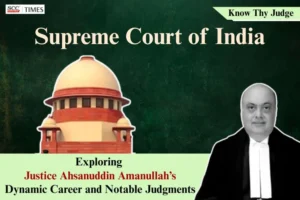
Justice Ahsanuddin Amanullah is the sitting judge of the Supreme Court of India. He has been active in the legal field since 1991 and has served in judicial capacity in Patna High Court and Andhra Pradesh High Court.
*Did you Know? Since joining the Supreme Court in 2023, Justice Amanullah has authored 79 judgments and has been part of over 600 decisions1
Early Life and Education2
Justice Ahsanuddin Amanullah was born on 11 May 1963. Justice Amanullah earned his LL.B. degree from Patna Law College after graduating with a Bachelor of Science (Chemistry Honours).
Career Trajectory3
As an Advocate
On 27 September 1991, Justice Amanullah joined as an Advocate with the Bihar State Bar Council and quickly rose through the ranks. He was in regular practice in the Patna High Court but also appeared before the Supreme Court of India and the Delhi High Court, Calcutta High Court and Jharkhand High Court in Constitutional, Civil, Criminal, Service, Taxation, Co-operative, Labour, Corporate and forest matters.
Justice Ahsanuddin Amanullah became well-known for his knowledge of constitutional and service law. He has also appeared before the Central Administrative Tribunal, the Commercial Taxes Tribunal, District Courts, the District Consumer Disputes Redressal Forum and arbitration matters.
Justice Amanullah served as Standing Counsel to the Government of Bihar from March 2006 till August 2010. He was appointed as Government Advocate for the State of Bihar from August 2010 till his elevation to the Bench.
Justice Amanullah represented the District Administration before the Dalsingsarai (Samastipur) Firing Enquiry Commission and the Income Tax Department of the Government of India in the Jharkhand High Court at Ranchi.
Justice Ahsanuddin Amanullah has represented and appeared for the Indian Railways, Unit Trust of India, Union Bank of India, RITES (previously Rail India Technical and Economic Services Limited), Indian Railway Catering and Tourism Corporation Limited (IRCTC), Bihar State Housing Board, Bihar State Electricity Board, Bihar State Textbook Publishing Corporation, Bihar State Cooperative Bank Limited, Bihar State Cooperative Marketing Union Limited (BISCOMAUN), Bihar Cooperative Land Development Bank Limited, Bihar State Agricultural Marketing Board, Bihar State Housing Cooperative Federation, Bihar State Credit and Investment Corporation (BICICO), Commercial Taxes Department (Government of Bihar), Magadh University at Bodh Gaya, Veer Kuer Singh University at Arrah, Samsung Corporation (Engineering & Construction Group), Mahindra and Mahindra, Bihar Industrial Area Development Authority, Bihar State Health Society etc. before various judicial and quasi-judicial fora, primarily the Constitutional Courts.
Justice Amanullah was empaneled by the Patna Legal Aid Committee for Criminal Appeals. He was Assistant Returning Officer for elections to the Bihar State Bar Council in 2002 and the Jharkhand State Bar Council in 2006. Justice Amanullah has assisted the Court as Amicus Curiae in matters of significance; furthermore, he has also been associated with social issues pro bono.
*Did You Know? Justice Ahsanuddin Amanullah was instrumental in drafting and vetting subordinate and delegated legislation for various Acts passed by the Bihar Legislature.4
Memberships and Chairmanships5
Justice Ahsanuddin Amanullah served as a Member and Head/Chairman of many committees in his career:
-
He was the Chairman of the Patna High Court Juvenile Justice Monitoring Committee.
-
He served as a member of the Board of Governors of the Bihar Judicial Academy in Patna.
-
He was the Chairman of the Patna High Court Legal Services Committee.
-
On 8 November 2021, he was appointed as the Executive Chairman of the Andhra Pradesh State Legal Services Authority.
*Did you Know? Justice Ahsanuddin Amanullah was the First Judge to hold paperless e-Court in the Patna High Court.6
As a Judge
Justice Amanullah was elevated as Judge, Patna High Court on 20 June 2011. He was transferred to the High Court of Andhra Pradesh on 10 October 2021. He was again re-transferred to Patna High Court on 20 June 2022. He was appointed to the Supreme Court on 4 February 2023 and took the oath of office on 6 February 2023.7
*Did You Know? Justice Ahsanuddin Amanullah has been elevated directly to the Supreme Court without serving as Chief Justice of any High Court.
Notable Supreme Court Decisions of Justice Ahsanuddin Amanullah8
Beyond Sabarimala: 9-Judge Bench Examines Validity of Parsi Excommunications Under Articles 25—26
A nine-judge Constitution Bench of the Court comprising of Surya Kant, CJ., B.V. Nagarathna, M.M Sundresh, Ahsanuddin Amanullah, Aravind Kumar, Augustine George Masih, Prasanna B Varale, R Mahadevan and Joymalya Bagchi, JJ., is hearing a seminal reference arising from the Indian Young Lawyers Assn. (Sabarimala Temple-5J.) v. State of Kerala, (2019) 11 SCC 1. The Bench has been considering foundational constitutional questions on the balance between individual religious freedom under Article 25 and denominational autonomy under Article 26 of the Constitution, the permissibility of gender-based exclusions in matters of faith, and the extent to which courts may scrutinize excommunicatory practices, including those within the Parsi community.
Watch: Sabarimala Temple Entry Hearing: Constitutional Morality vs Articles 25 & 26 Explained
Initial Ineligibility and Suppression of Medical Unfitness Vitiate Appointment in Uniformed Service; Supreme Court Set Aside U.P. Police Constable’s Reinstatement
The instant matter arose from the appointment of a constable in the U.P. Police, where the respondent, despite being declared medically unfit due to a “knock-knee” condition, managed to secure and continue in service, the Division Bench of Ahsanuddin Amanullah* and N.V. Anjaria, JJ., set aside the orders of the State Public Services Tribunal and High Court, directing his reinstatement, holding that a candidate declared medically unfit cannot claim appointment or continuation merely because he managed to enter service. The Court held that medical fitness in uniformed services is not a mere formality but a critical requirement linked to operational efficiency and discipline.
[State of U.P. v. Ajay Kumar Malik, 2026 SCC OnLine SC 639]
Section 202 CrPC not mandatory for public servant complaints; Supreme Court Denies Relief to Pharma Company in Drug Misbranding Case
In a matter arising from allegations of misbranding of a vaccine, where discrepancies in labelling triggered prosecution against the manufacturing company and its officials. The controversy centred on whether criminal proceedings initiated by a Drugs Inspector were legally sustainable, particularly in light of objections relating to delay, absence of inquiry under Section 202, Criminal Procedure Code, 1973 (CrPC), and lack of specific averments against the company’s officers. In the SPL filed by the State challenging the Kerala High Court’s order quashing the complaint, the Division Bench of Ahsanuddin Amanullah* and S.V.N. Bhatti, JJ., set aside the impugned judgment, holding that High Court erred in interfering at the threshold as the complaint instituted by the Drugs Inspector was within the period of limitation, as the relevant date for computation was when the identity of the accused became known during investigation, and not the earlier date of initial detection.
The Court further held that non-compliance with Section 202 CrPC did not vitiate the proceedings, since the complaint had been filed by a public servant acting in discharge of official duties. Such complaints stand on a different footing and do not attract the same procedural rigor as private complaints.
[State of Kerala v. Panacea Biotec Ltd., 2026 SCC OnLine SC 315]
Supreme Court restores criminal proceeding over unauthorised sale of CSI Church land
In an appeal challenging the Andhra Pradesh High Court’s order (impugned order) quashing the criminal proceedings relating to alleged fraud and forgery in the sale of CSI Church land, particularly when the allegations disclosed serious discrepancies concerning authorisation, extent of land sold, and compliance with governing rules, the Division Bench of Ahsanuddin Amanullah and R. Mahadevan, JJ., set aside the impugned order and restored the criminal proceedings, holding that the material on record disclosed prima facie allegations of fraud, forgery, and unauthorised alienation of trust property, i.e. CSI Church land, the High Court ought not had quash criminal proceedings at the threshold.
[State of A.P. v. B. Reddeppa Reddy, 2026 SCC OnLine SC 501]
In a long-pending criminal trial rooted in a violent incident arising out of a land dispute where a procedural irregularity triggered a significant legal controversy as to whether absence of signature on charge vitiated the entire trial and warranted a de novo trial, or whether it was merely a curable irregularity that did not prejudice the accused, the Division Bench of Ahsanuddin Amanullah and R. Mahadevan,* JJ., set aside the High Court’s order directing a fresh trial and restored the trial court’s order, holding that where the accused had full knowledge of the charges and actively participated in the trial, defects such as absence of signature on the charge constituted a curable procedural irregularity and did not vitiate the trial unless failure of justice was demonstrated. The Court further held that a de novo trial could not be ordered merely on technical grounds, particularly when the trial had substantially progressed and no real miscarriage of justice was shown.
[Sandeep Yadav v. Satish, 2026 SCC OnLine SC 474]
SC clarifies review principles; quashes Madras HC review on daughter as coparcener
While considering an appeal wherein the Division Bench of Ahsanuddin Amanullah and S.V.N. Bhatti*, JJ., had to consider the validity of Madras High Court’s impugned decision to remand the matter related to the Appellant’s status as a co-parcener in a partition suit to the Trial Court. The Court upon perusing the impugned order, delved into relevant precedents detailing the distinction between the power of review and appellate power and restated the power and scope of review jurisdiction, thereby summing up the grounds for Review.
[Malleeswari v. K. Sugna, 2025 SCC OnLine SC 1927]
While considering this appeal by Asian Paints Ltd, (appellant) whereby the Division Bench of Ahsanuddin Amanullah* and Prashant Kumar Mishra, JJ., were faced with the question that whether the appellant would fall under the definition of ‘victim’ as per Section 2(wa) read with the proviso to Section 372 CrPC or whether Section 378 CrPC would prevail in the facts and circumstances of the present case. The Court opined that Section 2(wa) CrPC does not define ‘victim’ in a narrow sense. The Court further stated that Section 372 CrPC is a self-contained and independent Section, i.e., it is a stand-alone Section and is not regulated by other provisions of Chapter XXIX CrPC including Section 378. Thus, the right of a victim to prefer an appeal as granted under the proviso to Section 372 CrPC is not restricted by any other provision of the CrPC Therefore, the Court opined that the appellant was a ‘victim’ as it suffered due to the counterfeit/fake products being sold/attempted to be sold as having been manufactured by the appellant.
[Asian Paints Ltd. v. Ram Babu, 2025 SCC OnLine SC 1427]
The bench of Ahsanuddin Amanullah and NV Anjaria, JJ has directed Union of India, all States and Union Territories, and the University Grants Commission (UGC) to furnish comprehensive details in order to examine the aspects relating to the creation/establishment/setting-up of all private Universities, either under the State Governments/Union Territories or the Central Government, and connected concerns.
[Ayesha Jain v. Amity University, Noida, 2025 SCC OnLine SC 2557]
The division bench of Ahsanuddin Amanullah and S.V.N. Bhatti, JJ. granted interim bail to the convict to enable him to reunite with the prosecutrix (now his wife) and their minor child, after both expressed their desire to live together as a family.
[Hemchand v. State of Chhattisgarh, 2025 SCC OnLine SC 2104]
While deliberating over the instant petition filed by politician Tahir Hussain, who is in custody in connection with several cases including offences under PMLA Act, rioting and murder, had sought interim bail for the purposes of contesting in upcoming Legislative Assembly Elections for NCT of Delhi; the Bench of Pankaj Mithal* and Ahsanuddin Amanullah**, JJ., delivered a split verdict in this regard. While Mithal, J., opined that interim bail is not permissible for the purposes of contesting elections, much less for campaigning; Amanullah, J., on the other hand deemed the petitioner eligible to be enlarged on conditional bail for limited period. Furthermore, since a spilt decision was rendered in the instant case, the Division Bench therefore, directed the Registry to place the matter before the Chief Justice of India for appropriate action.
[Mohd. Tahir Hussain v. State (NCT of Delhi), 2025 SCC OnLine SC 135]
In a criminal appeal against the Calcutta High Court’s decision, declining to grant relief to the appellant for allowing his private complaint for alleged offences under Sections 193, 199 and 200, Penal Code, 1860 (IPC) before a Tribunal, the Division Bench of Sudhanshu Dhulia and Ahsanuddin Amanullah, JJ. allowed the appeal and held that the only way out available for the appellant was to file a private complaint with direction to the Tribunal to entertain the private complaint.
[Anil Kumar J. Bavishi v. Mahendra Kumar Jalan, 2024 SCC OnLine SC 4276]
Supreme Court stays ‘pay minus pension’ rule for ex-defence faculty recruited by AIIMS Jodhpur
In a Special Leave Petition filed by retired defence officers who had been appointed to faculty posts at AIIMS Jodhpur through open advertisement and direct recruitment, the petitioners challenged a judgment passed by the Rajasthan High Court. The High Court had held that, although the petitioners were appointed through direct recruitment, they would be governed by Regulation 33, AIIMS Regulations, 1999. While the High Court restrained retrospective salary deductions, it allowed the prospective application of the “Pay minus Pension” formula from the date of its judgment, i.e., 15 May 2025. In response, a Division Bench of Ahsanuddin Amanullah and S.V.N. Bhatti, JJ. issued notice and granted interim relief to the recruited faculty members, staying the implementation of the “Pay minus Pension” rule pending further consideration.
[Arjun Singh Sandhu v. All India Institute of Medical Science, 2025 SCC OnLine SC 1468]
While considering a challenge to the impugned order passed by the National Consumer Disputes Redressal Commission (“NCDRC”) in which, appellant was directed to pay the interest at 6 per cent for a period of about 10 months to the respondents for delay in giving possession of a flat; the Division Bench of Ahsanuddin Amanullah and K.V. Viswanathan, JJ., set aside NCDRC’s reasoning for awarding compensation to the respondents whereby it had held that circumstances due to which there was delay in constructing the flats, could not be construed as ‘Force Majeure’. Supreme Court directed the appellants to hand over the possession of the flat in 2 weeks.
[Bengal Peerless Housing Development Co. Ltd. v. Arunava Bhattacharjee, 2025 SCC OnLine SC 2472]
The present appeal challenges the impugned order dated 18 November 2024, whereby the appellant’s petition assailing the order dated 16 August 2024 passed by the Additional Sessions Judge (ASJ)-2/Special Judge (NDPS), East, Karkardooma Courts, Delhi (‘Sessions Judge’) was dismissed. In the said order, the Sessions Judge had affirmed the bail granted to the accused persons by the Additional Chief Metropolitan Magistrate (‘ACMM’), Karkardooma Courts, East District, Delhi. The Division Bench of Ahsanuddin Amanullah and S.V.N. Bhatti, JJ., stated that the manner in which bail was granted revealed certain procedural irregularities at the grassroots level of the judiciary, which should not be ignored. Accordingly, the Court quashed and set aside the impugned order dated 18 November 2024 and the Session Judge’s order dated 16 August 2024. While refusing to turn a blind eye to the manner in which the ACMM granted bail to the accused and the Sessions Judge who refused to interfere with grant of bail, the Court stated that the Judicial Officers who passed the respective orders, should undergo special judicial training for a period of at least 7 days.
[Netsity Systems (P) Ltd. v. State (NCT of Delhi), 2025 SCC OnLine SC 2079]
In an appeal arising from a challenge to a Karnataka High Court order refusing to quash criminal proceedings in a complex land dispute, marked by allegations of non-payment and forged documents leading to multiple sales of the same property, the Division Bench of Ahsanuddin Amanullah and SVN Bhatti, JJ., the State of Karnataka to submit a comprehensive and categorical report on the status and direction of the investigation. It specifically instructed the Deputy Commissioner of Police (Central Crime Branch, Bangalore City) to supervise the probe and to report, in a sealed cover, on the authenticity of the disputed documents, the role of registration officials, and whether the charge sheet filed was preliminary or final. The Inspector General of Registration and the Commissioner of Stamps were also asked to provide their input in the final report. The interim order protecting the petitioner was directed to continue until the next hearing, which was scheduled for 11 November 2025.
[Chandrashekar C. v. State of Karnataka, 2025 SCC OnLine SC 2018]
In a criminal appeal filed against the judgment passed by the Allahabad High Court, wherein the accused was acquitted of the offence punishable under Section 302 IPC, the 3-judge bench of Abhay S Oka*, Pankaj Mithal and Ahsanuddin Amanullah, JJ. upon reappreciating the evidence, found that the view taken by the High Court, that the prosecution had failed to prove the guilt of the accused beyond a reasonable doubt was a plausible and reasonable interpretation of the evidence on record. Even if an alternative view could be reasonably drawn from the same evidence, the Court reiterated that this alone does not justify overturning the order of acquittal. In criminal law, the benefit of doubt must go to the accused, and unless the evidence decisively proves guilt, the acquittal must stand.
[Aejaz Ahmed v. State of U.P., 2025 SCC OnLine SC 913]
While considering the instant appeal filed by the State of Madhya Pradesh against the impugned order the High Court whereby the Court let go of the respondents (accused persons) taking into account their old age; the 3-Judge Bench of Abhay S. Oka*, Ahsanuddin Amanullah and Agustine George Masih, JJ., opined that considering the pendency of very old criminal appeals, priority is usually given to the hearing of the appeals where the accused are in prison. The appeals against conviction where the accused are on bail take a backseat. However, a right balance must be struck by taking up for hearing even some of the old criminal appeals against conviction where accused are on bail. Therefore, it is desirable that certain categories of appeals against conviction where the accused are on bail should be given priority.
[State of M.P. v. Shyamlal, 2025 SCC OnLine SC 590]
In a criminal appeal against Punjab and Haryana High Court’s decision, whereby the accused person’s application under Section 482 CrPC for quashing of proceedings initiated under Section 138, Negotiable Instruments Act, 1881 (NI Act) was dismissed, the Division Bench of Sudhanshu Dhulia* and Ahsanuddin Amanullah, JJ. allowed the appeal and set aside the impugned decision opining that the High Court erred in denying relief to the accused- former director of the corporate debtor by placing reliance upon P. Mohan Raj v. Shah Brothers Ispat (P) Ltd., (2021) 6 SCC 258. The Court explained that the cause of action under Section 138 NI Act arose after the commencement of the insolvency process. The Bench also quashed the summoning order and proceedings against the accused.
[Vishnoo Mittal v. Shakti Trading Company, 2025 SCC OnLine SC 558]
In a batch of civil appeals by the Sports Authority of India (SAI) challenging the dismissal of their recall applications by the Delhi High Court, the Division Bench of Sudhanshu Dhulia* and Ahsanuddin Amanullah, JJ. held that once an employee was considered as an ‘initial constituent’ under the Sports Authority of India (Sports Sciences and Sports Medicine) Staff Recruitment Rules, 1992 (Rules), it would mean that the said person could not be treated as a contractual employee but as a regular employee, who comes under direct enrolment/control of SAI. The Court also observed that once the order had been passed on a compromise or concession given by a party, that party cannot turn back and challenge the order before a higher court, unless it is a case of fraud or deception. Such a scenario is not permissible on principle as well as on law.
[Sports Authority of India v. Kulbir Singh Rana, 2025 SCC OnLine 489]
In a set of two civil appeals wherein reference was made to a Larger Bench to deal with conflicting views on the applicability of Sections 24 and 25, Hindu Marriage Act, 1955, (1955 Act) whether alimony can be granted where marriage has been declared void, the Three Judge Bench of Abhay S. Oka*, Ahsanuddin Amanullah and Augustine George Masih, JJ. answered the issue in the affirmative. The Court held- A spouse whose marriage has been declared void under Section 11, 1955 Act is entitled to seek permanent alimony or maintenance from the other spouse by invoking Section 25, 1955 Act. The grant of relief of permanent alimony can be granted or not always depends on the facts of each case and the conduct of the parties, as it is always discretionary. Even if a Court comes to a prima facie conclusion that the marriage between the parties is void or voidable, pending the final disposal of the proceeding under the 1955 Act, the Court is not precluded from granting maintenance pendente lite provided the conditions mentioned in Section 24 are satisfied.
[Sukhdev Singh v. Sukhbir Kaur, 2025 SCC OnLine SC 299]
In a criminal special leave petition against Rajasthan High Court’s decision whereby the petitioner’s miscellaneous petition seeking the basis of statements made by the police which allegedly humiliated her, was dismissed, the Division Bench of Sudhanshu Dhulia and Ahsanuddin Amanullah, JJ. dismissed the petition stating that during court proceedings, many statements are made and questions are posed which may make a person uncomfortable, but all such statements or questions cannot be misconstrued as humiliating a person.
[Dhanlaxmi v. State of Rajasthan, 2025 SCC OnLine SC 300]
While considering the instant matter revolving around unauthorised occupation of site known as the Gumti of Shaikh Ali by the Defence Colony Resident Welfare Association (Respondent 4); the Division Bench of Sudhanshu Dhulia and Ahsanuddin Amanullah, JJ., directed Respondent 4 to handover the peaceful possession of the site to the concerned officer in Land and Development Office, Ministry of Urban Affairs, Government of India.
[Rajeev Suri v. Archaelogical Survey of India, 2025 SCC OnLine SC 163]
In a criminal appeal filed against the conviction order of a man accused of rape and murder of a ten-year-old minor, passed by the Trial Court and upheld by the Allahabad High Court, the three Judge bench of Abhay S. Oka*, Ahsanuddin Amanullah, and Augustine George Masih, JJ. set aside the conviction, as the accused was not provided with proper legal aid during the trial, which violated his fundamental right to a fair trial under Article 21 of the Constitution of India. Further, the Court issued a series of directives concerning the critical roles of the Public Prosecutor and Legal Aid Counsels in ensuring procedural fairness and safeguarding the fundamental rights of the accused in criminal trials.
[Ashok v. State of U.P., 2024 SCC OnLine SC 3580]
In a criminal special leave to appeal against the decision of Kerala High Court, upholding the conviction of the present appellant/ convict to life imprisonment for offence under Section 376 IPC for raping his stepdaughter, the Division Bench of Sudhanshu Dhulia and Ahsanuddin Amanullah, JJ. upholding his conviction, reduced the life imprisonment to sentence of ten years and retained the fine amount as Rupees Two lakhs.
[Mallan v. State of Kerela, 2024 SCC OnLine SC 2442]
In a petition filed by the Indian Medical Association (‘IMA’) against an alleged false campaign carried out by Patanjali and its founders against the COVID-19 vaccination and modern medicine, the division bench of Hima Kohli and Ahsanuddin Amanullah, JJ. has said that the company should not be allowed to sell products for which licenses were suspended. Further, the Bench issued directions on the issue of misleading ads. The Court noted that the misleading advertisements for Patanjali products, which have now been prohibited, are still available on certain online platforms The Court has also issued notice to the IMA President and asked him to respond by 14 May 2024 on certain comments allegedly made against the Court in a media interview.
“Practice of mentioning caste or religion of litigants should be shunned and ceased”: Supreme Court
While hearing a transfer petition by under Section 25, Civil Procedure Code, 1908 (CPC), filed by petitioner-wife for transferring a petition for restitution of conjugal rights filed by the respondent-husband under Section 9, Hindu Marriage Act, 1955 pending before the Principal Judge, Family Court, Sri Ganga Nagar, Rajasthan to a Court of competent jurisdiction at Faridkot, Punjab, the Division Bench of Hima Kohli and Ahsanuddin Amanullah, JJ. noted that the caste of both the parties was mentioned in the memo of parties. The Court directed all the High Courts to ensure that the caste/religion of a litigant does not appear in the memo of parties.
[Shama Sharma v. Kishan Kumar, 2024 SCC OnLine SC 88]
In an appeal against the judgment and order passed by the Bombay High Court, whereby the appeal was dismissed, thereby confirming the order passed by the District Judge, which confirmed the order passed by the Assistant Charity Commissioner, Nagpur rejecting the change report filed by the appellants, the division bench of Vikram Nath* and Ahsanuddin Amanullah, JJ. while setting aside the impugned order and accepting the change report, has directed fresh elections for the new executive committee of the Society by the Charity Commissioner in accordance with law within six months from the receipt of a copy of this Judgment. Further, it held that the proviso to Section 15, Societies Registration Act, 1860 (Registration Act) would disentitle defaulting members from being given any notice even if their membership was not terminated or ceased.
[Babasaheb Wasade v. Manohar Gangadhar Muddeshwar, 2024 SCC OnLine SC 63]
In a criminal appeal against the Madras High Court’s decision, whereby the conviction order by the Trial Court for offence under Section 307 IPC was confirmed, the Division Bench of Vikram Nath and Ahsanuddin Amanullah*, JJ. Set aside the conviction under Section 307 IPC for no severe blows inflicted on the complainant.
[Sivamani v. State of Madras, 2023 SCC OnLine SC 1581]
In a petition under Article 136 of the Constitution of India filed against judgment passed by Patna High Court on 21 March 2023 which denied pre-arrest bail to petitioner accused under Sections 353, 387, 419, 420, 467, 468 and 120-B IPC and Sections 66-C and 66-D, Information Technology Act, 2000 (IT Act), the Bench of Aniruddha Bose, Ahsanuddin Amanullah and Augustine George Masih, JJ. refused to grant anticipatory bail and ordered the petitioner to surrender within 2 weeks. The Court also sought the High Court’s reply on the action taken.
[Aditya Kumar v. State of Bihar, 2023 SCC OnLine SC 1593]
In a batch of petitions challenging order passed by Calcutta High Court on 20-02-2023 granting bail to Jitendra Narain, Ex-Chief Secretary of Andaman and Nicobar Islands for offences under Sections 376D, 228A, 506 and 120 IPC and bail granted to two co-accused from the same First Information Report (FIR), the Division Bench of Vikram Nath* and Ahsanuddin Amanullah, JJ refused to interfere with the impugned order and modified the conditions for grant of bail.
[XXX v. State (UT of Andaman & Nicobar Islands), 2023 SCC OnLine SC 1062]
When a woman approached the Supreme Court seeking transfer of divorce petition under the Hindu Marriage Act, from Indore to Lucknow, the bench of Sanjay Kishan Kaul and Ahsanuddin Amanullah*, JJ noticed that the parties have suffered an irretrievable breakdown of marriage and hence, in order provide complete justice, the Court exercised the power under Article 142 of the Constitution of India to grant mutual consent divorce to the parties. The Court also closed all cases filed by the parties against each other.
[Mansi Khatri v. Gaurav Khatri, 2023 SCC OnLine SC 667]
The Division Bench of Ahsanuddin Amanullah* and Ajay Rastogi, JJ., allowed the appeal against the impugned judgment of the High Court of Madras for rejecting the for premature release of appellant passed by the State of Tamil Nadu. The Supreme Court granted benefit of premature release, however, rejected the contention that the case of appellant will fall under Exception to Section 300 IPC.
[Nagarathinam v. State, 2023 SCC OnLine SC 559]
In an application filed by Senior Advocate Indira Jaising against the existing system of designation of Senior Advocates, terming it flawed as it was not objective, fair, and transparent, and thus did not take into account considerations of merit and ability, the 3-Judge Bench of Sanjay Kishan Kaul*, Ahsanuddin Amanullah, and Aravind Kumar, JJ. has fine-tuned the guidelines laid down in the 2017 Judgment to bring in greater transparency and objectivity in the designation process.
[Indira Jaising v. Supreme Court of India, 2023 SCC OnLine SC 614]
Why Coal India Limited lost legal battle against CCI: Supreme Court verdict explained
In a case where Coal India Limited and its subsidiary Western Coalfields Limited had contended that they cannot be bound by the Competition Act, 2002 as both are governed by the Coal Mines (Nationalization) Act, 1973, the 3-judge bench of KM Joseph*, BV Nagarathna and Ahsanuddin Amanullah, JJ has rejected the contention and observed that,
“If Parliament has intended that State monopolies even if it be in the matter of distribution must come under the anvil of the new economic regime, it cannot be found flawed by the Court on the ground that subjecting the State monopoly would detract from the common good which the earlier Nationalisation Act when it was enacted, undoubtedly, succeeded in subserving. We see no reason to hold that a State Monopoly being run through the medium of a Government Company, even for attaining the goals in the Directive Principles, will go outside the purview of the Act.”
[Coal India Ltd. v. CCI, 2023 SCC OnLine SC 740]
In a civil appeal against dismissal of a challenge by the National Consumer Disputes Redressal Commission (‘NCDRC’) against order holding Indian Railways liable to pay Rs 1 lakh to the passenger whose cash was stolen while travelling by train, the Division Bench of Vikram Nath and Ahsanuddin Amanullah, JJ. allowed the appeal and set aside the orders passed by the NCDRC, SCDRC and District Consumer Forum in the instant matter.
[Station Superintendent v. Surender Bhola, 2023 SCC OnLine SC 741]
Register all migrants on e-Shram portal for Ration Card within 3 months: Supreme Court
The Division Bench of MR Shah* and Ahsanuddin Amanullah, JJ., has directed States/UTs to issue ration cards to the left out migrants on eShram portal within 3 months by giving wide publicity and approaching the migrants through the office of the concerned Collector of the District so that more and more registrants on eShram portal are issued the ration cards and get the benefit of the benevolent schemes floated by the UOI and the State Government including the benefit under the National Food Security Act.
[In re, Problems and Miseries of Migrant Labourers, 2023 SCC OnLine SC 456]
The bench of MR Shah* and Ahsanuddin Amanullah, JJ has reiterated that no member of the Bar can go on strike and/or abstain himself from court working and has hence, requested all the High Courts to constitute Grievance Redressal Committee in their respective High Courts.
[District Bar Association Dehradun v. Ishwar Shandilya, 2023 SCC OnLine SC 457]
While hearing an appeal against the order of Punjab and Haryana High Court wherein, the appellant’s petition to quash his trial and consequential orders to release the pensionary and other benefits was dismissed, the Division-Judge Bench of Krishna Murari and Ahsanuddin Amanullah*, JJ., allowed the appellant’s appeal and quashed the impugned order of the High Court allowing him to retain pension benefits. The Court gave additional directions for Judgment writing to all the Courts and Tribunals.
[B.S. Hari Commandant v. Union of India, 2023 SCC OnLine SC 413]
In a criminal appeal against the order of Punjab and Haryana High Court wherein, the appellant’s petition to quash his trial and consequential orders to release the pensionary and other benefits was dismissed, the Division-Judge Bench of Krishna Murari and Ahsanuddin Amanullah*, JJ., allowed the appellant’s appeal and set aside his conviction order and allowed the appellant to retain the pension benefits.
[B.S. Hari Commandant v. Union of India, 2023 SCC OnLine SC 413]
In a Miscellaneous Application seeking clarification of Court’s order restricting the transfer/sale/gift/entrustment of elephants being confined to Karnataka, the Division Bench of Krishna Murari and Ahsanuddin Amanullah, JJ. referred to other PILs filed before various High Courts and upheld the Tripura High Court’s decision of constituting a High-Powered Committee and extended its powers across the Country in the public interest and for the advancement of the cause of welfare, care and rehabilitation of wild animals. Read More..
[Muruly M.S. v. State of Karnataka, 2023 SCC OnLine SC 224]
Supreme Court grants anticipatory bail to 85% disabled accused in cheating case
In a special leave petition filed against the judgment and order of the Rajasthan High Court, wherein the Court refused to grant the benefit of anticipatory bail to the accused., the division bench of Krishna Murari and Ahsanuddin Amanullah, JJ. has granted anticipatory bail to the accused.
[Prem Singh v. State of Rajasthan, 2023 SCC OnLine SC 128]
Notable High Court Decisions by Justice Ahsanuddin Amanullah 9
Right to choose a life partner on attaining a majority is inherent under the Right to Life and Personal Liberty enshrined under Article 21 of the Constitution. A recent judgment was given by the Division Bench of Ahsanuddin Amanullah, and Purnendu Singh, JJ., observed that intimate relationships between two consenting majors do not require societal recognition to get recognized under the law. Therefore, the Bench held that a girl who has attained the age of majority has the right to choose a life partner and form a family.
[Amit Raj v. State of Bihar, 2022 SCC OnLine Pat 1671]
A Special 5-Judges Bench comprising of Ashwani Kumar Singh, Vikash Jain, Ahsanuddin Amanullah, Rajendra Kumar Mishra and Chakradhari Sharan Singh, JJ., had by the majority of 4:1, directed to demolish the entire building of newly erected Waqf Bhawan which was constructed in proximity of the northern side of the newly inaugurated Centenary Building of the Patna High Court. The Court opined. “The structure has been constructed in utter and brazen violation of provisions of law across statutes, starting from Section 32, Central Act, through the various provisions of the Municipal Act, and finally Bye-law 21, as discussed above, and must be held to be illegal and non-est from the word go.”
[Suo Motu cognizance taken by the Court vide order dated 01-03-2021 of a structure on the north side adjacent to the Centenary Building of the Patna High Court which came up during Covid-19 Pandemic, In Re., 2021 SCC OnLine Pat 1633]
Andhra Pradesh High Court upholds and modifies conviction from S. 302 to 304 Part II IPC for lack of premeditation or intention to kill
In an appeal filed against the judgment dated 16 April 2015 passed by the Special Judge for Trial of Cases under the Scheduled Castes and Scheduled Tribes (Prevention of Atrocities) Act by which the appellant, having been found guilty of the offence under Section 302 IPC has been convicted and sentenced to undergo life imprisonment and to pay a fine of Rs.5,000/- and in default thereof to undergo two years’ simple imprisonment, a division bench of Ahsanuddin Amanullah and G Ramakrishna Prasad, JJ., upholds the conviction of the appellant for the action of causing the deceased’s death but modifies such conviction from Sections 302 to 304-Part II IPC as there was no premeditation nor an intention to kill the deceased.
[Harijana Katthi Krishna v. State of A.P., 2022 SCC OnLine AP 563]
Andhra Pradesh High Court upholds conviction under Contempt of Courts Act due to wilful disobedience of the order
In an appeal filed under Section 19(1), Contempt of Courts Act, 1971 by way of which the appellant impugns the judgement and order dated 21 October 2021 passed by the Single Judge in a contempt case, whereby the appellant, upon his conviction for having committed contempt of Court, has been sentenced to undergo simple imprisonment for a period of four weeks and subjected to a fine of INR 2,000/- payable within two weeks from the date of the order, failing which he would be liable for further simple imprisonment of two weeks. A division bench of Ahsanuddin Amanullah and B Krishna Mohan JJ., upholds conviction of the appellant however, owing to his unblemished track record in his long career, modified the impugned order by increasing the fine to Rs 10,000 (Rupees Ten Thousand) and reducing the imprisonment awarded to one week.
[N Prateep Kumar v. M Jagadish Chandra Prasad, 2022 SCC OnLine Del 512]
*Judge who has authored the Judgment
2. Justice Ahsanuddin Amanullah | Supreme Court of India | India (sci.gov.in)
4. Know Thy Judge| 5 Judges who have received President’s nod for appointment as Supreme Court Judges, SCC Times.
6. Justice Ahsanuddin Amanullah | Supreme Court of India | India (sci.gov.in)
7. CJI DY Chandrachud administers the oath of office of 5 new SC judges; here’s all you need to know, Mint.