


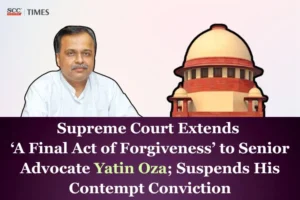
Supreme Court: The criminal appeal arose from controversy stemmed from a live press conference held on 5 June 2020 during the COVID-19 pandemic, wherein, appellant-senior advocate and former President of the Gujarat High Court Advocates’ Association (GHCAA) made severe allegations against the functioning of the Gujarat High Court and its Registry and the High Court considered the remark “gambling den” made against it as scandalous and damaging to the institution of judiciary and by order dated 6 October 2020 convicted the appellant for criminal contempt under Section 2(c)(i), Contempt of Courts Act, 1971 (Contempt of Courts Act). While holding that the Gujarat High Court’s findings and reasons in convicting the appellant for criminal contempt did not require interference, the Division Bench of J.K. Maheshwari* and Atul S. Chandurkar, JJ., as a final act of forgiveness, exercised its powers under Article 142 of the Constitution to indefinitely suspend Senior Advocate Yatin Oza’s contempt conviction and sentence.
Factual Matrix
In the instant matter, the contempt proceedings were triggered by a press conference telecast live on Facebook on 5 June 2020. During the conference, the appellant alleged that the Registry of the Gujarat High Court indulged in corrupt practices, favoured industrialists, smugglers and influential litiga nts, and ensured circulation of matters for wealthy persons while ordinary litigants and junior advocates suffered. He referred to the High Court as a “gambling den” and stated that only litigants with money and influence could obtain relief.
The High Court, taking suo motu cognizance on 9 June 2020, recorded that the appellant had made “irresponsible, sensational and intemperate” statements and had questioned the credibility of the institution without any valid basis. The Court particularly noted allegations of forum shopping, preferential listing, and corruption in the Registry.
The High Court issued notice under Section 17, Contempt of Courts Act and restrained the appellant from making further scandalous remarks pending proceedings.
The appellant initially challenged the contempt notice before the Supreme Court through special leave petition (SLP) but later withdrew it. Thereafter, he filed an affidavit before the High Court tendering unconditional apology and explained that he had voiced grievances of junior advocates struggling during the COVID-19 pandemic. He stated that numerous complaints regarding listing of matters had reached him as President of the GHCAA and that the expression “gambling den” was an emotional outburst uttered under stress.
Proceedings Relating to Senior Advocate Designation
Parallel to the contempt proceedings, a Full Court of the Gujarat High Court initiated proceedings for withdrawal of the appellant’s designation as Senior Advocate under Rule 26, Gujarat High Court Designation of Senior Advocate Rules, 2018. It issued a show-cause notice observing that the appellant had acted in a manner “not befitting a Senior Advocate.”
The appellant again tendered unconditional apology and alternatively requested an opportunity to argue on merits. However, by unanimous resolution dated 18 July 2020, the Full Court withdrew his designation. It found that the apology to be a “paper apology” and a calculated attempt to avoid consequences. It noted that the appellant had repeatedly indulged in similar misconduct in the past and followed a pattern of “slap — say sorry & forget.” It further observed that the appellant had publicly branded the High Court as a “gambling den” and thereby caused “tremendous disrepute and caused great damage to the prestige and dignity of the High Court.”
Aggrieved by the withdrawal of his senior designation, the appellant approached the Supreme Court through writ petition. On 6 August 2020, the Supreme Court recorded the appellant’s unconditional apology and observed that though grievances may exist, they should always be conveyed in dignified language without unnecessary imputations. The Court also noted that the appellant deeply regretted his conduct and had assured that he would never repeat such behaviour. The Court deferred consideration of the writ petition hoping that finality would be given to the contempt proceedings and the issue concerning restoration of senior designation.
Pursuant thereto, the appellant submitted another apology before the Full Court on 10 August 2020. Nevertheless, the Full Court, by order dated 10 August 2020, declined to accept the apology, observing that repeated misconduct of this nature could not be ignored merely because apologies were tendered afterwards. It stated that acceptance of such apology would amount to failure to uphold the majesty of law and the dignity of the institution.
Proceedings Relating to Criminal Contempt
The appellant also filed an additional affidavit in the contempt proceedings reiterating that he had no intention to scandalise the Court and again tendered unconditional apology. However, by order dated 26 August 2020, the High Court refused to accept the apology.
The High Court held that repeated acts of contempt by the appellant showed absence of bona fide remorse. It observed that every time the appellant realised there was “no escape route, the weapon of unconditional apology comes to his rescue”. The Court stated that forgiveness shown in the past had emboldened him further and that a strong message must be send that “we are open to every healthy criticism respecting the fundamental right of freedom of expression and at the same time, we are obligated not to permit any attempt to tarnish the image of the Institution and to despise and damage the prestige of the same and to demean the respect it enjoys by one and all.”
By judgment dated 6 October 2020, the High Court convicted the appellant for criminal contempt under Section 2(c)(i). Contempt of Courts Act, holding that
-
The Registry formed an inseparable part of the Court and allegations against it effectively targeted the institution itself.
-
The allegations were not merely against the Registry but indirectly against judges of the High Court.
-
Statements suggesting that the High Court functioned only for the rich and influential undermined public confidence in the judiciary.
-
A 3-Judge Committee appointed by the Chief Justice found no substance in the allegations raised by the appellant. Hence, the defence of truth was unavailable.
The Court sentenced the appellant was sentenced till rising of the Court and fined Rs 2,000 with a default stipulation of 2 months’ simple imprisonment.
Subsequent Developments
The Supreme Court stayed operation of the impugned contempt order on 28 October 2021 while hearing the contempt appeal together with the writ petition concerning senior designation. Simultaneously, exercising powers under Article 142 of the Constitution, the Court in Yatin Narendra Oza v. High Court of Gujarat, (2022) 17 SCC 759, temporarily restored the appellant’s senior designation for 2 years from 1 January 2022 subject to “impeccable behaviour.”
Subsequently, another incident dated 9 April 2024 was brought on record before the Supreme Court. During proceedings before the Gujarat High Court, the appellant allegedly accused the Court of “forum shopping.” The Full Court resolved to withdraw the temporary restoration of senior designation. However, the resolution was kept in abeyance due to pendency of the present appeal.
The appellant denied misconduct and asserted that the expression “forum shopping” was directed at the litigant and not the Court. He also tendered apology for any misunderstanding.
Parties’ Contentions
The appellant’s counsels urged the Court to put a quietus to the matter considering the attendant circumstances. They argued that the appellant had already suffered immensely due to withdrawal of his senior gown for over 2 years and that continuing punishment would destroy his professional life. It was submitted that the “gambling den” remark was admittedly inappropriate but was uttered during emotional turmoil caused by grievances of junior advocates during the COVID period and due to the pressure, he faced as President of GHCAA. The statements lacked malice and were not directed personally against judges.
It was further argued that past incidents relied upon by the High Court could not be used against the appellant because they were not part of the original contempt notice. Moreover, in earlier matters his apologies had already been accepted and adverse remarks expunged by the Supreme Court.
However, the counsel appearing for the High Court argued that the appellant’s apology lacked sincerity and was merely tactical. He submitted that the statements were not spontaneous but carefully organised through WhatsApp messages and a live press conference. It highlighted the appellant’s repeated past misconduct involving allegations against judges and the institution, followed by apologies whenever proceedings were initiated. Reliance was placed upon prior incidents in 2006, 2010 and 2016 to establish a pattern of conduct.
It was further argued that despite magnanimity shown by the Supreme Court in restoring his senior gown temporarily, the appellant again indulged in objectionable conduct in 2024 by alleging “forum shopping” before the High Court. The High Court therefore urged that accepting yet another apology would not amount to magnanimity but rather retreat, causing irreversible damage to judicial prestige.
Issue for Determination
Whether the conviction and sentence imposed by the High Court on the appellant under the Contempt of Courts Act vide the impugned order requires interference by this Court?
Analysis
The Court examined the entire history of the appellant’s conduct and observed that he had repeatedly found himself “on the wrong side of the Court’s forbearance”, primarily owing to his dual role as a Senior Advocate and the President of the Bar Association.
The Court agreed with the High Court that proceedings for criminal contempt and proceedings for withdrawal of senior designation under Rule 26 were distinct and could run simultaneously, even when they arise out of the same source or incident. It affirmed that recall of designation could not substitute punishment for contempt.
“Criminal contempt under Section 2(c) of the 1971 Act is distinct from recalling of designation and the power to punish for contempt is not only statutory under the 1971 Act, but also Constitutional, viz Article 215 of the Constitution of India.”
The Court revisited its earlier order in Yatin Narendra Oza (supra), dated 28 October 2021 whereby it had restored the appellant’s senior designation for 2 years. The Court observed that the earlier order itself reflected extraordinary constitutional magnanimity and granted the appellant “a slap on the wrist, a breath of a new life”.
The Court also acknowledged that the appellant had suffered professionally and socially owing to deprivation of his senior designation from 21 July 2020 to 31 December 2021, and stated that it “cannot turn a blind eye to the consequences arising out of the same source which have befallen the appellant even though it may not dampen the effect or force which is carried through these contempt proceedings.”
The Court extensively considered the apology tendered by the appellant at various stages and noted that in his very first affidavit filed before the High Court, the appellant had expressly admitted that he “ought not to have alleged corrupt practice in the Registry” and “used terminology of gambling den.” The Court also referred to its earlier observations recording the appellant’s remorse and undertaking not to repeat such conduct.
However, the Court rejected the contention that the High Court was bound to accept the apology merely because the Supreme Court had recorded it earlier. The Supreme Court in its earlier order merely observed that “since the contempt proceedings are pending, the High Court must apply its mind to the issue considering the apology as tendered by the appellant” and therefore, it cannot be said that the Court had directed the High Court to accept the apology. It asserted that the power to accept or reject apology remained within the discretion of the High Court under Article 215 and the Contempt of Courts Act.
The Court further examined the background circumstances of the present case and noted that the appellant, as President of the GHCAA during the COVID-19 lockdown, was receiving numerous complaints from junior advocates facing severe financial and professional distress due to non-listing of matters and technical hurdles in e-filing. It took into account appellant’s resignation letter as President of the GHCAA, where he described junior advocates working as delivery personnel to survive and spoke of answering hundreds of distress calls daily. It also referred to the appellant’s letter dated 5 June 2020 addressed to the Chief Justice of the High Court, where he detailed complaints received from advocates regarding circulation of matters and alleged favouritism in listing.
The Court clarified that these factors were not being considered to justify the statements made, particularly the “gambling den” remark, but only to understand the mental and emotional state in which the statements were made.
The Court also recognised that the appellant’s conduct was indefensible and unbecoming of a senior advocate, particularly a leader of the Bar. At the same time, it also considered the constitutional tradition of judicial magnanimity and reform.
Decision
Weighing the gravity of the contempt against the appellant’s repeated apologies, his professional suffering, the extraordinary circumstances prevailing during the COVID-19 pandemic, and the fact that he had already undergone severe consequences through withdrawal of his senior designation and the reformative approach adopted earlier by the Supreme Court, the Court decided to put quietus to the matter.
The Court concluded that
-
The Gujarat High Court’s findings and reasons in convicting the appellant for criminal contempt did not require interference. However, as a final act of forgiveness, the Court exercised its powers under Article 142 of the Constitution to indefinitely suspend and keep in abeyance the appellant’s conviction and sentence.
-
It clarified that no legal disqualification or adverse consequence flowing from the contempt conviction would operate against the appellant. This specifically included protection from disqualification under Section 24-A, Advocates Act, 1961.
-
The Gujarat High Court was directed to periodically review the appellant’s conduct every 2 years in light of the undertaking given by him before the Supreme Court. If the appellant indulges in any similar misconduct in future, the High Court would be free to approach the Supreme Court in the disposed appeal seeking revival and immediate enforcement of the contempt conviction and sentence.
-
Regarding the 2024 incident and the issue of withdrawal of the appellant’s senior advocate designation, the Court requested the High Court to reconsider the matter afresh in light of the present judgment, without being influenced by the earlier contempt conviction. The issue of continuation or withdrawal of the appellant’s senior designation could itself be reviewed periodically every 2 years along with the review of his conduct.
Expressing hope and expectation that the appellant would maintain exemplary conduct in future and honour the undertaking given before it in its true spirit, the Court disposed of the criminal appeal all pending applications.
[[Yatin Narendra Oza v. Suo Motu, High Court of Gujarat, Criminal Appeal No. 669 of 2020, decided on 11-5-2026]
*Judgment by Justice J.K. Maheshwari
Advocates who appeared in this case:
Mr. K.K. Venugopal, Mr. Kapil Sibal, Dr. Abhishek Manu Singhvi, Mr. Arvind Datar and Mr. Sushil Kumar Jain, Sr. Advs., Counsel for the Appellant
Mr. Vijay Hansaria, Sr. Adv., Counsel for the Respondent