


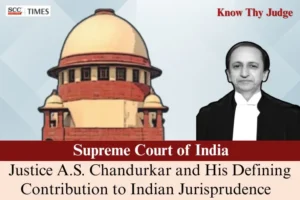
Born on 7 April 1965 in Bhusawal, Maharashtra, Justice A.S. Chandurkar’s illustrious journey, from his early education in Pune to his subsequent elevation to the hallowed echelons of the Supreme Court, is a testament to his commitment to the cause of justice.
Justice A.S. Chandurkar’s Education1
Justice Atul Sharachchandra Chandurkar received his schooling at St. Vincent’s High School in Pune. Subsequently, he pursued higher education, earning a degree in Commerce from Ness Wadia College, Pune. His academic pursuits culminated in acquiring his law degree from ILS Law College in Pune, marking the commencement of his distinguished legal career.
Justice A.S. Chandurkar’s Career as an Advocate2
Justice A.S. Chandurkar commenced his legal career on 21 July 1988, at the chambers of Shri Bhimrao Naik, a highly respected Senior Advocate in Mumbai, who was subsequently elevated as a Judge of the Bombay High Court. In January 1992, Justice Chandurkar shifted his practice to Nagpur.
His advocacy was predominantly focused on civil litigation, involving appearances across various judicial fora, including trial and appellate courts. Additionally, he provided legal representation to numerous local bodies and corporations.
Justice A.S. Chandurkar’s Judicial Career
After a stellar tenure as a counsel for 25 years, Justice A.S. Chandurkar’s legal career took a new trajectory as his distinguished judicial career began with his elevation as an Additional Judge of the Bombay High Court on 21 June 2013.3 He subsequently became a Permanent Judge of the Bombay High Court on 2 March 2016.4 During his tenure as Judge, he undertook diverse judicial responsibilities, presiding over cases at the Principal Seat of the Bombay High Court in Mumbai, as well as its Benches situated in Nagpur and Aurangabad, and the High Court at Goa.
Justice Chandurkar’s career trajectory gained further impetus when the Supreme Court Collegium on 26 May 2025, recommended his name for elevation as Judge of Supreme Court of India. The Ministry of Law and Justice swiftly confirmed the recommendation on 29 May 2025 and finally on 30 May 2025, Justice Chandurkar was sworn in as Judge of Supreme Court of India.
Did you Know? With Justice A.S. Chandurkar’s elevation to the Supreme Court, there are now 3 Judges whose parent High Court is Bombay.5
Justice A.S. Chandurkar’s literary engagements6
Justice A.S. Chandurkar’s profound legal acumen is further demonstrated by his authorship of two notable books on “The Maharashtra Municipal Councils, Nagar Panchayats and Industrial Townships Act, 1965” and “The Maharashtra Rent Control Act, 1999”.
Did you know? Justice A.S. Chandurkar is the 8th Judge from Nagpur to become a Supreme Court Judge.7
Notable Judgments by Justice A.S. Chandurkar
Neighbourhood schools must ensure admission of children belonging to disadvantaged sections to the extent of 25 per cent
The Division Bench of P.S. Narasimha and Atul S. Chandurkar, JJ., stated that the obligation of a “neighbourhood school” to admit children belonging to weaker and disadvantaged sections of our society, to the extent of 25 per cent of the class strength, under Section 12, Right of Children to Free and Compulsory Education Act, 2009 (RTE Act) has the extraordinary capacity to transform the social structure of our society. Earnest implementation can truly be transformative. It is not only a step towards educating young India, but also a substantive measure in securing the preambular objective of “equality of status”. The constitutional declaration of the right under Article 21-A, followed by the statutory mandate under Section 3, RTE Act for free and compulsory elementary education can be realised only with effective implementation of the provisions of the Act. The Court held that ensuring admission of such students must be a national mission and an obligation of the appropriate government and the local authority.
[Dinesh Biwaji Ashtikar v. State of Maharashtra, 2026 SCC OnLine SC 56]
Examining the legality of a dismissal order passed by invoking Article 311(2)(b) of the Constitution without holding a departmental inquiry, the Division Bench of J.K. Maheshwari* and Atul S. Chandurkar, JJ., quashed the order of the Delhi High Court which had affirmed the order of dismissal of service against the appellant, issued by exercising power under Article 311 of the Constitution without conducting the departmental inquiry under Article 311(2). The Court held that the reasoning assigned by the disciplinary authority, while issuing an order of dismissal from service under clause (b) of second proviso to Article 311(2), for dispensing with an inquiry ought to be relevant and shall be recorded in writing.
[Manohar Lal v. Delhi Police, 2026 SCC OnLine SC 363]
While considering the present matter, the Court had to answer whether it is permissible for a non-signatory to an agreement leading to arbitration proceedings to remain present in such arbitration proceedings. The Division Bench of P.S. Narasimha and A.S. Chandurkar*, JJ., held that when arbitration proceedings can take place only between parties to an arbitration agreement and Section 35, Arbitration and Conciliation Act, 1996 (A&C Act) does not make the arbitral award binding on non-signatories to such agreement, therefore, there can be no legal right conferred by the A&C Act that would enable a non-party to the agreement to remain present in arbitration proceedings between signatories to the agreement.
[Kamal Gupta v. L.R. Builders (P) Ltd., 2025 SCC OnLine SC 1691]
In a special leave petition filed against the judgment of Kerala High Court, wherein it was held that it was not compulsory for political parties to set up an Internal Complaints Committee (ICC) to address sexual harassment complaints as per the Sexual Harassment of Women at Workplace (Prevention, Prohibition and Redressal) Act, 2013 (POSH Act), since there is no employer-employee relationship among its members, the three-Judge Bench of B.R. Gavai, CJI, K. Vinod Chandran and Atul S. Chandurkar, JJ., refused to entertain a petition seeking to bring registered political parties under the ambit of the POSH Act.
[Yogamaya M.G. v. State of Kerala, 2025 SCC OnLine SC 2011]
In the present case, petitioner-Maharashtra State Judges Association, an Association comprising members of judicial service in the State of Maharashtra, sought to raise a challenge to the recruitment process of District Judges through nomination and challenged the advertisement dated 30 September 2023 regarding the selection process for the year 2022 and the advertisement dated 9 January 2024 regarding selection process for the year 2023. The Division Bench of A.S. Chandurkar* and Rajesh S. Patil, JJ., dismissed the petition and held that the attempt to fill in the 25 per cent posts through nomination was not in excess of 25 per cent quota, that is, what was permissible under the Maharashtra Judicial Service Rules, 2008 (the 2008 Rules).
[Maharashtra State Judges Assn. v. State of Maharashtra, 2025 SCC OnLine Bom 109]
Presidential reference on Governor and President’s powers under Articles 200/201: Supreme Court
The Constitution Bench of B.R. Gavai, CJI, Surya Kant, Vikram Nath, P.S. Narasimha and Atul S. Chandurkar, JJ., opined that, the Governor has 3 constitutional options before him, under Article 200, namely — to assent, reserve the Bill for the consideration of the President, or withhold assent and return the Bill to the legislature with comments. The first proviso to Article 200 is bound to the substantive part of the provision, and restricts the existing options, rather than offering a fourth option. Pertinently, the third option — to withhold assent and return with comments — is only available to the Governor when it is not a Money Bill.
The Court further opined that the discharge of the Governor’s function under Article 200, is not justiciable. The Court cannot enter into a merits review of the decision so taken. However, in glaring circumstances of inaction that is prolonged, unexplained, and indefinite — the Court can issue a limited mandamus for the Governor to discharge his function under Article 200 within a reasonable time period, without making any observations on the merits of the exercise of his discretion.
[Assent, Withholding or Reservation of Bills by the Governor and the President of India, In re, 2025 SCC OnLine SC 2501]
Pertaining to conservation of tigers and their habitat, restoration of Jim Corbett Tiger Reserve and permitting tiger safaris, the 3-Judge Bench of B.R. Gavai, CJI*, Augustine George Masih and A.S. Chandurkar, JJ., directed that Tiger Safari shall not be permitted in the core or a critical tiger habitat area.
[T.N. Godavarman Thirumulpad v. Union of India, 2025 SCC OnLine SC 2463]
While considering this matter wherein the petition challenged her removal from the post of Councillor at Nagar Parishad, Bhikangaon as she had failed to disclose a conviction under Section 138, Negotiable Instruments Act, 1881 (NI Act) while filing her nomination papers, the Division Bench of P.S. Narasimha and Atul S. Chandurkar*, JJ., explained that once it is found that there has been non-disclosure of a previous conviction by a candidate, it creates an impediment in the free exercise of electoral right by a voter. A voter is thus deprived of making an informed and advised choice. It would be a case of suppression/non-disclosure by such candidate, which renders the election void.
[Poonam v. Dule Singh, 2025 SCC OnLine SC 2359]
In a case where the Court was called upon to decide whether the requirement of a recommendation from the Assistant Registrar as a precondition to claim stamp duty exemption under Section 9-A, Stamp (Bihar Amendment) Act, 1988 was legal or ultra vires, the Bench of Pamidighantam Sri Narasimha and Atul S. Chandurkar, JJ., has held the memo as illegal, emphasising on simplicity in public transactions as a key tenet of good governance.
Holding that once a cooperative society is registered and a certificate is issued, Section 5(7) of the Act declares it to be a conclusive proof of its existence and continuation as a body corporate, the Court noted that administrative procedures should avoid superfluous or irrelevant requirements that serve no legal purpose or value addition.
[Adarsh Sahkari Grih Nirman Swawlambi Society Ltd. v. State of Jharkhand, 2025 SCC OnLine SC 2716]
In a 40-year-old civil dispute, a Division Bench of P.S. Narasimha and Atul S. Chandurkar, JJ., commended a court-appointed mediator for successfully resolving the matter. The Court observed that the essence of dispute resolution rested in selfless endeavour, the foundation of harmonious living. It held that exactly that had occurred, the mediator set aside the argumentative skills and adversarial demeanour associated with a lawyer and personally travelled to Hamirpur to mediate between the parties.
[Raksha Devi v. Parkash Chand, 2025 SCC OnLine SC 2238]
Supreme Court issues notice over alleged irregularities and lapses in the conduct of SSC exams
While considering a writ petition highlighting widespread irregularities and lapses in conduct of SSC exams including SSC Selection Post/Phase XIII Examination and the Stenographer Examination Grade “C” and “D” Examination 2025, the Division Bench of P.S. Narasimha and Atul S. Chandurkar, JJ., issued notice in the matter.
[Nikhil Kumar v. Union of India, 2025 SCC OnLine SC 1921]
In a petition filed by nine girl students (petitioners) of the respondent College (College) challenging the dress code instructions issued by the College for all its students that restricted the donning of articles revealing anyone’s religion, including hijab and niqab claiming them to be violative of the fundamental rights enshrined under Articles 19(1)(a) and 25 of the Constitution. The Division Bench of A.S. Chandurkar* and Rajesh S. Patil, JJ., held that the instructions were issued to maintain discipline and ensure that the students do not reveal their religious faith through their attire. The Court further pointed out that the petitioners did not present sufficient material to prove that donning a hijab or niqab is an essential practice in Islam, and that the fundamental right of establishing and administering an educational institution would prevail over the fundamental right of an individual, since the former is in the larger interest.
[Zainab Abdul Qayyum Choudhary v. Chembur Trombay Education Society’s N.G. Acharya and D.K. Marathe College of Art, Science and Commerce, 2024 SCC OnLine Bom 1925]
Bombay High Court strikes down IT Rules Amendment 2023; major setback for fact-check units
In a case filed challenging Information Technology (Intermediary Guidelines and Digital Media Ethics Code) Amendment Rules, 2023, i.e., Rule 3, which empowered the government to establish Fact-Check Units (FCUs) to identify false news against the government on the grounds that it violated constitutional rights and amounted to state censorship. The Bench of G.S. Patel and Neela Gokhale, JJ., had delivered a split verdict. Justice A.S. Chandurkar was appointed as the tie-breaker Judge. A.S. Chandurkar, J., concurring with the opinion of G.S. Patel, J., held that the amendments were unconstitutional as they infringed on Articles 14 and 19 of the Constitution, striking down the contested provisions.
…under the right to freedom of speech and expression, there is no further “right to the truth” nor is it the responsibility of the State to ensure that the citizens are entitled only to “information” that was not fake or false or misleading as identified by the FCU.
[Kunal Kamra v. Union of India, 2024 SCC OnLine Bom 3025]
The petitioner filed a writ petition under Article 226 of the Constitution, challenging the validity of Rule 4(1)(a) of the Maharashtra Land Revenue (Transfer of Occupancy by Tribals to Non-Tribals) Rules, 1975 (the 1975 Rules), the Division Bench of A.S. Chandurkar* and Rajesh S. Patil, JJ., opined that the restriction placed on grant of sanction to the transfer of occupancy by way of sale in favour of non-tribal only when the transferee intended to use it for non-agricultural purposes was legally justifiable as the object behind the same was to prevent non-tribals from accumulating agricultural lands of tribals which could result in future exploitation of tribals and requiring them to undertake agricultural operations on the very lands of which they were owners.
The Court opined that in absence of any bar for a tribal to transfer his occupancy in favour of another tribal who could continue to use such land for agricultural purpose, such restriction on the transfer in favour of a non-tribal by way of sale if the land was to be used for agricultural purpose did not suffer from the vice of classification and thus, the challenge to Rule 4(1)(a)(i) could not be accepted.
…Individual hardship by itself cannot be a ground to hold a provision to be invalid or unworkable especially in the light of the fact that such provision has been enacted keeping in mind the directive principles under Article 46 of the Constitution of India for the larger good and welfare of tribals.
[Mahendarsingh Digvijaysingh Mukne v. State of Maharashtra, 2025 SCC OnLine Bom 2142]
Bombay HC sets aside expulsion order for sexual misconduct by MNLU student; Cites procedural violations in disciplinary proceedings
The Division Bench of A.S. Chandurkar* and Rajesh S. Patil, JJ., set aside the expulsion of a law student from Maharashtra National Law University (MNLU) for sexual misconduct. The Court’s decision primarily hinged on serious procedural violations committed by the university during the disciplinary process, specifically the failure to adhere to the mandatory safeguards stipulated under the University Grants Commission (UGC) Regulations, 2015. While acknowledging the gravity of the student’s misconduct, the Court emphasised the necessity of procedural fairness and suggested that a more reformative approach to punishment could have been considered.
[X v. Maharashtra National Law University, 2024 SCC OnLine Bom 3258]
Principles of natural justice to be read into Section 8, Goa Tourist Places (Protection and Maintenance) Act, 2001 prior to directing recovery of expenses/costs incurred to remove nuisance: Bombay HC
In a writ petition was filed under Articles 226 and 227 of the Constitution wherein the issue raised was whether the principles of natural justice were required to be complied with prior to directing recovery of the amount of expenses and costs incurred by the competent authority in removing any nuisance under Section 8, Goa Tourist Places (Protection and Maintenance) Act, 2001 (the 2001 Act). The Division Bench of A.S. Chandurkar* and Nivedita P. Mehta, JJ., held that even if there was no mention whatsoever of the requirement of complying with the principles of natural justice under Section 8, 2001 Act, the same must be read into the said provision to ensure compliance of the principles of natural justice and procedural fairness. Therefore, it could not be held that the principles of natural justice stood excluded even by implication. The Court set aside, orders which were passed by the competent authority without giving the petitioners a chance to be heard.
[Salgaocar Mining Industries (P) Ltd. v. State of Goa, 2025 SCC OnLine Bom 662]
The petitioner-Maharashtra State Judges Association, an Association comprising members of judicial service in the State of Maharashtra, sought to raise a challenge to the recruitment process of District Judges through Nomination and challenged the advertisement dated 30 September 2023 regarding the selection process for the year 2022 and the advertisement dated 9 January 2024 regarding selection process for the year 2023. The Division Bench of A.S. Chandurkar* and Rajesh S. Patil, JJ., dismissed the petition and held that the attempt to fill in the 25% posts through Nomination was not in excess of 25% quota, that is, what was permissible under the Maharashtra Judicial Service Rules, 2008 (the 2008 Rules).
[Maharashtra State Judges Assn. v. State of Maharashtra, 2025 SCC OnLine Bom 109]
In a petition before the Division Bench of A.S. Chandurkar and Rajesh S. Patil, JJ., the petitioner sought the grant of permission to participate in the admission process for the Bachelor of Science-Research (BSc-R) programme starting in 2024, at the Indian Institute of Science, Bangalore (IISC). The candidates were required to submit their online applications by 14 May 2024, however, the petitioner submitted his application on 9 June 2024. The petitioner contended that he should be permitted to participate in the admission process based on the All India Rank (AIR) 10 that he had secured in the IISER Aptitude Test 2024 (entrance test). The Court stated that the grant of such relief would be an injustice to the other applicants who were similarly situated as the petitioner and who could not submit their applications in time as well. Therefore, no relief was granted by the Court and the petition was dismissed.
[Siddhant Mahesh Rane v. Indian Institute of Science, 2024 SCC OnLine Bom 2242]
The petitioner, a law graduate and a former Judicial Officer, raised a challenge to the Notification dated 9 September 2015 notifying the “Rules for Presentation and Conduct of Proceedings in Person by Parties” (the Rules) on the ground that the Rules prevent a party-in-person from appearing before the Court and arguing his/her case in person. The Division Bench of A.S. Chandurkar* and Jitendra Jain, JJ., held that the bar was not absolute, and the Rules were merely regulatory in nature. The Court opined that the Rules were not prohibitive to offend the provisions of Articles 14 and 19(1)(a) of the Constitution, and the Rules were framed to enable the presentation and conduct of proceedings by a party in person smoothly to facilitate the administration of justice. The Court held that the Notification dated 9 September 2015 did not deserve to be quashed on the grounds urged by the petitioner.
[Naresh Govind Vaze v. High Court of Bombay, 2024 SCC OnLine Bom 1266]
In a petition wherein the bank notes of denomination of Rs 500 and Rs 1000 were seized from the petitioners on 26 December 2016, before they could deposit the said demonetised bank notes in the bank before the deadline, that is, 30 December 2016, the Division Bench of A.S. Chandurkar* and M.M. Sathaye, JJ., opined that the petitioners could be permitted to deposit the specified bank notes for the value of Rs 20,00,000 bearing the said serial numbers with Respondent 4, as this would facilitate receipt of legal tender for the said value by the petitioners.
[Ramesh Bapurao Potdar v. Union of India, 2025 SCC OnLine Bom 575]
Bombay High Court upholds validity of the Textile Undertakings (Nationalisation) Laws (Amendment and Validation) Act, 2014
In a writ petition was filed under Article 226 of the Constitution challenging the constitutional validity of the Textile Undertakings (Nationalisation) Laws (Amendment and Validation) Act, 2014 (the 2014 Act). It was also prayed that the Sick Textile Undertakings (Nationalisation) Act, 1974 (the 1974 Act) and the Sick Textile Undertakings (Nationalisation) Act, 1995 ( 1995 Act) as amended, be struck down as being invalid and violative of the provisions of the Constitution. The Division Bench of A.S. Chandurkar* and Jitendra Jain, JJ., held that the challenge to the 2014 Act as being manifestly arbitrary, transgressing the dividing line of separation of powers and seeking to nullify the decision of the Supreme Court in National Textile Corpn. Ltd. v. Nareshkumar Badrikumar Jagad, (2011) 12 SCC 695 (Nareshkumar-I case) could not succeed. Further, the Court held that the 2014 Act did not suffer from manifest arbitrariness nor was it violative of Article 14 of the Constitution.
There is a strong presumption attached to the constitutionality of a plenary legislation. While considering challenge to the vires of a plenary legislation, the Court would be required to be conscious of the presumption of constitutionality attached to such legislation. This presumption proceeds on the basis that legislature is best suited to understand and address societal needs.
[Byramjee Jeejeebhoy (P) Ltd. v. Union of India, 2024 SCC OnLine Bom 1619]
In a matter, where student suffering from depression, anxiety, and Internet Gaming Disorder sought permission to reattempt the Higher Secondary Certificate Examination to improve his scores. Despite the Board’s regulations allowing a one-time reattempt in the next schedule, his request was denied due to his ongoing treatment. The Division Bench of A.S. Chandurkar and Rajesh S. Patil, JJ., in the interest of justice, allowed the petitioner, identified as a bright student, to appear in the upcoming examination.
[Aradhya Arvind Singh v. State of Maharashtra, 2024 SCC OnLine Bom 2055]
In a writ petition was filed by the State against the judgment of the Maharashtra Administrative Tribunal (MAT), reinstating the respondent government employee on probation whose services were terminated on the grounds of misconduct. The Division Bench of A.S. Chandurkar* and Jitendra Jain, JJ., upheld the MAT judgment holding that the petitioners did not follow the Maharashtra Engineering Administrative Service (Recruitment) Rules, 2017 (2017 Rules), under which the appointment of the respondent was made. The Court found that the government order terminating the services of the respondent was stigmatic in nature and no enquiry was conducted vis-à-vis the respondent’s alleged misconduct as mandated by the 2017 Rules.
[State of Maharashtra v. Taramati Santosh Taji, 2024 SCC OnLine Bom 1349]
The Division Bench of A.S. Chandurkar* and Jitendra Jain, JJ., permitted the petitioners (victims of acid attack) to seek compensation beyond the three-year limitation period provided under the Maharashtra Victim Compensation Scheme for Women Victims/Survivors of Sexual Assault/Other Crimes, 2022 (Scheme), further, the Court said that the delay could be allowed in deserving cases.
[ABC v. State of Maharashtra, 2024 SCC OnLine Bom 1106]
In an appeal was filed by the husband challenging the Family Court’s decision to grant divorce on the ground of cruelty. The Division Bench of A.S. Chandurkar and Pushpa V. Ganediwala, JJ., upheld the Family Court’s finding, concluding that the husband’s unsubstantiated and wild allegations, including his belated claim of the wife’s epilepsy and accusations regarding a false caste certificate, coupled with actions seemingly intended to prejudice her employment, collectively constituted mental cruelty to the wife.
[Thalraj v. Jyoti, 2021 SCC OnLine Bom 255]
In an appeal was filed challenging the Family Court’s decision to grant custody of a minor daughter to the father under Sections 7, 12 and 25, Guardians and Wards Act, 1890. The Division Bench of A.S. Chandurkar* and N.B. Suryawanshi, JJ., upheld the Family Court’s judgment, emphasising the child’s welfare as the paramount consideration and noting the father’s and his parents’ ability to provide a better upbringing.
[Sashanka v. Prakash, 2020 SCC OnLine Bom 3497]
In present matter, the High Court addressed the validity of a contingent fee agreement where a consultancy firm, rather than a registered advocate, represented a party in arbitration proceedings and sought remuneration based on the arbitration outcome. A Single Judge Bench of A.S. Chandurkar, J.*, upheld the trial court’s decision, clarifying that such an agreement, typically void under Section 23, Contract Act, 1872 when entered into by an advocate, is valid and enforceable when the individual acts solely as a “counsel” in arbitration and not as a registered “advocate”.
[Jayaswal Ashoka Infrastructures (P) Ltd. v. Pansare Lawad Sallagar, 2019 SCC OnLine Bom 578]
Amendment in the Maharashtra Village Panchayats Taxes and Fees Rules, 1960 is unconstitutional
In a writ petition challenged the constitutional validity of the Maharashtra Village Panchayats Taxes and Fees (Amendment) Rules, 1999 (Amendment Rules, 1999), which changed the basis of property tax assessment from capital or annual letting value to the total area of the building or land. A Division Bench of A.S. Oka and A.S. Chandurkar*, JJ., struck down Clauses 2, 3, 4 and 5(a) of the Amendment Rules, 1999 as unconstitutional, holding them to be discriminatory and violative of Article 14 of the Constitution for failing to account for depreciation and treating unequal properties as equal.
[Vijay Dinkarrao Shinde v. State of Maharashtra, 2014 SCC OnLine Bom 1667]
Married daughter continues to be part of parents’ family
A Division Bench comprising A.S. Oka and A.S. Chandurkar*, JJ., delivered a landmark judgment holding that married daughters remain part of their parents’ family, and any rule discriminating against married women is violative of Articles 14, 15 and 19(1)(g) of the Constitution. The Court struck down State Government Rules/Circulars that excluded married daughters from the definition of “family” for the purpose of inheriting a kerosene retail licence, directing the State to reconsider the petitioner’s application.
[Ranjana Murlidhar Anerao v. State of Maharashtra, 2014 SCC OnLine Bom 910]
The Division Bench of A.S. Chandurkar and Amit Borkar*, JJ., expressing that the right to travel abroad has been spelt out from the expression “personal liberty” in Article 21 of the Constitution, observed that, the provisions under the Recovery of Debts Due to Banks and Financial Institutions Act, 1993, do not impliedly confer such powers on the Debt Recovery Tribunal to restrain a person from travelling abroad.
[Anurag v. Bank of India, 2022 SCC OnLine Bom 1160]
The Division Bench of A.S. Chandurkar and Urmila Joshi-Phalke*, JJ., allowed a writ petition which was filed by a minor victim of sexual abuse requesting to terminate her pregnancy.
The Court noted that in the present case, the petitioner is unmarried, and she is not only a victim of sexual abuse but also is lodged in an Observation Home. The Court opined that she has already undergone the trauma due to the sexual assault on her, and she is also suffering mentally as she is also charged for the offence punishable under Section 302, Penal Code, 1860. The Court agreed that she cannot be forced to give birth to a child. The Supreme Court has also observed several times that it is the right of women to have reproductive choice. She has a choice to give birth to the child or not.
[A v. State of Maharashtra, 2022 SCC OnLine Bom 1361]
*Judge who has authored the Judgment
1. Supreme Court of India, Justice A.S. Chandurkar.
2. Supra.
3. Bombay HC | Former Judges | Justice A.S. Chandurkar.
4. Supreme Court of India, Justice A.S. Chandurkar.
5. bbsr.s3waas.gov.in/s35d6646aad9bcc0be55b2c82f69750387/uploads/2025/06/202506021223895274.pdf.
6. Bombay HC | Former Judges | Justice A.S. Chandurkar.
7. Moment: Justice A.S. Chandurkar of Nagpur Takes Oath as Supreme Court Judge, Nagpur Today.