


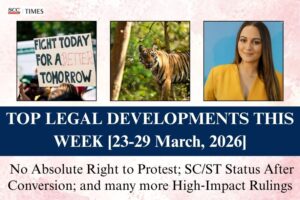
Catch up on the top legal developments this week (23—29th March 2026), including Child Rights Guidelines, Tiger Corridor at Risk, Land-for-Jobs Case, Railway’s Shoe-Shine Licence Policy, Man Placed Miscarried Foetus Before Judge, NHAI-Tarsem Singh Conundrum Resolved, and more.
STORY OF THE WEEK
SC/ST Act | Conversion to Christianity extinguishes SC/ST status and protection under SC/ST Act
In Chinthada Anand v. State of A.P., 2026 SCC OnLine SC 466, the Supreme Court held that, the appellant, having professed Christianity, could not claim the status of Scheduled Caste and therefore could not invoke the provisions of the SC/ST Act; no person who professes a religion other than Hinduism, Sikhism or Buddhism shall be deemed to be a member of a Scheduled Caste; the State Government Order and caste certificate could not override the Constitution (Scheduled Castes) Order, 1950; the High Court had rightly exercised its power under Section 482 CrPC as the allegations under both the SC/ST Act and IPC did not disclose a sustainable case.
Read SC/ST Status After Conversion case HERE
Right to Protest | “No absolute right to protest at chosen venue”; ‘unusual prayer’ for daily protest “until World War ends” dismissed with Rs 50,000 costs
In S. Prabhu v. Collector1, the Madras High Court held that although freedom of speech and peaceful assembly are cherished constitutional rights, they are not absolute. The Court noted that the petitioner’s request was open-ended and imposed an impossible burden on the authorities. The Court further observed that alternate venues had been offered, but the petitioner rejected them on untenable grounds, making disparaging remarks about respected public figures. Emphasising that writ jurisdiction cannot be invoked to enforce personal obstinacy under the guise of constitutional liberty, the Court dismissed the petition and directed the petitioner to pay costs of Rs 50,000 to a government school.
Read No Absolute Right to Protest Case HERE
SUPREME COURT HIGHLIGHTS
Criminal Law | Absence of signature on charge curable irregularity, de novo trial not justified unless failure of justice shown
In Sandeep Yadav v. Satish2, the Supreme Court set aside the High Court’s order directing a fresh trial and restored the trial court’s order, holding that where the accused had full knowledge of the charges and actively participated in the trial, defects such as absence of signature on the charge constituted a curable procedural irregularity and did not vitiate the trial unless failure of justice was demonstrated. The Court further held that a de novo trial could not be ordered merely on technical grounds, particularly when the trial had substantially progressed and no real miscarriage of justice was shown.
Read No De Novo Trial Unless Failure of Justice case HERE
Criminal Law | Court not to conduct mini-trial; strong and cogent evidence sufficient to summon additional accused
In Mohd. Kaleem v. State of U.P., 2026 SCC OnLine SC 397, the Supreme Court set aside the impugned judgments and allowed the summoning of additional accused persons. The Court held that at the stage of exercising power under Section 319 CrPC, the Court should not conduct a detailed evaluation of credibility or insist on proof sufficient for conviction, and minor inconsistencies or absence of documentary corroboration cannot by themselves justify refusal to summon additional accused.
Read Exercising Power Under Section 319 CrPC case HERE
Environment Law | Land earmarked for development under statutory Master Plan can’t be declared ‘deemed forest’ on later vegetation growth
In Naveen Solanki v. Rail Land Development Authority, 2026 SCC OnLine SC 452, the Supreme Court upheld the impugned judgment and held that land which was not recorded as forest and was earmarked for development under a statutory Master Plan cannot subsequently be treated as deemed forest merely due to later growth of trees.
Read Later Growth Cannot Be Deemed Forest case HERE
Reservation | Relaxation in qualifying exam doesn’t bar reserved category candidates’ migration to open category on merit unless expressly prohibited
In Chaya v. State of Maharashtra, 2026 SCC OnLine SC 457, the Supreme Court held that reserved category candidates who secured higher marks than the last selected candidate in the open category were entitled to be considered for the open category, even if they had availed relaxation in the Teacher Eligibility Test (TET) qualifying marks. Such relaxation affects only the eligibility criteria and not the merit, and in the absence of an express prohibition in the recruitment rules, migration to the open category is permissible.
Read Migration of Reserved Category case HERE
Women Rights | ‘Subjected to structural disadvantages’; Systemic unfairness for women flagged in Armed Forces over consideration of SSCWOs for Permanent Commission
In Pooja Pal v. Union of India, 2026 SCC OnLine SC 468, the Supreme Court grimly flagged the unfair manner in which women officers have been treated due to certain systematic traits in the functioning of the Armed Forces. The Court pointed out that the inclusion of SSCWOs in the zone of consideration for PC is not a matter of discretion, but of constitutional obligation and any expectation to the contrary is inherently illegitimate. The Court found that the denial of PC to SSCWOs was not merely the outcome of individual assessments, but the consequence of a systemic framework rooted in assumptions that entrenched disadvantages in career progression.
Read Permanent Commission for Women in Armed Forces case HERE
SEBI Regulations | Diversion of preferential allotment funds, contrary to disclosed object, constituted violation of PFUTP Regulations
In SEBI v. Terrascope Ventures Ltd., 2026 SCC OnLine SC 403, the Supreme Court set aside the impugned order and restored the order of the Adjudicating Officer dated 29 April 2020. The Court held that the diversion of preferential allotment funds contrary to disclosed objects constitutes violation of PFUTP Regulations, the diversion amounted to fraudulent and unfair trade practice, and the subsequent ratification could not validate the illegality. The Court observed that, “when a company offers private placement or goes public, the legal regime mandates fair disclosure and transparency. The investors and all other stakeholders concerned with the securities market irrespective of whether they ultimately subscribe to the shares or not, adjust their affairs based on the disclosure made.”
Read Diversion of Preferential Allotment Funds case HERE
Government Job Recruitment | Non-Joining of Selected Candidate Doesn’t Give Vested Right to Appointment to Next Candidate in Absence of Enabling Provision
In State of Karnataka v. Santhosh Kumar C., 2026 SCC OnLine SC 458, the Supreme Court held that the appointment of another candidate against the unfilled post after release of the select list cannot be allowed merely on non-joining of a selected candidate, in absence of any enabling provision.
Read No Right to Appointment to Unfilled Seats case HERE
Judicial Review | Declaring gazetted/public holidays a policy matter within executive domain, not open to judicial direction
In All India Shiromani Singh Sabha v. Union of India3, the Supreme Court declined to issue directions holding that relief sought was not justiciable under Article 32 as declaration of nationwide gazetted holiday or framing of uniform policy for public holidays lies within executive policy domain.
Read Declaring Gazetted/Public Holidays case HERE
Land Compensation | Landowners Win as NHAI-Tarsem Singh Conundrum was Resolved; Held Liability Spike Not a Ground for Review of Judgment
In NHAI v. Tarsem Singh4, the Supreme Court finally settled the controversy and issued the following directions to balance the competing considerations of entitlement and finality: (i) Landowners whose claims relating to compensation were pending on or after 28 March 2008 were entitled to seek addition of solatium, interest, and interest on solatium. (ii) Where such claims were raised after 28 March 2008 with delay, the landowners would not receive interest for the delayed period. Interest would accrue only from the date the claim was actually raised. (iii) If compensation proceedings had attained finality before 28 March 2008, the matter cannot be reopened to claim solatium or interest. (iv) Matters pending before High Courts were remanded for recalculation of compensation in accordance with these directions. (v) Amounts already paid to landowners should not be recovered.
Read NHAI-Tarsem Singh Conundrum case
Departmental Inquiry | Misuse of Article 311(2)(b) Flagged: Departmental Inquiry Cannot Be Dispensed with Lightly
In Manohar Lal v. Commissioner of Police5, the Supreme Court quashed the order of the Delhi High Court which had affirmed the order of dismissal of service against the appellant, issued by exercising power under Article 311 of Constitution without conducting the departmental inquiry under Article 311(2). The Court held that the reasoning assigned by the disciplinary authority, while issuing an order of dismissal from service under clause (b) of Second Proviso to Article 311(2), for dispensing with an inquiry ought to be relevant and shall be recorded in writing.
Read Misuse of Article 311(2)(b) case
HIGH COURT HIGHLIGHTS
Insolvency | Banks must issue notice before making fraud declaration and entering Directors’ names in Central Fraud Registry
In Nayan Thakarshi Shah v. RBI, 2026 SCC OnLine Bom 2086, the Bombay High Court held that, in view of SBI v. Rajesh Agarwal, (2023) 6 SCC 1, the principles of audi alteram partem must necessarily be complied with before making a fraud declaration and entering Directors’ names in the Central Fraud Registry. Consequently, the Court interdicted the impugned classification and granted liberty to Respondent 2 (Bank) to proceed afresh after issuing proper show-cause notices.
Read Notice Before Making Fraud Declaration case HERE
RTI | Marks in Recruitment Exams disclosable under RTI, not Photocopies of other candidates’ answer sheets
In Union of India v. Central Information Commission, New Delhi, 2026 SCC OnLine All 549, the Allahabad High Court held that while marks obtained in a public examination are subject to disclosure in the interest of transparency, answer sheets of other candidates involve confidentiality concerns and are not liable to be disclosed.
Read Other Candidates’ Answer Sheets Not Disclosable case HERE
Copyright | Copyright strike notices on digital platforms, without follow-up legal action, attract groundless threats remedy
In Associated Broadcasting Co. Ltd. v. Google LLC, 2026 SCC OnLine Del 815, the Delhi High Court held that the extent of use of the copyrighted material fell within “fair use” and did not amount to infringement. The Court explained that Section 60, Copyright Act, 1957, allows any person aggrieved by groundless threats of legal action by the copyright owner to institute a declaratory suit; however, the remedy is only available if the alleged copyright owner did not take proper legal action to settle the dispute between the parties.
Read YouTube Copyright Strikes Groundless Threat case HERE
SC/ST Act | Bail set aside for Non-Compliance with Mandatory S. 15A(3) SC/ST Act Notice in Mob Lynching Case; Directed surrender in 3 days
In State of Kerala v. Anu, 2026 SCC OnLine Ker 3693, the Kerala High Court allowed the appeal and set aside the bail granted in mob lynching case as it did not comply with the mandatory notice required under Section 15-A(3), SC/ST Act to the victim’s dependent which rendered it non est in the eye of the law. The Court cancelled the bail bonds and directed the accused persons to surrender within three days, giving them the liberty to file fresh bail applications in strict compliance with Section 15-A(3), SC/ST Act.
Read No Bail for Non-Compliance of SC/ST Act case HERE
Principal Bench Jurisdiction | Principal Seat continues to retain Jurisdiction despite Establishment of a Circuit Bench
In Shekhar Champalal Pagaria v. CFM Assets Reconstruction Pvt. Ltd., 2026 SCC OnLine Bom 1837, the Bombay High Court rejected the petition to hold that the writ petition will continue at the Principal Seat after observing that, “even if a choice of forum becomes subsequently available to a litigant due to the establishment of a Circuit Bench, it cannot be said that the Principal Seat of the High Court loses jurisdiction to further hear and entertain a writ petition that was originally and validly filed before it”.
Read Jurisdiction on Establishment of Circuit Bench case HERE
Child Rights Guidelines | Registrar General directed to consider formulation of Child Access and Custody Guidelines with Parenting Plan
In Ayushman Initiative for Child Rights v. High Court of Delhi6, the Delhi High Court directed the Registrar General of Delhi High Court to consider formulation of Child Access and Custody Guidelines with Parenting Plan. After examining the averments made in the writ petition along with the documents placed on record, the Court opined that the matter involved issues relating to policy formulation and administrative decision-making within the High Court, and therefore an appropriate course would be to first place the matter before the competent authority on the administrative side. The Court permitted the petitioner to approach Registrar General of Delhi High Court with an exhaustive representation enclosing all the documents which were relied upon in this writ petition. The Court directed that on receipt of such representation the Registrar General should place the matter before the appropriate Committee/authority and take decision regarding formulation of policy / guidelines relating to child access, custody, and parenting plans in consultation with stakeholders, in terms of the prayers made in the petition.
Read Child Access and Custody Guidelines case HERE
Courtroom Shocker | Man alleging ₹200-Crore Maruti Scam Placed Miscarried Foetus Before Judge; Claims of Threat to Family Found ‘Vague’
In Dayashankar Pandey v. His Excellency the President of India, 2026 SCC OnLine MP 3191, the Madhya Pradesh High Court dismissed the petition, holding that the petitioner’s allegations were misconceived, vague, and not supported by material particulars. The Court also rebuked the petitioner for attempting to evoke the Court’s sympathy by placing his wife’s miscarried foetus in front of the Court dais, stating that such conduct was highly objectionable, improper, and amounted to lowering the dignity and decorum of the Court.
Read Miscarried Foetus Placed Before Judge case HERE
Medical Evidence | “Preservation of fairness and justice necessitates re-examination”; Independent Medical Board directed to re-examine Victim’s Injuries
In Ajeet Singh v. State of Rajasthan7, the Rajasthan High Court held that the preservation of fairness and justice necessitated that the injuries of the victims should be re-examined by an independent Medical Board. Thus, the Court allowed the petition and stated that the entire process, from the constitution of the Medical Board to the final report, should be completed expeditiously within 7 days.
Read Independent Medical Board to Re-examine Victim’s Injuries case HERE
Environmental Law | Tiger Corridor at risk? Assistance sought from National Tiger Conservation Authority, Wildlife Board on NH-46 Widening
In Advait Keole v. Union of India8, the Madhya Pradesh High Court directed the National Tiger Conservation Authority (NTCA) and National Board for Wildlife (NBWL) to assist the Court and explain the integrated landscape management plan proposed for managing the said area while ensuring that the wild life passage was not disturbed in a way that impeded on the free movement of wild life.
Read Tiger Corridor case HERE
Land-for-Jobs Case | Section 17-A of the Prevention of Corruption Act Didn’t Shield Lalu Prasad Yadav in Land-for-Jobs Case
In Lalu Prasad Yadav v. CBI9, the Delhi High Court refused to quash the FIR, holding that, Section 17-A, Prevention of Corruption Act, 1988, is prospective in operation and has no application to offences alleged to have been committed between 2004 and 2009. Absence of prior approval under Section 17-A did not vitiate the preliminary enquiry, registration of the FIR, investigation, or the cognizance orders passed by the Special Judge. Bar under Section 17-A would not apply in the present case as the alleged act was not relatable to any recommendations or decisions taken by the petitioner in discharge of his official functions or duties. No ground was made out for quashing FIR, charge-sheets or cognizance orders.
Read Land-for-Jobs case HERE
POSH | ICC report set aside due to non-service of complaint copy on delinquent
In the X v. Kerala Social Security Mission10, Kerala High Court set aside the ICC’s report, holding that the non-service of the complaint constituted a breach of natural justice and of POSH Act and Rules. The Court also directed that a fresh enquiry be conducted within two months.
Read Non-service of POSH Complaint case HERE
GST | Missed GST deadlines not fatal where intent to comply exists; 160-day delay condoned
In M.R. Traders v. Union of India11, the Rajasthan High Court held that due to lack of proper advisory by the counsel/consultant accountant, the petitioner was deprived of filing the appeal within the limitation, and mere absence of a supporting affidavit of the consultant accountant/counsel, which was beyond the petitioner’s control, could not be a ground to reject the petitioner’s stand. Thus, the Court allowed the petition by condoning the delay of 160 days in filing the appeal and remanded back to the appellate authority.
Read GST Delay Condonation case HERE
Shoe-Shine Licence Policy | Central Railway’s 2018 Shoe-Shine Licence Policy upheld; Rejected monopoly claim, mandated minimum wages
In Bombay Shoe-Shine Workers Co-Op. Society Ltd. v. Railways12, the Bombay High Court dismissed the writ petition, upholding the validity of Central Railway’s 2018 Policy. The Court found no arbitrariness in the impugned policy and directed that no monopoly can be created in tenders for shoe-shine services and that mandatory payment of minimum wages to the workers must be ensured.
Read Railway’s Shoe-Shine Licence Policy case HERE
Trademark | What Registrar Should Be Doing to Stop Domain Name Fraud
In Dabur India Ltd. v. Ashok Kumar, 2025 SCC OnLine Del 9651, the Delhi High Court examined the obligations and liabilities of DNRs in relation to infringing domain names, the adequacy of existing safeguards for protection of trade mark rights, the enforcement of court orders against non-compliant DNRs, and the formulation of appropriate directions, including grant of dynamic+ injunction, to curb such systemic abuse. The Court observed that, “By registering domain names using a well-known mark or a registered trade mark, a whole network is built only to deceive innocent and gullible consumers and members of the public. The bank account is operated for a temporary period and after the money is collected the same is withdrawn and even before the trade mark owner is able to take action, the bank account is almost empty. Thereafter, even after the Court grants an interim injunction against the infringing domain names, there are further domain names/websites registered and opened which follow the same pattern as described above.”
Read DNR Responsibility in Domain Name Fraud case HERE
Technology Law | Sonakshi Sinha’s Personality Rights Protected; AI-generated deep fakes directed to be taken down
In Sonakshi Sinha v. Character Technologies Inc., 2026 SCC OnLine Del 1177, the Delhi High Court held that the voice, name, likeness, etc. of Sonakshi Sinha were exclusively attributable to her. Thus, the Court granted an ex parte ad interim injunction in favour of Sonakshi Sinha, restraining the defendants from creating or disseminating any AI-generated pictures, videos or merchandise that misuses and infringes upon the personality rights of Sonakshi Sinha.
Read Protection from AI-generated Deep Fakes case HERE
OTHER UPDATES
NEWS
-
Supreme Court Collegium recommends appointment of Permanent Judges for Madras HC and Chhattisgarh HC
-
CAM Advises AMI Paradigm on ₹452.5 Cr LTTS Smart World Business Acquisition
LEGISLATIONS
-
Petrol and Diesel Export Tax Benefits Revised: What Remains and What Has Been Withdrawn
-
Punjab Government Scraps ₹80 Fee; FIR Downloads Now Free on Sanjh Portal
-
What’s New in Trademark Law: CGPDTM Publishes 13 New Well-Known Trademarks
ALSO READ
1. W.P. Crl. (MD) No.1596 of 2026, decided on 24-3-2026
2. Criminal Appeal No. 1617 of 2026, decided on 25-3-2026
3. Writ Petition (Civil) No. 1474 of 2020, decided on 17-3-2026
4. Review Petition (Civil) No. 2528 of 2025, decided on 25-3-2026
5. Civil Appeal No. 13860 of 2024, decided on 12-3-2026
6. W.P.(C) 1565/2026, decided on 4-2-2026
7. S.B. Criminal Misc (Pet.) No. 1673 of 2026, decided on 18-3-2026
8. WP No. 28573 of 2021, decided on 23-03-2026
9. W.P.(CRL) 1845/2025, decided on 24-3-2026
10. WP(C) No. 31952 of 2025, decided on 17-3-2026
11. D.B. Civil Writ Petition No. 4558 of 2025, decided on 7-1-2026
12. Writ Petition No.1643 of 2022, decided on 18-3-2026