


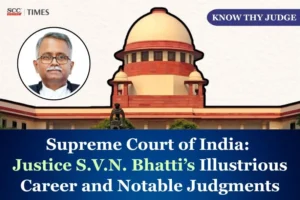
Early Life and Education1
Justice Sarasa Venkatanarayana Bhatti (Bhatt)2 was born on 6 May1962 and is a native of Madanapalli in Chittoor, Andhra Pradesh3. Justice Bhatti obtained his bachelor’s degree in law from Jagadguru Renukacharya College, Bangalore.
Career Trajectory
As an Advocate
After completing law, Justice Bhatti enrolled himself on 21 January 1987 with the Bar Council of Andhra Pradesh and started his practice in the Trial Court at Madanapalli4 before moving his practice to the High Court of Judicature of Andhra Pradesh at Hyderabad.5
Justice Bhatti served as a Special Government Pleader in the Office of Advocate General at the High Court of Andhra Pradesh from 2000 to 2003.6
As a Judge7
Justice S.V Bhatti was sworn-in as Additional Judge of the High Court of Andhra Pradesh on 12 April 2013. He was appointed as Judge of the High Court of Judicature at Hyderabad for the State of Telangana and the State of Andhra Pradesh and assumed his charge on 1 June 2014.
Upon bifurcation and establishment of the High Court of Judicature of Andhra Pradesh at Amaravathi on 1 January 2019, Justice Bhatti was sworn-in as a Judge of Andhra Pradesh High Court and was later transferred to Kerala High Court. He was appointed as Judge of the High Court of Kerala and assumed office with effect from 19 March 2019.
Justice Bhatti was also appointed as Acting Chief Justice of Kerala High Court with effect from 24 April 2023 and was appointed as its Chief Justice with effect from 1 June 2023.
Within a month into the Chief Justiceship of Kerala High Court, news started pouring in that Justice Bhatti’s name is being considered for elevation to the Supreme Court. On 05-07-2023, the Collegium recommended Justice Bhatti’s name, which was approved by the Ministry of Law and Justice on 12 July 2023 finally on 14 July 2023 Justice Bhatti took oath as Supreme Court Judge.
The Collegium8 while considering Justice Bhatti’s name for elevation observed that during his long tenure as a judge of the High Court of Andhra High Pradesh and as a Judge and subsequently as Chief Justice of the High Court of Kerala, Justice Bhatti has acquired considerable experience in various branches of law. “The judgments authored by him dealing with issues in various branches of law stand testimony to his legal acumen and competence (…) the appointment of Justice Bhatti will provide a value addition in terms of his acquired knowledge and experience. He commands a good reputation and possesses integrity and competence.” Justice S.V. Bhatti’s induction in the Supreme Court gave much-needed representation to the High Court of Andhra Pradesh in the Supreme Court since retirement of former Chief Justice N.V. Ramana in 2022.9
Notable Decisions by Justice S.V. Bhatti10
Supreme Court
*Did you Know? Since 2023, Justice S.V.N. Bhatti has been part of over 500 decisions11.
Section 2(e) of Payment of Gratuity Act doesn’t apply to Central Govt. employees holding Civil Posts: Supreme Court
In civil appeals arising from a common judgment of the Madras High Court regarding gratuity claim entitlement of retired employees of the Heavy Water Plant (“HWP”), Tuticorin, under the Payment of Gratuity Act, 1972 (“Payment of Gratuity Act”). The principal question before the Court was whether the employees of HWP, functioning under the Department of Atomic Energy, Government of India, fall within the definition of “employee” under Section 2(e) of the Payment of Gratuity Act, or whether they stand excluded by virtue of holding civil posts under the Central Government and being governed by the CCS (Pension) Rules, 1972 (“Pension Rules”). A Division Bench of Pankaj Mithal and S.V.N. Bhatti,* JJ., upheld the High Court’s judgment and held that the Payment of Gratuity Act does not apply to the employees of Heavy Water Plant, Tuticorin and therefore petitioners are not entitled to claim gratuity under the Payment of Gratuity Act. Read more
[N. Manoharan v. Administrative Officer, 2026 SCC OnLine SC 189]
Apprehended Industrial Dispute justifies Reference; Prior Demand Not Mandatory: Supreme Court
In an appeal, arising from a challenge to the order of reference dated 28-01-2020 made by the appropriate Government under Sections 10(1) and 12(5) of the Industrial Disputes Act, 1947 (ID Act) thereby referring an industrial dispute for adjudication to the Industrial Court, where the principal question was whether the reference was vitiated on the ground that no prior written demand had been raised with the Management before approaching the Conciliation Officer, and whether, in such circumstances, a valid industrial dispute or apprehended industrial dispute existed within the meaning of the Act, a Division Bench of Pankaj Mithal and S.V.N. Bhatti,* JJ., affirmed the High Court’s judgment, holding that the reference made by the appropriate Government was legal and valid, and that a prior demand is not mandatory for an industrial dispute reference under the Act. Read more
[Premium Transmission (P) Ltd. v. State of Maharashtra, 2026 SCC OnLine SC 113]
Supreme Court directs Registry not to list paper-books appended with black and white photographs
While hearing a petition arising out of an impugned Bombay High Court judgment, the 3-Judge Bench of Surya Kant, S.V. N. Bhatti and Joymalya Bagchi, JJ., directed the Registry to not clear any paper-book for listing where black and white photographs are appended. The Court further stated that directions should be circulated within the AORs that unless proper coloured photographs, along with distance dimensions and supported by a conceptual plan, are appended, no such material shall be allowed to be placed on record, and the matter will remain in the list of ‘defects not cured’ till further orders. Read more
[Dinamati Gomes v. State of Goa, 2025 SCC OnLine SC 2572]
‘Manner of granting bail revealed procedural irregularities at grassroot levels of judiciary’; Supreme Court directs special training for two judicial officers
The present appeal challenges the impugned order dated 18-11-2024, whereby the appellant’s petition assailing the order dated 16-8-2024 passed by the Additional Sessions Judge (ASJ)-2/Special Judge (NDPS), East, Karkardooma Courts, Delhi (‘Sessions Judge’) was dismissed. In the said order, the Sessions Judge had affirmed the bail granted to the accused persons by the Additional Chief Metropolitan Magistrate (‘ACMM’), Karkardooma Courts, East District, Delhi. The Division Bench of Ahsanuddin Amanullah and S.V.N. Bhatti, JJ., stated that the manner in which bail was granted revealed certain procedural irregularities at the grassroots level of the judiciary, which should not be ignored. Accordingly, the Court quashed and set aside the impugned order dated 18-11-2024 and the Session Judge’s order dated 16-8-2024. While refusing to turn a blind eye to the manner in which the ACMM granted bail to the accused and the Sessions Judge who refused to interfere with grant of bail, the Court stated that the Judicial Officers who passed the respective orders, should undergo special judicial training for a period of at least seven days. Read more
[Netsity Systems (P) Ltd. v. State (NCT of Delhi), 2025 SCC OnLine SC 2079]
SC restates principles on power, scope & grounds for Review Jurisdiction; Sets aside Madras HC review order on daughter’s status as coparcener
While considering an appeal wherein the Division Bench of Ahsanuddin Amanullah and S.V.N. Bhatti*, JJ., had to consider the validity of Madras High Court’s impugned decision to remand the matter related to the Appellant’s status as a co-parcener in a partition suit to the Trial Court. The Court upon perusing the impugned order, delved into relevant precedents detailing the distinction between the power of review and appellate power and restated the power and scope of review jurisdiction, thereby summing up the grounds for Review as follows:
-
The ground of discovery of new and important matter or evidence is a ground available if it is demonstrated that, despite the exercise of due diligence, this evidence was not within their knowledge or could not be produced by the party at the time, the original decree or order was passed.
-
Mistake or error apparent on the face of the record may be invoked if there is something more than a mere error, and it must be the one which is manifest on the face of the record.8 Such an error is a patent error and not a mere wrong decision. An error which has to be established by a long-drawn process of reasoning on points where there may conceivably be two opinions can hardly be said to be an error apparent on the face of the record.
-
The phrase ‘for any other sufficient reason’ means a reason that is sufficient on grounds at least analogous to those specified in the other two categories. Read more
[Malleeswari v. K. Suguna, 2025 SCC OnLine SC 1927]
Accuracy of averment made in written statement must be decided by Trial Court on conclusion of evidence at time of suit’s final determination
While considering the instant appeal concerning Rajasthan High Court’s refusal to quash FIR; the Division Bench of Pankaj Mithal and SVN Bhatti, JJ., held that whether a statement made in the written statement is incorrect or false must be considered and decided by the Trial Court itself upon the conclusion of the evidence, at the time of the final determination of the suit or if necessary in proceedings under Section 340 of the CrPC. Unless this exercise is completed, it is difficult to say that the averments made therein are false and constitutes an offence attracting penal action. Read more
[Ramchandra v. State of Rajasthan, 2025 SCC OnLine SC 685]
SC summarises sequence of application of Karnataka Stamp Act provisions on insufficiently stamped instruments
While deliberating over the instant appeals revolving around the scope of Sections 33, 34, 37, and 39 of the Karnataka Stamp Act, 1957, the Division Bench of Hrishikesh Roy and SVN Bhatti*, JJ., took note that there are still certain misgivings vis-a-vis in the sequence of application of Ss. 33, 34, 35, 37, and 39 of Karnataka Stamp Act and summed up the steps for the benefit of practice and procedure. Read more
[Seetharama Shetty v. Monappa Shetty, 2024 SCC OnLine SC 2320]
Supreme Court stays directive to Eateries along Kanwar yatra route to display names of owners and staff
In separate pleas by Association of Protection of Civil Rights, Member of Parliament Mahua Moitra, Delhi University Professor Apoorvanand and activist Aakar Patel against Uttar Pradesh, Uttarakhand and Madhya Pradesh Governments’ directives to the owners of the shops and eateries along the Kanwar Yatra route to display their names outside such shops, the Division Bench of Hrishikesh Roy and SVN Bhatti, JJ. stayed the said directives. Read more
[Association for Protection of Civil Rights v. State of Uttar Pradesh]
Supreme Court issues notice in MP Bar Association plea claiming exemption from electricity charges
In a special leave petition filed against the judgment and order dated 3-05-2024 passed by the Madhya Pradesh High Court, wherein the Court refused to entertain a Writ Petition against disconnection of the Bar Association’s electricity supply, holding that seeking free electricity is a freebie for the Bar Association, for their own purposes, the vacation division bench of Manoj Misra and SVN Bhatti, JJ. has issued notice and in the meantime, directed the State to maintain the electricity supply of the Bar Association and recovery of electricity bills for the allocated premises till further orders. Read more
[M.P. High Court Bar Assn. v. State of M.P., 2024 SCC OnLine SC 1630]
‘Ghee’ is a livestock product and can be regulated under AP (Agricultural Produce and Livestock) Markets Act: SC upholds Andhra Pradesh HC Judgment
In an appeal concerning whether “ghee” is a “product of livestock” under the provisions of the Andhra Pradesh (Agricultural Produce and Livestock) Markets Act, 1966 (‘the Act’), the division bench of Sudhanshu Dhulia and SVN Bhatti, JJ. has held that there was nothing wrong in the 1994 notification and the challenge to the notification has rightly been turned down by the Full Bench of the Andhra Pradesh High Court, stating that the notification is not under Section 3 but under Section 4 of the Act, and is valid and moreover “ghee” is a livestock product. Read more
[Sangam Milk Producer Co. Ltd. v. Agricultural Market Committee, 2024 SCC OnLine SC 236]
Non-bailable warrants cannot be issued in a routine manner; Supreme Court quashes criminal proceedings
The petitions were filed by the petitioners challenging legal proceedings initiated alleging various criminal charges, including breach of trust, fraud, and assault, leading to legal proceedings against them. The case relates to chargesheets being filed without stating sufficient details of the facts constituting the offense or putting the relevant evidence on record merely carrying a reproduction of the details mentioned by the complainant in the First Information Report, and then proceed to state whether an offence is made out, or not made out, without any elucidation on the evidence and material relied upon. A division bench of Sanjiv Khanna and SVN Bhatti, JJ., dismissed the charges against the petitioners and granted anticipatory bail further quashing the summoning order and non-bailable warrants against Manager Singh.
[Sharif Ahmed v State of UP, 2024 SCC OnLine SC 726]
Supreme Court penalizes Telangana Government with Rs. 5 Lakh cost for misleading affidavits, Authorizes recovery from responsible officials
The petition was filed due to a dispute over land ownership and forest reservation highlighting that a notification was issued declaring the land as reserved forest and seeking a declaration of title and permanent injunction. A division bench of M.M Sundresh and S.V.N Bhatti, JJ., held that the High Court exceeded its jurisdiction by entertaining a re-hearing and acting as an appellate court in the review pointing out errors in the judgment that favored the plaintiff despite their failure to prove title to the land. Additionally, the court noted discrepancies in the handling of the case by state officials, ultimately setting aside the impugned judgment and restoring the earlier judgment. The Court permitted the Telangana government to investigate and recover costs from officials responsible for submitting misleading affidavits.
[State of Telangana v Mohd Qasim, 2024 SCC OnLine SC 548]
Supreme Court Orders Study to Assess Impact of Blasting Activities on Chittorgarh Fort
The case was filed due to concerns about the potential impact of mining activities, particularly blasting operations, on the Chittorgarh Fort, a historical monument of significant cultural importance. The petition was likely filed by parties concerned about the preservation of the fort and its surroundings, possibly including local residents, heritage conservation groups, or government authorities responsible for monument protection. A division bench of Sanjiv Khanna and S V Bhatti, J., held that while mining activities were permissible, blasting operations within a five-kilometre radius of the fort were prohibited to prevent potential damage to its structures. Manual or mechanical mining operations within this radius were allowed, subject to valid leases and compliance with regulations. Additionally, the court ordered the establishment of a multidisciplinary expert committee to study the environmental impact of blasting operations beyond the prohibited radius. The committee was tasked with assessing the impact on the fort’s structures, identifying causes of damage, and conducting an environmental impact assessment. The petitioner, Birla Corporation Limited, was directed to bear the expenses of the study.
[Birla Corporation Limited v Bhanwar Singh, 2024 SCC OnLine SC 41]
Kerala High Court
[Safe Kerala Project] | Kerala High Court directs govt. to halt payment for AI Camera deal until further orders
In a petition by two Congress leaders primarily seeking stay on the implementation of fully Automated Traffic enforcement system for Safe Kerala by levying fine on the public, S.V.N. Bhatti, C.J. and Basant Balaji, JJ. directed the respondents not to make any payment under annuity until further orders of the Court.
[V.D. Satheesan MLA v. State of Kerala]12
Kerala High Court directs State Bar Council to accept advocates enrollment fee of Rs 750
In a writ appeal seeking stay on operation and implementation of order dated 15-02-2023 which directed the Kerala Bar Council to accept petitioner’s enrollment application with a fee of Rs 750 only, S.V.N. Bhatti, CJ and Basant Balaji, J. directed the Bar Council of Kerala to accept enrollment fee of Rs 750 from all the aspirants seeking enrollment as an advocate to avoid individual cases seeking reduction of fees.
[Bar Council of Kerala v Akshai M Sivan, 2023 SCC OnLine Ker 4242]
Kerala High Court| Child should grow up knowing both parents and should enjoy the comfort of both parents
An appeal was filed by the mother of a minor child aged 6 years seeking custody of the child relating to a compromise decree passed wherein the appellant had agreed for the permanent custody of Vaishnav to be with the father and temporary custody to herself every Saturday from 10.00 a.m till 10.00 a.m. on the next day. A division bench of S V Bhatti and Bechu Kurian Thomas, JJ., modified the impugned order and held that taking note of the welfare of the child, which alone is the paramount consideration, the mother should have custody of the child during summer holidays for a period of 15-days each month and for 5 days during Onam and Christmas apart from custody on every Saturday from 10.00 Am till the next day-Sunday, till 6.00 PM.
[Saranya v Jyothi Basu, 2020 SCC OnLine Ker 15296]
Will the maxim res ipsa loquitor get attracted in a case where a healthy man ‘walks’ into the operation theater for removal of kidney stones, taken out as a paraplegic? Kerala High Court answers
An appeal was filed by PRS Hospital challenging the order directing damages to be paid to an alleged victim of medical negligence who was an otherwise healthy young man of 29 years, who rode his motorbike to the hospital to undergo minor surgery/procedure for the removal of kidney stones, however, the young man was brought out from the operation theater as a paraplegic and his speech, lost. A division bench of S V Bhatti and Bechu Kurian Thomas, JJ., upheld the impugned order for damages and held that by the application of the principle of res ipsa loquitor, the hospital alone could have answered or explained the allegation of negligence, however, in the nature of the evidence adduced, they have failed to prove the absence of negligence.
[PRS Hospital v P Anil Kumar, 2020 SCC OnLine Ker 8268]
Can a party to a litigation seek production of the medical records of a stranger to the lis especially those relating to a person with alleged mental illness? Kerala High Court answers
A petition was filed by the petitioner with a degree in M.Tech with second rank in the University, challenging a divorce proceeding wherein her right to privacy was allegedly infringed on account of a court certificate issued by the Family Court, Pala, for producing medical records of treatment undergone by the petitioner and her mother in a hospital. A division bench of S V Bhatti and Bechy Kurian Thomas, JJ., opined that unless the release of treatment records come within the purview and scope of the exceptions enshrined in Section 23 of Mental Healthcare Act, 2017, the records of treatment of a person with mental illness cannot be released by any health professional.
On perusing the affidavit supporting the application for issuance of Court Certificate for production of medical records of the petitioner and her mother, the Court held that
“The only averment written in the affidavit justifying production was “it is highly necessary to verify the treatment records of those persons from the year 2005 to 2015 for the fair disposal of the above case’, which cannot justify the production of treatment records of an alleged mentally ill person. Thus, there is no whisper even, as to how the document of a stranger to the litigation could be relevant or essential for the litigation.”
[X v Dr. S, 2020 SCC OnLine Ker 4377]
Kerala High Court refuses habeas corpus relief to a follower seeking production of Swami Prakashanantha alleging maladministration of hospital
A habeas corpus writ was filed by the petitioner, an ardent devotee of the dharma of H.E. Sri Narayana Guru Swami, having special attachment and affection for Swamiji seeking to produce Swami Prakashanantha before the Court and set him at liberty, due to him gaining knowledge that Swamiji is hospitalised in Shivagiri Sree Narayana Medical Mission Hospital, Varkala and alleging maladministration and ill-treatment. A division bench of S. V. Bhatti, and Bechu Kurian Thomas, JJ., refused grant writ relief and directed the hospital authorities to continue to give the best available treatment to Swami and keep a highly qualified and competent person informed on a day-to-day basis with a view to ensuring transparency.
[Vijendrakumar M v Swami Visudhananda, 2020 SCC OnLine Ker 17109]
Kerala High Court dismisses PIL challenging grant of Environmental Clearance for the construction of a shopping mall at Thiruvananthapuram
A PIL was filed by a person who espouses public causes and claims to have filed several public interest litigations in the Court due to his social commitment challenging the grant of Environmental Clearance (‘the EC’) for the construction of a shopping mall at Thiruvananthapuram. A division bench of S V Bhatti and Bechu Kurian Thomas, JJ., dismissed the PIL as the project does not violate either the Environment Impact Assessment notification or the Coastal Regulation Zone regulations.
[M K Salim v State of Kerala, 2021 SCC OnLine Ker 3119]
Every Muslim entitled to offer prayers in any mosque or buried dead bodies in a public khabarsthan; Kerala High Court holds Elappully Eranchery Jama-at Palli a public mosque and graveyard
A revision petition was filed by Elappully Erancheri Jama-Ath Palli (defendants) seeking revision of an order that upheld the order passed in a suit filed by members and beneficiaries of Elappully Eranchery Jama-ath Palli, a wakf challenging a ban on the members of the Jama-ath from participating in the marriage and their ceremonies along with burial of the dead bodies of the plaintiffs, others and their family members because the plaintiffs and 40 members of Elappully Erancheri Jama-Ath Palli wakf attended a religious discourse conducted by the Kerala Naduvathul Mujahideen. A division bench of S V Bhatti and Basant Balaji, JJ., held that the Elappully Eranchery Jama-ath Palli Mosque and khabarsthan being a public one, the defendants cannot obstruct the plaintiffs in offering prayers and burying the dead.
The Court opined “A mosque is a place of worship, and every Muslim offers prayer in the mosque. The Elappully Eranchery Jama-at Palli has no right to obstruct a member of the Jama-ath or any other Muslim from offering prayers. The burying of dead bodies is also a civil right. The graveyard situated in the plaint schedule property is a public graveyard. Every Muslim is entitled to get a decent burial according to civil rights and the graveyard under the supervision of the Elappully Eranchery Jama-at Palli is a public graveyard, any Muslim or any member of the Elappully Eranchery Jama-ath Palli has a right to bury the dead.”
[Elappully Eranchery Jama-at Palli v Mohammed Haneef, 2022 SCC OnLine Ker 5916]
Hyderabad High Court
Hyderabad High Court | Declarations prescribed by Section 18 of Legal Metrology Act, 2009 r/w Rule 6(1) & (2) Legal Metrology Rules, 2011 are mandatory and demand compliance by the manufacturer
An appeal was filed examining the nature, scope and object of Sections 18 and 52 of the Legal Metrology Act, 2009 and Rule 6 (2) of the Legal Metrology (Packaged Commodities) Rules, 2011 and seeking to suspend the orders passed by the Single Judge in dated 11-07-2018 in the interest of justice. A division bench of Thottathil B Radhakrishnan, CJ., and S V Bhatt, J., that the that the requirement of sub-rule (2) of Rule 6 is mandatory and in the case on hand, admittedly the details given in compliance with the requirement of Rule 6(1) are treated as satisfying the requirement of 6(2) as well, hence are untenable and are accordingly set aside.
[State of Telangana v Himjal Beverages Private Limited, 2018 SCC OnLine Hyd 509]
Hyderabad High Court | Statutory obligations/rights under ESI Act cannot be contracted out by the employer and the employee/union; Such contracts are void and unenforceable
An application was filed based on an order of reference dated 30-04-2011, which occasioned the constitution of a Larger Bench, passed by the Full Bench in the civil appeals, in view of a divergence of the opinions/views expressed in two separate judgments. The issue under consideration was whether the parties are entitled to contract out of the beneficial provisions of the Employees State Insurance Act, 1948. A full bench of Dilip B Bhosale ACJ., K C Bhanu, S V Bhatt, A Shankar Narayana, and Anis, JJ., held that the scheme of the ESI Act is intended to secure compulsory participation and/or contribution of sums due under the Act, and strikes at all attempts by contract to either limit or extinguish these rights directly or indirectly. The contracting out of statutory obligation by employer and employee when the obligation by operation of law is towards the Corporation, is void and illegal. Thus, the Act does not explicitly forbid such a course, but if the interpretation to contract out of the Act is accepted, the interpretation will defeat and destroy the compulsive character introduced by the legislation.
[RCC Sales Private Limited v ESI Corporation, 2015 SCC OnLine Hyd 258]
Hyderabad High Court| Notice to the tenant in a shop is necessary in case of acquisition of land by Municipal authorities for road widening even if the landlord/owner of the premises has given his consent
An application was filed to address the issue whether in case of acquisition of land by municipal authorities, for road widening, on consent of the landlord of a shop any notice is necessary to be given to the tenant in the shop. A full bench of Dilip B Bhosale, ACJ., and M S Ramachandra Rao, S V Bhatti, S. Ravi Kumar, and Anis, JJ., answered the question under consideration in the affirmative and held that a notice to the lessee/tenant in the shop is necessary in case of acquisition of land by the municipal authorities for road widening on consent of landlord of a shop.
[Raisunna Begum v Premsukhai Jain, 2015 SCC OnLine Hyd 598]
Hyderabad High Court| Any detenue under preventive detention/ illegal detention has a right under Article 226 of the Constitution; Required to be heard by a bench of two Judges
An application was filed to address the issue whether a petition for a writ in the nature of habeas corpus, under Article 226 of the Constitution can be entertained against the order of preventive detention passed under the provisions of Andhra Pradesh Prevention of Dangerous Activities of Bootleggers, Dacoits, Drug Offenders, Goondas, Immoral Traffic Offenders and Land Grabbers Act or any other enactment authorizing preventive detention. A three-judge bench of Dilip B Bhosale, ACJ., and S V Bhatti, and A Shankar Narayana, JJ., answered in the affirmative and held that the writ of habeas corpus provides a prompt and effective remedy against illegal detention under the Act or any other enactment authorizing preventive detention. Article 21 of the Constitution provides that no person shall be deprived of life and liberty except in accordance with the procedure established by law.
[G. Archana v State of Andhra Pradesh, 2015 SCC OnLine Hyd 240]
2. Justice S V Bhatti also mentioned as ‘Bhatt’ in one of the official Supreme Court notifications. Justice Bhatti also finds mention as Justice ‘SV Bhatt’ in the Telangana/ AP High Court orders. The official Supreme Court notifications however refer to him as “Justice Sarasa Venkatanarayana Bhatti (Bhatt)”.
3. S.V. Bhatti appointed Chief Justice of Kerala High Court – The Hindu
4. Justice Sarasa Venkatanarayana Bhatti | Supreme Court of India | India (sci.gov.in)
6. Justice Sarasa Venkatanarayana Bhatti | Supreme Court of India | India (sci.gov.in)
7. Supra
8. Supreme Court Collegium Resolution
9. Justice Ujjal Bhuyan and Justice S.V. Bhatti take oath as Judges of Supreme Court (scconline.com)
11. https://www.scconline.com/ ”Coram only” feature
12. Civil Writ Petition No. 19992 of 2023