


Supreme Court: In a case originated from a challenge to a conviction and sentence of death confirmed by the Patna High Court, however, during the course of proceedings, the Court’s attention was drawn to a recurring and deeply concerning issue — inordinate delay in filing appeals and special leave petitions (SLPs) in matters involving legal aid, the Division Bench of Sanjay Karol* and Nongmeikapam Kotiswar Singh, JJ., issued directions institutionalising reforms in the legal aid system, making timelines binding and directing structural changes to ensure timely filing of appeals and effective access to justice.
Background
The present proceedings originated from an appeal filed by the appellant challenging the judgment of conviction and sentence of death imposed upon him and confirmed by the Patna High Court decided on 20 February 2014. While entertaining the matter, the Supreme Court, by order dated 5 May 2017, noticed a recurring issue of inordinate delay in legal aid matters, particularly in filing appeals and SLPs on behalf of convicts.
In order to ascertain the causes behind such delay and to evolve corrective measures, the Court appointed Ms Vibha Datta Makhija, Senior Advocate, as Amicus Curiae. Subsequent proceedings reveal continuous engagement with various stakeholders including the Supreme Court Legal Services Committee (SCLSC) and the National Legal Services Authority (NALSA). A set of recommendations was prepared and circulated among High Courts, State Governments, and Union Territories for inputs.
By orders dated 26 February 2020 and 5 March 2020, the original death reference stood decided and the miscellaneous proceedings were de-tagged. However, the issue of delay in legal aid cases continued to engage the Court.
On 19 January 2021, the Court took serious note of delays in filing SLPs through legal aid mechanisms and observed that such delays undermine even-handed justice. It directed constitution of a committee comprising senior officials from the Ministry of Home Affairs, National Informatics Centre (NIC), Supreme Court e-Committee, and NALSA to examine solutions involving digitisation, translation, and electronic transmission of records.
Further, by order dated 23 May 2025, the Court sought detailed information from the SCLSC regarding pendency, delays, infrastructure, causes of delay, and status of digital connectivity.
Also Read: Law Ministry outlines initiatives for establishing Legal Aid Centres in tribal and remote belts
Data and Affidavit by SCLSC
In its affidavit dated 14 July 2025, the SCLSC furnished extensive data and explanations. It disclosed that thousands of legal aid applications were received annually, but there remained gaps in tracking actual filings due to lack of real-time updates by panel advocates.
The SCLSC outlined the procedure for availing legal aid, including submission of applications through multiple channels, High Court Legal Services Committees (HCLSCs), district authorities, jail authorities, and online portals. Cases undergo scrutiny by screening committees before being assigned to panel advocates, except in matters involving prisoners, where assignment is direct.
The SCLSC candidly identified major causes of delay, including, late or incomplete applications by litigants, delay in filing by panel advocates, time consumed in translation of vernacular records, and difficulty in obtaining custody certificates and court records.
To address these issues, the SCLSC outlined measures adopted to curb delays, including:
-
Launch of a “Mission Mode” campaign (in January 2025) to identify eligible prison inmates and collect data through coordinated communication with authorities, with follow-up reminders and organisation of videoconferences.
-
Constitution of teams of panel advocates for jail visits, and expansion of the panel of advocates along with introduction of assisting counsels and increase in screening committees.
-
Online connectivity through the SCLSC portal, with separate login IDs for all stakeholders, provision for videoconferencing and communication, and facility for applicants to track their cases.
Directions to Stakeholders
The SCLSC, sought directions from the Court and the Court by order dated 1 September 2025 issued detailed operational directions to streamline coordination among stakeholders.
The Court noted a degree of laxity on the part of authorities in furnishing affidavits, which caused concern, and therefore requested the Amicus Curiae to personally interact with the Chairpersons of Legal Services Authorities and compile the required information in tabular form.
In respect of HCLSCs, the Court directed that:
-
Where an applicant approaches the SCLSC directly, the HCLSC must transmit the complete paperbook of the High Court and courts below within seven days of requisition.
-
Where applications originate from HCLSCs, the forwarding must include the complete paperbook. In non-criminal matters or where the applicant is not in custody, the HCLSC must forward the duly signed vakalatnama and attested affidavit within seven days, along with soft scanned copies of all documents.
In respect of jail authorities, it was directed that:
-
Where the applicant is in judicial custody, the vakalatnama and custody certificate, duly attested, must be sent to the HCLSC within three days of request. Thereafter, the HCLSC is required to transmit all documents, including paperbooks and records of lower courts, to the SCLSC within seven days. Further, any additional documents sought by the advocate or SCLSC must be supplied within seven days.
Subsequently, by order dated 16 September 2025, the Court expressed anguish at the failure of statutory authorities to respond to its earlier orders, and once again requested the Amicus Curiae to engage with the Chairpersons of State Legal Services Authorities to ensure compliance before the next date of hearing.
Legal Aid: Conceptual and Legal Introduction
The Court discussed a comprehensive conceptual foundation of legal aid and stated that “legal aid, simply put, refers to the provision of free or affordable legal services to individuals who lack the economic or social capacity to access justice through conventional means”. Legal aid is intrinsically linked with the constitutional promise of justice — social, economic, and political and equality of opportunity.
The Court emphasised that Article 39-A, introduced by the 42nd Constitutional Amendment, imposed a duty upon the State to ensure that justice was not denied due to economic disadvantage. Over time, this mandate had been strengthened by judicial interpretation linking legal aid to Article 21, thereby making it an essential component of fair procedure. It was highlighted that legal aid is not merely a welfare measure but a constitutional obligation, integral to the Rule of Law and democratic governance.
Tracing judicial evolution, the Court referred to landmark decisions in Sunil Batra v. Delhi Admin., (1978) 4 SCC 494, where it was held that prisoners retain fundamental rights even within prison walls; Hussainara Khatoon v. State of Bihar, (1980) 1 SCC 81, where speedy trial and free legal aid was recognised as essential elements of Article 21; Madhav Hayawadanrao Hoskot v. State of Maharashtra, (1978) 3 SCC 544, where the right to counsel was affirmed as a fundamental right and Khatri (II) v. State of Bihar, (1981) 1 SCC 627, where the Court clarified that legal aid must be provided from the first production before a Magistrate and does not depend on a request by the accused.
The Court also relied on Suhas Chakma v. Union of India, (2024) 16 SCC 1, where systemic deficiencies in legal aid access were examined, and extensive directions were issued to improve pre-litigation assistance, awareness, monitoring, and digitalisation.
Also Read: Free Legal Aid services reach citizens from Taluk to Supreme Court, says Law Ministry
Standard Operating Procedure (SOP) by Amicus Curiae
After extensive consultations and deliberations carried out by the Amicus Curiae, a Standard Operating Procedure (SOP) for Translation and Transmission of Records was formulated. The SOP aims to ensure timely filing of appeals and SLPs in legal aid matters by establishing structured processes, accountability, and use of technology.
Objective and Scope
The SOP sought to minimise delays, ensure accurate translation of judicial records, promote inter-agency coordination, incorporate digital tools for transparency, and upheld Articles 21, 39-A and 142. It intended to apply to all legal aid cases before High Courts and the Supreme Court.
Categorisation of cases
Cases were classified into, Category A (high priority): death sentence, life imprisonment, severe civil matters, Category B (medium priority), and Category C (general cases). This classification determined timelines, monitoring frequency, and resource allocation.
Translation and Documentation
The SOP mandated immediate initiation of translation upon eligibility for legal aid. Priority documents included judgments, FIRs, witness statements, medical evidence, and trial records. Translations must meet strict standards, including certification and conflict-free declarations.
Timelines and Responsibilities
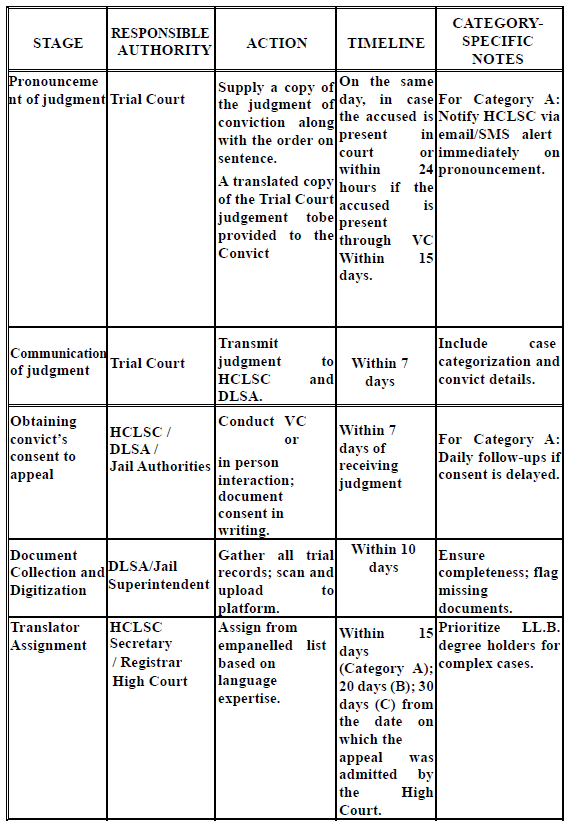
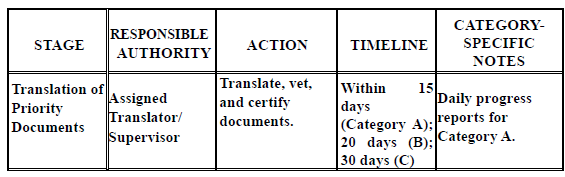
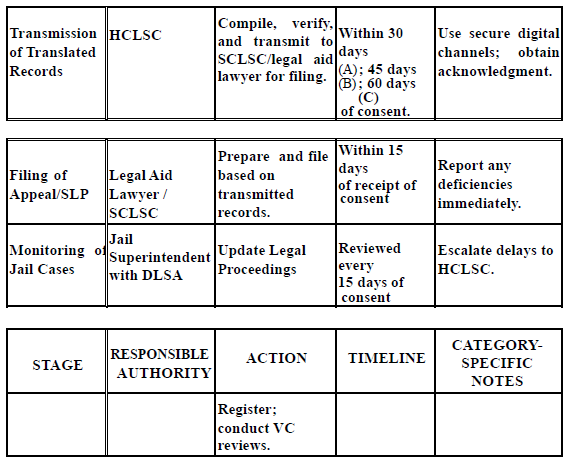
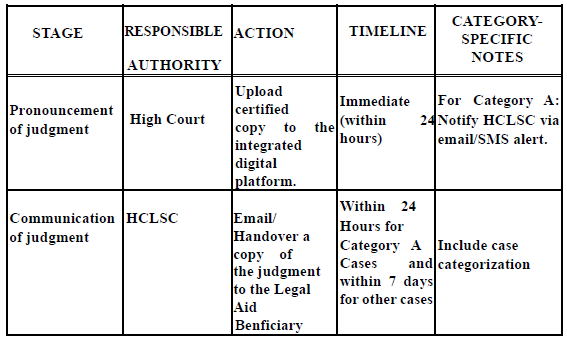
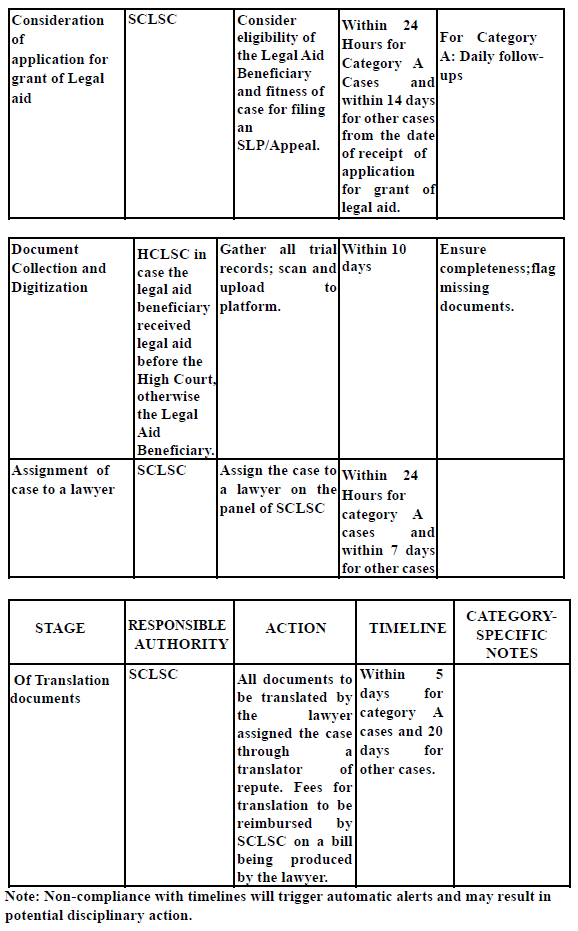
Detailed timelines were prescribed for each stage, i.e., from pronouncement of judgment to filing of appeal/SLP. For instance, judgment communication within seven days, document collection within 10 days, translation within 15—30 days depending on category, filing within 15 days of receipt of documents, etc. (these timelines are illustrated in tabular form in pages 19—22 of the judgment.)
Translator Engagement
The SOP called for creation of dedicated translator cadres in High Courts, with defined qualifications, training, performance metrics, and remuneration structures. The oversight mechanisms were required to ensure accuracy and accountability.
Digital Coordination
A unified digital platform was envisaged for real-time tracking, secure document exchange, automated alerts, and audit trails which was to be oversaw by NALSA.
Monitoring and Accountability
Monitoring committees comprising Senior Advocates and officials was to conduct periodic reviews, evaluate performance, and address delays. Monthly and annual reporting mechanisms was prescribed.
Coordination with Jail Authorities
Regular videoconferencing, maintenance of legal proceedings registers, and establishment of legal aid kiosks in prisons was mandated to ensure continuous communication with inmates.
Quality Assurance and Audit
Quarterly audits, feedback systems, and continuous improvement mechanisms was built into the SOP to maintain high standards.
Delay Explanation Format
A structured checklist was introduced requiring disclosure of each stage of delay, from judgment to filing, ensuring transparency in condonation applications.
The Amicus Curiae further proposed creation of translator cadres, development of a unified digital platform by NIC, constitution of monitoring committees, and appointment of a nodal officer (Member Secretary, NALSA).
Court’s Directions and Decision
After careful consideration, the Court held that the SOP reflects comprehensive stakeholder deliberation and deserves adoption by High Courts.
The Court, after considering the SOP, issued the following directions:
-
The SOP shall be placed before all High Courts for consideration and adoption.
-
Timelines under Heading 5 of the SOP were made binding.
-
High Courts were advised to examine translator-related reforms within four weeks.
-
Monitoring committees must be constituted expeditiously.
-
Coordination mechanisms with jail authorities and inter-agency communication must be implemented.
-
The delay-explanation format must be mandatorily incorporated within two weeks.
-
Directions regarding creation of digital platform and appointment of nodal officer (NALSA) were accepted.
-
The Registrar (Judicial) was directed to circulate the order to all High Courts, and compliance reports were ordered to be filed by 30 April 2026.
For better understanding timelines under Heading 5 of the SOP is listed below:
5. TIMELINES AND RESPONSIBILITIES
5.1 The following table outlines key stages, responsible authorities, actions, and timelines. All timelines are mandatory and subject to extensions only with documented justification and approval from the SCLSC.
APPEAL BEFORE THE HIGH COURT — CRIMINAL CASES


SLP/APPEAL BEFORE THE SUPREME COURT — CRIMINAL CASES
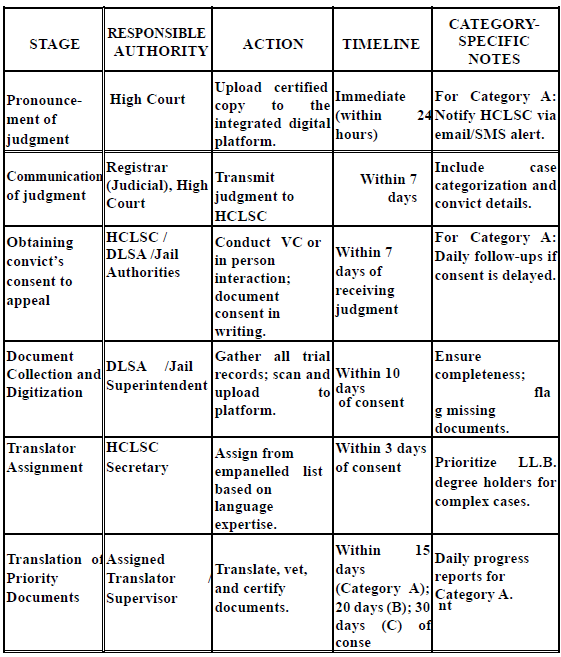


APPEAL BEFORE THE SUPREME COURT — CIVIL CASES

Lastly, the Court appreciated the contributions of counsel, particularly the Amicus Curiae, in addressing systemic issues affecting access to justice.
The Court fixed the next day of hearing for further consideration on 4 May 2026.
[Shankar Mahto v. State of Bihar, 2026 SCC OnLine SC 606, decided on 16-4-2026]
*Judgment by Justice Sanjay Karol