


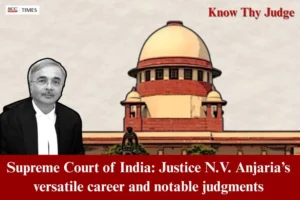
Born on 23-03-1965 at Ahmedabad, Justice Nilay Vipinchandra Anjaria comes from a family of lawyers and Judges (Justice Anjaria’s father was also in judiciary)1. A native of the picturesque district of Mandvi-Kutch, Gujarat, Justice N.V. Anjaria started his own journey within the legal echelons from 1988 and from there, he never looked back. A seasoned lawyer, an academic and an editor, Justice N.V. Anjaria’s career boasts of versatility.
Justice N.V. Anjaria’s Education2
Justice NV Anjaria graduated from H.L. College of Commerce; Ahmedabad and he obtained his LL. B degree from Sir L.A. Shah Law College in 1988. Further on Justice Anjaria obtained Master’s degree in Law in 1989 from University School of Law, Ahmedabad.
Justice N.V. Anjaria’s Career as an Advocate3
After obtaining his law degree, Justice Anjaria started his practice in the High Court of Gujarat from August 1988 by joining chamber of celebrated Senior Advocate, S.N. Shelat.
During his time as a practising counsel, Justice Anjaria conducted matters involving constitutional issues and all categories of civil cases, labour and service. He was also appointed as Standing Counsel / Panel Advocate for High Court and subordinate Courts, State Election Commission, Gujarat Information Commission, Gujarat Industrial Development Corporation, Municipalities, etc.
Furthermore, Justice Anjaria was also a Trained Mediator in the Gujarat High Court Mediation Centre.
Justice N.V. Anjaria’s Academic Pursuits4
Justice Anjaria established his versatility not only as a lawyer but also was awarded Research Fellowship in 1992 by Late Shri Navinchandra Desai Foundation, Ahmedabad on ‘Freedom of Speech and Expression — With Reference to Media’.
Justice NV Anjaria also rendered his services as Associate Editor of Gujarat Law Herald. Furthermore, his articles, write-ups especially on Constitutional and legal subjects published in books and various reputed Law Journals.
Justice Anjaria also contributed a write-up titled ‘High Court of Gujarat: Advent and Ascent’ in the Souvenir published under the aegis of High Court of Gujarat on the occasion of its Golden Jubilee Celebrations in April 2010.
Justice N.V. Anjaria’s Judicial Career
After serving the High Court with his legal expertise as an advocate for 23 years, Justice N.V. Anjaria was elevated as Additional Judge, High Court of Gujarat on 21-11-2011 and was confirmed as Permanent Judge on 06-09-2013.
He continued to serve his parent High Court in the capacity of a Judge and his competency, impeccable integrity and knowledge in law was rewarded furthermore when the Supreme Court Collegium considered and recommended his name for the post of Chief Justice of Karnataka High Court, which was duly accepted by the Ministry of Law and Justice and notified his appointment for the post by the President of India.
Upon the retirement of Justice P.S. Dinesh Kumar, Justice Anjaria was then sworn in as the next Chief Justice of Karnataka High Court on 25-02-2024 by Governor of Karnataka, Thaarwar Chand Gehlot5. Earlier former Chief Justice, Prasanna B. Varale, was elevated as a judge of the Supreme Court on 25-01-2024 and Justice P.S. Dinesh Kumar took oath as Chief Justice on 03-02-2024 and retired on 24-02-2024 after serving for a short duration of 22 days as Chief Justice.
In recognition of Justice N.V. Anjaria’s stellar career, the Supreme Court Collegium on 26-5-2025, recommended his name for elevation as Supreme Court Judge and in a display of speedy action, the Centre notified Justice Anjaria’s appointment. Justice Anjaria took oath of office as Judge of Supreme Court of India on 30-5-2025.
Notable Judgments of Justice N.V. Anjaria
The bench of Ahsanuddin Amanullah and NV Anjaria, JJ has directed Union of India, all States and Union Territories, and the University Grants Commission (UGC) to furnish comprehensive details in order to examine the aspects relating to the creation/establishment/setting-up of all private Universities, either under the State Governments/Union Territories or the Central Government, and connected concerns. The direction came while dealing with a dispute related to Amity University, Noida wherein the Court felt the pressing need to examine the establishment and functioning of private Universities across the country in the larger public interest. Ayesha Jain v. Amity University, 2025 SCC OnLine SC 2557
Capture, Vaccinate, Release: Supreme Court modifies stray dog order; Bans street feeding
In a suo motu case concerning stray dogs, that was initially heard by a 2-Judge Bench on 11-08-2025, and later placed before a 3-Judge Bench, the bench of Vikram Nath, Sandeep Mehta, and NV Anjaria, JJ modified the directions issued by the 2-judge bench and observed that that “the direction given in the order dated 11-08-2025, prohibiting the release of the treated and vaccinated dogs seems to be too harsh”. The previous Bench, comprising Justice JB Pardiwala and Justice R Mahadevan, had issued directions for the removal of stray dogs in the Delhi National Capital Region (NCR) to shelter homes. The case was then referred to a Three-Judge Bench. The Bench reserved its judgment on 14-08-2025, which was pronounced on 22-08-2025.
The Court noted that, in the intervening period, several interlocutory applications for intervention had been filed, purportedly by individuals and organizations working for the welfare of stray dogs, seeking a stay on the directions contained in the order dated 11-08-2025. City Hounded by Strays, Kids Pay Price, In re, (2025) 9 SCC 1
In furtherance of the directions passed by the Court in City Hounded by Strays, Kids Pay Price, In re, (2025) 9 SCC 1, the 3-Judge Bench of Vikram Nath, Sandeep Mehta* and N.V. Anjaria, JJ., perused the compliance affidavits filed by the States and Union Territories pursuant to this Court’s earlier directions; and deemed it fit to modify, the directions issued by the High Court of Judicature for Rajasthan at Jodhpur in Suo Moto v. Union of India, 2025 SCC OnLine Raj 3831 and issued further directions in respect of institutional areas, including educational establishments, hospitals, sports complexes, and other public spaces such as railway stations and bus depots, where incidents of dog-bite attacks continue to be reported with alarming frequency, raising a cause of grave concern and requiring emergent remedial measures.
While deciding whether, when a director is convicted under Section 138 of the Negotiable Instruments Act (NI Act), in the absence of the company’s conviction due to a legal impediment such as winding up, the appellate court can mandate deposit of 20% of the compensation under Section 148 of the NI Act, a Division Bench of Aravind Kumar* and N.V. Anjaria, JJ., referred the matter to the larger bench for an authoritative determination of the issue. Bharat Mittal v. State of Rajasthan, 2025 SCC OnLine SC 2856
While considering this reference made by a Division Bench of the Court in a Special Leave Petition filed against notice issued against an Advocate under Section 179 of the Bharatiya Nagarik Suraksha Sanhita, 2023 (BNSS), the 3-Judge Bench of B.R. Gavai, CJI., K. Vinod Chandran* and N.V. Anjaria, JJ., issued several directions to ensure that the Client-Advocate privilege is not impinged upon by valiant investigators or overzealous parties to a litigation, purely on the basis of the interpretation of the evidentiary rules codified. Summoning Advocates Who Give Legal Opinion Or Represent Parties During Investigation of Cases & Related Issues, In re, (2026) 2 SCC 233
In an appeal filed by a man convicted under Section 6 of the Protection of Children from Sexual Offences Act, 2012 (‘POCSO Act’) for aggravated penetrative sexual assault on his 11-year-old niece, the division bench of Aravind Kumar and NV Anjaria, JJ. upheld the 20-year rigorous imprisonment sentence awarded by the Special POCSO Court and affirmed by the Gauhati High Court. The Court further emphasised that courts must remain vigilant to ensure that procedural submissions are not misused as tactics for harassment. In strong terms, it held that requests to recall a child victim after the conclusion of trial and concurrent findings of guilt raise serious concerns, particularly when there is no manifest illegality or perversity in the appreciation of evidence. Arjun Sonar v. State of Arunachal Pradesh, 2025 SCC OnLine SC 2065
NEET-PG 2025 to be held in one shift: Supreme Court
In a batch of civil writ petitions, the partial working days three-Judge Bench of Vikram Nath, Sanjay Kumar, and NV Anjaria, JJ. directed the National Board of Examination (NBE) to hold National Eligibility-cum-Entrance Test (Postgraduate) (NEET-PG 2025) in one shift. Aditi v. National Board of Examinations6
While considering the instant petition concerning death of elephants by electrocution and by other unnecessary causes; the Division Bench of N.V. Anjaria, CJ and M.I. Arun, J., held that it is essential that the competent authorities commit themselves to conserve and preserve the animal-asset-elephant to minimize, avoid and obliterate the risk of elephants succumbing to death by electrocution. The Court said that ensuring that the elephants are kept away from the risk of electrocution is in the hands of Forest Department and measures which could be taken in that regard are under their control. Hence the Court issued certain directions, holding that these measures must be taken steadfastly. High Court of Karnataka v. Union of India, 2025 SCC OnLine Kar 19
The instant appeals challenged the common judgment of the Single Judge Bench dated 02-07-2024 whereby which the order of National Company Law Tribunal (NCLT) in MIH Edtech Investments B.V. v. Think & Learn (P) Ltd., 2024 SCC OnLine NCLT 2889, was set aside and the matter was remitted to the NCLT for reconsideration. The Division Bench of NV Anjaria, CJ., and KV Aravind, J., directed the parties to maintain the status quo vis-a-vis the subject matter of the dispute till a final decision is made by the NCLT during the remand proceedings. The Court further directed that respondents shall not make allotment of shares in the interregnum. General Atlantic Singapore TL Pte Ltd. v. Byju Raveendran, 2024 SCC OnLine Kar 62
While deliberating over the status of proceedings in the notorious Belagavi stripping incident that occurred in December 2023, the Bengaluru and Dharwad Benches of the High Court directed the completion of trial within one year and granted bail to the 11 accused persons respectively. The Division Bench of N.V Anjaria, CJ., and Krishna S. Dixit, J., at Bengaluru took note of the measures that have been taken to ensure the security of the victim and the compensation granted to her and issued directions expeditious completion of trial. Whereas the single Judge Bench of S. Vishwajith Shetty, J., at Dharwad Bench granted conditional bail to the 11 accused persons in case registered by Kakati Police Station, Belagavi City, for the offences punishable under Sections 109, 114, 117, 143, 147, 148, 307, 323, 324, 326, 341, 342, 353, 354, 354(B), 355, 392, 427, 452, 504, 506, 149, 34 and 37 of the Penal Code, 1860 (IPC) and Section 2(A) of the Prevention of Destruction and Loss of Property Act, 1981. High Court of Karnataka v. State of Karnataka7
In the instant appeal, Mangalore Electricity Supply Company Limited (MESCOM) challenged the interim order of the Single Judge Bench whereby the Court directed MESCOM not to take any coercive action against the respondent pursuant to the electricity dues recovery and disconnection notices impugned on the condition that the respondent deposits Rs.20,00,000/- before the Court. While considering the challenge, the Division Bench of N.V. Anjaria, CJ*., and K.V. Aravind, J., pointed out that the impugned order challenged in the appeal in an interim order, as the very kind and nature of the order, it cannot be said that the order pronounced anything final or that it has crystallized the rights of any of the parties finally. Hence the appeal was dismissed. Mangalore Electricity Supply Co. Ltd. v. Ultratech Cement Ltd., 2025 SCC OnLine Kar 12
While deliberating over the instant appeal questioning the single Judge Bench order concerning issuance for a writ of mandamus to the respondents to grant the subject land by issuing Grant Certificate, the Division Bench of N.V. Anjaria, CJ and Krishna S. Dixit, J., had to peruse Karnataka Land Grant Rules, 1969, published by KLJ Publications, wherein the Court noticed certain discrepancies and therefore sternly warned law publishers in general that it is high time for them to be extra cautious while publishing statutes and statutory instruments otherwise they will risk being hauled up for contempt of Court and perjury, in addition to being blacklisted from public tenders for the supply of books of their publication. “If for the ‘mistake of law’, none should suffer, none should suffer for the ‘mistake of Law Publisher’ too”. Valerian Fernandes v. State of Karnataka, 2024 SCC OnLine Kar 35
In a batch of civil petitions filed by petitioners/ parents of children below the age of six years as on 01-06-2023, challenging the Notification dated 31-01-2020, whereby age limit of six years as on 1st June of the academic year 2023-24 was prescribed for admission of a child in 1st standard, the Division Bench of Sunita Agarwal, CJ. and N.V. Anjaria, J. dismissed the petition. The Court also held that forcing children to go to a pre-school below the age of three years is an illegal act on the part of the parents. Shubhra Hiteshbhai Gupta v. State of Gujarat, 2023 SCC OnLine Guj 2810
In a set of appeals filed by various meat vendors and associations challenging the closure of meat shops, slaughter houses, outlets, hotels by official authorities on grounds of non-compliance with food safety laws and setting up unlicensed shops, the Division Bench of N.V Anjaria* and Niral R. Mehta, JJ., set aside the civil appeals and said that all slaughter houses and meat shops are not ordered to be closed, those who are complying with norms are permitted to run their business. “The freedom to trade or right to do business has to yield the public health norms and the restrictive compulsions needed to be enforced in larger public good. The right to free trade in food items like meat, or any such food has to be subserving to public health and food safety requirements”. Patel Dharmeshbhai Naranbhai v. Dharmendrabhai Pravinbhai Fofani, 2023 SCC OnLine Guj 986
A Division Bench of Sonia Gokani and N.V. Anjaria, JJ., while addressing matter wherein a minor boy had taken away the minor girl and were missing for a significant amount of time, stated that, “…right kind of understanding needs to be given, in the form of legal awareness amongst the children and college students so that society can simultaneously protect very young minor boys, who due to their lack of understanding of law, turn into the offenders in serious matters.” Vikramsinh Champaksinh Parmar v. State of Gujarat, 2020 SCC OnLine Guj 960
The Division Bench of Sonia Gokani and N.V. Anjaria, JJ., while addressing a matter for protection of a couple, stated that, caste system in the country is making it more and more difficult for the young people to decide their own life partner and the rigidity in the minds of adults in the family becomes the serious cause of division of human relationship. Further the Court added that it gets difficult for the administration to handle social and emotional upheaval which eventually turn into legal battleground. Niteshkumar Mulchandbhai Prajapati v. State of Gujarat, 2020 SCC OnLine Guj 897
A Division Bench of Sonia Gokani and N.V. Anjaria, JJ., rejected the unconditional apology of Advocate Yatin Oza, and observed that, “Entire gamut of facts when dispassionately and objectively viewed, we are unable to accept these words as true words of remorse and contrition and therefore, request to accept apology even if termed as unqualified, cannot be acceded to”. Suo Motu v. Yatin Narendra Oza, 2020 SCC OnLine Guj 1175
Gujarat High Court goes beyond the relief sought, helps POCSO victim to become self-sufficient
The Division Bench of Sonia Gokani and N.V. Anjaria, JJ. went beyond the case to help a POCSO victim to continue her further studies from her parental home. Order was issued against a Criminal Misc. Application filed by the desirous victim pleading the Court to allow her to handover the custody of her minor daughter and join her parents. The applicant was called before the Court with her child before passing of the order. Kakiben Raval v. State of Gujarat, 2021 SCC OnLine Guj 2030
The Bench of N.V. Anjaria, J., dismissed a petition challenging the eligibility criteria in Advertisement No. RC-0719/2019 published by the respondents, for the position of Civil Judge, holding that a Deputy Manager working in the legal branch of a bank could not be treated as an employee working in the ‘department allied to Court’. Rule 7(2)(b) of the Gujarat State Judicial Services Rules, 2005 states that the eligibility required for selection to the position of a Civil Judge. is that a candidate “must be practicing as an Advocate in Courts of Civil and/or Criminal Jurisdiction on the last date fixed for receipt of application; or must be working in the Courts or other allied Departments on the last date fixed for receipt of application.” Avinash Detha v. Registrar, 2019 SCC OnLine Guj 804
Sardar Sarovar Narmada Nigam Limited (Conferment of Power to Redeem Bonds) Act, 2008 does not fall within Entry 43 in the State List or Entry 20 in the Concurrent List to the Seventh Schedule: Gujarat HC
In determining the legislative competence, and therefore constitutional validity of the Sardar Sarovar Narmada Nigam Limited (Conferment of Power to Redeem Bonds) Act, 2008, the Bench of Jayant Patel, ACJ and NV Anjaria, J*., held that the impugned Act does not fall within the legislative head or legislative field either under Entry 43 in the State List being ‘Public Debt of the State’ or under Entry 20 in the Concurrent List being ‘Economic and Social Planning’, to the Seventh Schedule of the Constitution nor it traces legislative field even by reading the said two Entries together.
It was further held that the impugned legislation is constitutionally invalid, for, the impugned legislation and the provisions thereof operate in the legislative field already occupied by the competent Central legislation, in particular Securities Contract (Regulation) Act, 1956, Security Exchange Board of India Act, 1992, the Indian Companies Act, 1956 as the provisions of these Central legislations govern the matters and aspects sought to be dealt with and provided for by the impugned legislation.
The State Legislature cannot claim and does not have the legislative competence to enact the impugned law. If the legislative head is to be traced for the impugned legislation, at the best, the same may be traced in Entry 7 in the Concurrent List for the reason that the impugned legislation and the provisions enacted therein deal with the special kind of contract which would be falling within the said Entry. But then even in this purview the State law fails to co-exist and stands in conflict with the Security Contracts (Regulation) Act. Kalyan Janta Sahakari Bank Ltd. v. State of Gujarat, 2016 SCC OnLine Guj 848
“In acquisition, the Government exercises power of eminent domain”: Gujarat High Court
While considering the petitions praying to issue a writ of mandamus for quashing and setting aside the notification issued under section 6 of the Land Acquisition Act, 1894, the Bench of NV Anjaria, J., observed that in acquisition, the Government exercises power of eminent domain. Under the provisions of the Land Acquisition Act, 1894, the procedure for acquisition is prescribed. If the procedure in law is followed and the notifications acquiring the lands are issued by the State Government have been satisfied on the need as well as on the public purpose of acquisition, the action could not be challenged on the spacious grounds as urged on behalf of the petitioners. Amarsinh Shankerbhai Patel v. State of Gujarat, 2012 SCC OnLine Guj 6209
1. High Court of Gujarat (gujarathighcourt.nic.in)
2. Supra
3. Supra
4. Supra
5. Justice Anjaria takes oath as 34th Chief Justice of Karnataka High Court – The Hindu
6. WP(civil) 456/2025
7. WP no. 29727 of 2023