Disclaimer: This has been reported after the availability of the order of the Court and not on media reports so as to give an accurate report to our readers.
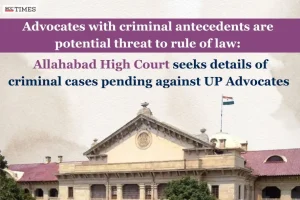
Allahabad High Court: In a petition filed by the petitioner, a practicing advocate, the order passed by the Additional Sessions Judge was challenged which upheld the Chief Judicial Magistrate’s order refusing his request to summon certain police officers in a complaint case, a Single Judge Bench of Vinod Diwakar, J., held that on several occasions the functioning of the District Judiciary has been adversely affected due to the conduct of certain advocates with criminal antecedents appearing before the Court and even if not frequent, such situations pose a potential threat to the rule of law.
The Court, thus, invoked jurisdiction under Article 227 of the Constitution and sought comprehensive details of criminal cases pending against advocates enrolled with the Bar Council of Uttar Pradesh.
Background
In the present case, three FIRs had been registered against the petitioner who being an advocate, was enrolled with the Bar Council of Uttar Pradesh and a lifetime member of the District Bar Association. The first FIR was registered under Sections 506, 504 and 323 of the Penal Code 1860 (‘IPC’), the second under Sections 120-B, 506, 384, 406, 471, 468, 467 and 420 of the IPC and, the third under the Uttar Pradesh Gangsters and Anti-Social Activities (Prevention) Act 1986 (‘Gangsters Act’).
The petitioner had submitted that in the above-mentioned three cases, he was on regular bail in the first one, had been granted anticipatory bail in the second one and his arrest in the third one had been stayed.
The petitioner’s affidavit revealed that in November 2025, he was allegedly assaulted by Constable near an egg stall close to the railway station and his phone was snatched. Consequently, a complaint was lodged. Thereafter, the constable lodged an FIR against the petitioner and his brother, alleging abuse and assault during the same incident.
The State’s affidavit listed numerous cases against the petitioner and his brothers including offences relating to cow slaughter, gambling, assault, Protection of Children from Sexual Offences Act 2012, Arms Act 1959 violations, and the Gangsters Act, indicating that they were habitual offenders.
Analysis and Decision
The Court perused the affidavits and noted that the petitioner was implicated in three criminal cases, and that all his brothers were identified as hardened criminals. Thus, the Court found it necessary to assess the extent to which the petitioner’s involvement in such criminal proceedings could be borne upon his professional integrity. This evaluation was essential to determine whether his conduct could in any manner affect the functioning of the courts and whether he would be capable of discharging his professional duties in a fair and credible manner.
Further, the Court highlighted that Article 227 of the Constitution vested the High Court with the power of superintendence over all Courts and Tribunals within its territorial jurisdiction and it could intervene where there is a jurisdictional error, procedural irregularity, perversity in findings, patent illegality or grave dereliction of duty resulting in miscarriage of justice.
The Court stressed that on several occasions the functioning of the District Judiciary has been adversely affected due to the conduct of certain advocates with criminal antecedents appearing before the Court. Further, in many districts, advocates who possess criminal backgrounds and are facing serious criminal charges occupy positions of authority within the respective District Bar Associations.
The Court stated that “The legal system derives its strength not merely from statutory provisions or judicial precedents, but from the moral legitimacy that flows from public confidence in its fairness and integrity. Advocates and office bearers of Bar Associations occupy a unique institutional position, being both officers of the court and custodians of professional ethics. Their conduct is therefore inseparably tied to legality and professionalism.”
Further, the Court specified that although it was correct that, until a court of law awarded a conviction, every individual was presumed to be innocent, yet an individual’s conduct and antecedents undeniably bear upon both personal and professional integrity. Crime originates in thought, and thought influences conduct, therefore, when individuals facing serious criminal allegations hold positions of influence within the legal system, there exists a legitimate concern that they may improperly exert influence over police authorities and judicial processes while operating under the cloak of professional legitimacy.
Thus, the Court stated that even if not frequent, such situations posed a potential threat to the rule of law. Any circumstance that affects or has a tendency of undermining public confidence, and Courts working in the impartial administration of justice, warrants close scrutiny. The Court stated that it was duty-bound to ensure that even the slightest threat to the rule of law was addressed with sensitivity and seriousness so that the faith of the common citizen in the justice delivery system remained unshaken.
The Court directed all Commissioners, SSP and SP, Uttar Pradesh, through the Director General of Police, and all Joint Directors (Prosecution) and SPP’s through the Director General of Police (Prosecution) to furnish comprehensive details of criminal cases pending against advocates enrolled with the Bar Council of Uttar Pradesh, at the earliest, in tabular format. The informations shall include:
-
date of registration of FIR with respective crime numbers, and penal provisions,
-
name of police station concerned,
-
present status of investigation, and date of conclusion of investigation, if concluded,
-
date of filing of charge-sheet,
-
date of framing of charge, and
-
details of prosecution witnesses examined thus far, and current status of trial.
The Court further stated that “any lackadaisical approach by the administration shall be viewed seriously.”
The Court, accordingly, adjourned the matter to 9-12-2025.
[Mohammad Kafeel v. State of UP, 2025 SCC OnLine All 8008, decided on 26-11-2025]
Advocates who appeared in this case:
For the Petitioner: Kamaluddin Khan
For the Respondent: G.A.
Buy Constitution of India HERE

Buy Penal Code, 1860 HERE