


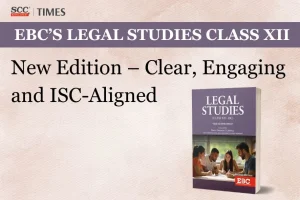
Legal Studies Class XII ISC by Dr Vijay Singh is the second in a series specially designed for students of Class XII, in strict alignment with the latest ISC syllabus (effective from 2024—25). While the content has been carefully structured to meet academic requirements, the book consciously extends beyond classroom learning. It seeks to provide readers with a broader understanding of law and its practical relevance, making it equally valuable for students, teachers, and general readers interested in the legal system.
The book is divided into nine comprehensive units, each further subdivided into chapters that cover a wide range of important legal themes. Concepts are explained in a lucid, engaging, and contemporary manner, with emphasis on clarity, relevance, and critical understanding. Whether used as an examination resource, a teaching aid, or an introductory guide to law, the book aims to offer meaningful insights to every reader.
Objective of Writing This Book
Legal Studies is offered as an elective subject in Classes XI and XII under both the CBSE and ICSE curricula in India. The introduction of this subject at the school level is a visionary step, as it provides students with an early orientation to legal education.
Legal education in India is a professional discipline regulated under the Advocates Act, 1961. While the subject is particularly beneficial for aspiring lawyers, it is equally important for students from all streams. Legal Studies offers a foundational understanding of laws that every citizen ought to know. The well-known maxim ignorantia juris non excusat—ignorance of law is no excuse—underscores the importance of legal awareness. Understanding the nature of law and legal systems is therefore essential for responsible citizenship.
Alignment with the Interdisciplinary Approach under NEP 2020
The National Education Policy (NEP) 2020 emphasizes an interdisciplinary approach and exploratory learning. It recognizes that contemporary societal challenges—such as access to clean water and sanitation, quality education and healthcare, infrastructure, energy, transportation, and environmental protection—require solutions grounded not only in science and technology but also in a deep understanding of social sciences and humanities (para 17.4).
NEP 2020 further highlights that legal education must be globally competitive while remaining rooted in constitutional values of social, economic, and political justice. Legal curricula should reflect socio-cultural contexts, the history of legal thought, principles of justice, jurisprudence, and human rights, while also embracing technological advancements and bilingual education where appropriate (para 20.4).
This book fully aligns with these objectives and fulfills the interdisciplinary vision envisioned under NEP 2020.
What Is the Book About?
The book opens with the law of crimes, offering an in-depth understanding of criminal liability, stages of crime, and major offences under the Bhartiya Nyaya Sanhita. The second unit introduces Alternative Dispute Resolution (ADR) mechanisms such as arbitration, mediation, and Lok Adalats as effective alternatives to litigation.
The third unit focuses on access to justice, examining the Legal Services Authorities Act, 1987, free legal aid, and institutional mechanisms that ensure justice for all. The fourth unit deals with the law of contract, explaining the formation and enforcement of legally binding agreements.
The fifth unit explores the law of torts, covering civil wrongs such as negligence, nuisance, and defamation. This is followed by transfer of property law, including key doctrines like lis pendens and election.
The seventh unit examines Fundamental Rights, Fundamental Duties, and the Directive Principles of State Policy, highlighting constitutional values and the State—citizen relationship, with special emphasis on Fundamental Duties.
The eighth unit discusses important laws, including human rights law and anti-corruption legislation, focusing on the Protection of Human Rights Act, 1993 and the Lokpal and Lokayuktas Act, 2013. The final unit introduces important legal maxims, familiarising students with Latin expressions commonly used in legal reasoning and judicial decisions.
About the Author
Dr Vijay Kumar Singh is Professor and Dean, Faculty of Law, SRM University, Sonepat. He has previously served as Head, School of Corporate Law at the Indian Institute of Corporate Affairs (IICA) under the Ministry of Corporate Affairs, Government of India, and has also worked with the Competition Commission of India (CCI).
Dr Singh has been associated with Hidayatullah National Law University, Raipur, and UPES Dehradun as faculty and academic administrator. A doctorate in law, he holds a science degree followed by law degrees, earning Gold Medals in both LL.B. and LL.M. from Nagpur University, and an MBA in HR from IGNOU.
He is a certified trainer in dispute management by CEDR, a mediator with ICADR, and a NCC “C” Certificate holder with ‘A’ Grade. He is the author of Corporate Power to Corporate Crimes: Understanding Corporate Criminal Liability in India and Legal Studies I, the first volume of this series.
An avid writer, Dr Singh has published extensively on subjects including corporate governance, insolvency, competition law, environmental law, CSR, IPR, human rights, and international trade. He has travelled widely across Europe, the UK, USA, and Asia, and is a frequent resource person for national and international training programmes.
He is a Life Member of several prestigious institutions, including IIPA, ISIL, ICADR, ILI, ICPS, and ICA, and an Associate Member of the European Law Institute (ELI).
Praise for the Book
I am confident that this book will serve as a dependable guide for students preparing for examinations, a useful resource for teachers, and an enlightening read for anyone interested in understanding the law. It is a commendable contribution to the cause of legal education at the school level and, by extension, to the development of an informed and conscious citizenry.
I congratulate Prof. (Dr) Vijay Kumar Singh for this scholarly yet accessible work and wish it the wide readership it truly deserves.
— Paramjit S. Jaswal
Vice Chancellor,
SRM University Delhi-NCR, Sonepat
Who Is the Book Meant For?
Legal Studies helps students develop awareness of legal concepts, public affairs, rights, and responsibilities as citizens. It nurtures essential skills such as communication, logical reasoning, critical analysis, and interpretation—qualities central to legal thinking and valuable across professions.
Law intersects with every field. Whether one is a business manager, designer, media professional, engineer, doctor, pharmacist, or software developer, a basic understanding of law and legal systems is indispensable. This book is therefore relevant not only to future lawyers but to all students preparing to engage meaningfully with society and their professions.
Conclusion
In an increasingly complex and interconnected world, legal awareness is no longer the preserve of legal professionals alone; it is an essential component of informed citizenship. This book seeks to demystify the law by presenting fundamental legal concepts in a structured, accessible, and engaging manner, while remaining firmly aligned with contemporary curricular and policy frameworks. By integrating doctrinal knowledge with constitutional values, socio-legal perspectives, and practical relevance, the book encourages learners to move beyond rote learning towards critical and reflective understanding.
Through its comprehensive coverage of core areas of law and its emphasis on access to justice, rights and duties, dispute resolution, and legal reasoning, the book aims to equip students with the intellectual tools necessary to understand and engage with legal institutions and processes. At the same time, it aspires to nurture responsible, aware, and ethically grounded citizens. As the second volume in this series, this book builds upon the foundation laid earlier and reinforces the idea that law is not merely a subject of study, but a living instrument that shapes society, governance, and everyday life.
A copy of the book can be bought here.