


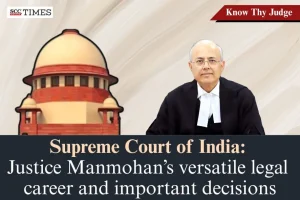
An alumnus of Campus Law School, Delhi, Justice Manmohan’s legal career boasts of versatility and as a Judge he has delivered a number of significant judgments concerning duty of the Government to ensure at the bare minimum that economically weaker sections have access to essential medicines even for rare diseases like enzyme replacement, right of every child to access digital education during the Covid-19 pandemic and creation of a universal administrative protocol by local bodies to deal with rescue and rehabilitation of children who are victims of human trafficking1 and addressing the issue of backlog of cheque bounce cases in the District Court.
Early Life and Education of Justice Manmohan
Justice Manmohan was born in Delhi on 17-12-1962, to late Jagmohan, a renowned bureaucrat-turned-politician who served as the Governor of erstwhile State of Jammu and Kashmir and the Lieutenant Governor of Delhi2.
He did his schooling from Modern School, Barakhamba Road and received his B.A. (Hons.) in History from Hindu College of University of Delhi.
Justice Manmohan attended Campus Law Centre, University of Delhi and received his LL.B. in 1987, and enrolled as an Advocate with the Bar Council of Delhi in the same year.
Legal Practice and Designation as Senior Advocate Post enrollment, Justice Manmohan practiced primarily in Supreme Court and Delhi High Court in Civil, Criminal, Constitutional, Taxation, Arbitration, Trademark and Service litigation. He also served as Senior Panel Advocate for the Government of India in High Court of Delhi and Supreme Court of India3. After nearly 15 years of practice, Justice Manmohan was then designated as Senior Advocate by the High Court of Delhi on 18-1-2003.
In his private practice, Justice Manmohan handled various important cases including Dabhol Power Company, Hyderabad Nizam’s Jewellery Trust matter, Claridge’s Hotel dispute, as well as Gujarat Ambuja Cement’s sales tax and Fatehpur Sikri encroachment matter.
Judgeship at Delhi High Court and the Supreme Court of India
After a thriving legal practice of 2 decades, Justice Manmohan stepped onto the next stage of career when he was appointed Additional Judge of High Court of Delhi on 13-3-2008 and was later elevated as Permanent Judge on December 17-12-2009.
After the elevation of the then Chief Justice of Delhi High Court, Justice Satish Chandra Sharma, to the Supreme Court, Justice Manmohan, on account of being the senior-most Judge of the High Court, was appointed as Acting Chief Justice of w.e.f. 09-11-2023.
The Supreme Court Collegium on 11-7-2024, recommended the name of Justice Manmohan as the next Chief Justice of the High Court of Delhi. With the recommendation pending before the Law Ministry, Justice Manmohan continued to discharge the duties of Acting Chief Justice. Then finally on 21-9-20244 , the Ministry notified the appointment of Justice Manmohan as the Chief Justice of his parent High Court.
Within a very short span of time, Justice Manmohan’s growth trajectory led to the hallowed halls of the Supreme Court. The Collegium on 28-11-2024, the Supreme Court Collegium headed by Justice Sanjiv Khanna, Chief Justice of India, recommended the appointment of Justice Manmohan as Judge of Supreme Court of India. On 3-12-2024, the President of India in exercise of powers under Art. 124(2) of the Constitution, appointed Justice Manmohan, as Judge of the Supreme Court of India, with effect from the date he assumes charge of his office. On 5-12-2024, Justice Manmohan, was sworn in as Judge of Supreme Court of India.
Important Supreme Court Judgments by Justice Manmohan
While considering this appeal challenging Bombay High Court’s decision to acquit the accused under Section 138 of the Negotiable Instruments Act, 1881 (NI Act), the Division Bench of Manmohan* and N.V. Anjaria, JJ., took judicial notice of the fact that despite repeated directions by the Court in various judgments, pendency of cheque bouncing cases under the NI Act in District Courts in major metropolitan cities of India continues to be staggeringly high. Thus, in view the massive backlog and the fact that service of summons on the accused in a complaint filed under Section 138 of the NI Act continues to be one of the main reasons for the delay in disposal of the complaints as well as the fact that punishment under the NI Act is not a means of seeking retribution but is more a means to ensure payment of money and to promote credibility of cheques as a trustworthy substitute for cash payment, the Court issued extensive Guidelines. [Sanjabij Tari v. Kishore S. Borcar, 2025 SCC OnLine SC 2069]
While considering this appeal whereby the accused challenged the dismissal of revision petition against the dismissal of his discharge application by Calcutta High Court, the Division Bench of N. Kotiswar Singh and Manmohan*, JJ., emphasised that where there is a pending civil dispute between the parties, the Police and the Criminal Courts must be circumspect in filing a chargesheet and framing charges respectively. The Court stated that, “In a society governed by rule of law, the decision to file a chargesheet should be based on the Investigating Officer’s determination of whether the evidence collected provides a reasonable prospect of conviction”. The Police at the stage of filing of Chargesheet and the Criminal Court at the stage of framing of Charge must act as initial filters ensuring that only cases with a strong suspicion should proceed to the formal trial stage to maintain the efficiency and integrity of the judicial system. [Tuhin Kumar Biswas v. State of West Bengal, 2025 SCC OnLine SC 2604]
In a significant matter the primary issue was whether Union of India after having issued a Notification under Section 12 of the Army Act, 1950 allowing induction of women in the Judge Advocate General (‘JAG’) branch, could have denied admission to the Petitioners who secured 4th and 5th rank in the merit list of women candidates in preference to Respondent 3 who secured 3rd rank in the merit list of men candidates, but obtained lesser marks than the female candidate placed at 10th in the Females Merit List. The Division Bench of Dipankar Datta and Manmohan*, JJ., opined that Executive cannot restrict number of women candidates and/or make a reservation for male officers under the guise of ‘extent of induction’ by way of a policy or administrative instruction. [Arshnoor Kaur v. Union of India, 2025 SCC OnLine SC 1668]
In a Special Leave Petition challenging the judgment of the Delhi High Court, which upheld the conviction of a lawyer for using abusive and inappropriate language towards a female judge during proceedings in a challan matter, the Division Bench of Prashant Kumar Mishra and Manmohan, JJ. declined to grant any relief to the petitioner and refused to interfere with the impugned orders. However, at the request of counsel for the petitioner, the Court granted the petitioner two weeks’ time to surrender. [Sanjay Rathore v. State (Govt. of NCT Delhi), 2025 SCC OnLine SC 1351]
While considering the instant appeal wherein the appellant claimed that Gujarat High Court had erroneously held that the date for determination of market value of yet to be acquired, He-0-11-41 sq. meters land shall be 01-1-2014 i.e., the date of commencement of the Right to Fair Compensation and Transparency in Land Acquisition, Rehabilitation and Resettlement Act, 2013 (2013 Act); the Division Bench of Dipankar Datta and Manmohan*, JJ., opined that proviso to Section 26(1) of the 2013 Act lays down the methodology for computing the market value of the land on the date of the acquisition notification. The use of the word “shall” in Section 26(1) proviso is reflective of the legislative mandate that Section 11 Notification is the date for determination of the compensation. [Sumitraben Singabhai Gamit v. State of Gujarat, 2025 SCC OnLine SC 832]
In a criminal appeal against Gauhati High Court’s decision, whereby, the appellant truck owner had sought release of his vehicle which was seized by the police on recovery of heroin after his application was dismissed by Trial Court, the Division Bench of Sanjay Karol and Manmohan, JJ. allowed the appeal and directed the Trial Court to release the vehicle in question in the interim on superdari after preparing a video and still photographs of the vehicle and after obtaining all information/documents necessary for identification of the vehicle, which shall be authenticated by the Investigating Officer, owner of the Vehicle and accused by signing the same. Further, the Court directed that the appellant shall not sell or part with the ownership of the vehicle till conclusion of the trial and shall furnish an undertaking to the Trial Court that he shall surrender the vehicle within one week of being so directed and/or pay the value of the vehicle (determined according to Income Tax law on the date of its release), if so ultimately directed by the Court. [Bishwajit Dey v. State of Assam, (2025) 3 SCC 241]
Landmark Delhi High Court Judgments
In a Public Interest Litigation (‘PIL’) filed to seek issuance of directions to the Union of India (respondent) to restore legal protection against non-consensual sexual acts as was provided under the now-repealed Section 377 of the Penal Code, 1860 (‘IPC’) to ensure the safety and dignity of individuals, especially those from the LGBTQIA+ community, a Division Bench of Manmohan, ACJ. and Tushar Rao Gedela, J. directed the Union of India to treat the present petition as a representation and to decide the same as expeditiously as possible. [Gantavya Gulati v. Union of India, 2024 SCC OnLine Del 5990]
In an appeal filed under Clause X of the Bombay High Court (Letters Patent) Act, 1866 to challenge the judgment dated 30-05-2019 which dismissed a previous writ petition filed by the appellant on the ground that he was not entitled to any interest on the ex-gratia compensation of Rs. 1,00,000/- awarded to him, a Division Bench of Manmohan, ACJ. and Tushar Rao Gedela, J.* said that since the rehabilitation policy of 2006 was to be implemented in a time-bound manner, failure to do so could not be treated lightly and held that the appellant was entitled to interest at 10 percent per annum on the amount of compensation paid to him with effect from 16-01-2006 till 08-04-2016. [Gurnam Singh v. Union of India, 2024 SCC OnLine Del 5685]
While perusing a report by the Delhi State Legal Services Authority (‘DSLSA’) dated 03-09-2024, a Division Bench of Manmohan, ACJ., and Tushar Rao Gedela, J. opined that the absence of a documentation mechanism by land-owning agencies post urbanization disproportionately affects the urban poor and thus, directed the Registry to register the present report as a suo motu writ petition. [Court on its own motion v. L&DO, Ministry of Urban Development]5
The present appeal was filed challenging the judgment dated 03-05-2024, passed by the Single Judge, whereby an application under Section 92 of the Civil Procedure Code, 1908 (‘CPC’) seeking leave to institute the subject suit, filed by the Respondents 1 and 2 was allowed. The Division Bench of Manmohan, ACJ* and Tushar Rao Gedela, J., stated that the appellant-society was of a charitable nature, as it had been formed primarily for serving the under-privileged sections of the society, in particular, patients suffering from tuberculosis. The Court agreed with the view of the Single Judge that all the donations, gifts etc. made to the appellant-society were property entrusted to it, by reason of which the society acquired the character of a ‘constructive trust’. Thus, the Court stated that the impugned judgment did not call for an interference and accordingly, dismissed the present appeal. [Operation Asha v. Shelly Batra, 2024 SCC OnLine Del 5936]
In an appeal filed by appellant challenging the order dated 12-03-2024 (‘impugned order’) passed by the Single Judge, whereby the appellant’s writ and review petition seeking imposition of penalty on the officials concerned under Section 20 of the Right to Information Act, 2005 (“RTI Act”) had been dismissed, the Division Bench of Manmohan*, ACJ. and Tushar Rao Gedela, J., dismissed the appeal and held that information seeker had no locus standi in penalty proceedings under Section 20 of the RTI Act. [Sunny Sachdeva v. ACP North RTI Cell, 2024 SCC OnLine Del 4961]
In an appeal filed by Pracheen Shiv Mandir Avam (‘appellant’) against the impugned judgement, whereby the Single Judge ordered the Delhi Development Authority (‘DDA’), the respondent, to remove idols and encroachments from the Yamuna Bank, the Division Bench of Manmohan*, ACJ. and Tushar Rao Gedela, J., dismissed the appeal and observed that the construction of temple over the land was unauthorized and the DDA had proper authority to remove any such unauthorized construction or structures. [Pracheen Shiv Mandir Avam Akhada Samiti v. DDA, 2024 SCC OnLine Del 4845]
A petition was filed under Article 226 of the Constitution of India seeking a declaration that Regulation 2(i) (‘impugned Regulation’) of the Food Safety and Standards (Labelling and Display) Second Amendment Regulations, 2022 (‘Second Amendment Regulations’) published on 11-10-2022 be declared as illegal and violative of Articles 14, 19(1)(a) and 19(1)(g) of the Constitution of India. Petitioners also seek a declaration that the impugned Regulation is ultra vires of the Food Safety and Standards Act, 2006 (‘FSS Act’).
A division bench of Manmohan, ACJ., and Manmeet Pritam Singh Arora, J., dismissed the writ petition, affirming the validity of the Food Safety and Standards (Packaging and Labelling) Amendment Regulations, 2023, emphasizing their alignment with public health protection and the adequacy of compliance timelines, while rejecting claims of discrimination or disproportionate impact. [Dharampal Satyapal Ltd. v. Union of India, 2024 SCC OnLine Del 4702]
An appeal was filed challenging the order dated 30-05-2024 passed by the Single Judge whereby the writ petition filed by the appellant was dismissed on the ground that the petition was replete with unsubstantiated and reckless allegations and tainted with malafides and oblique motives. A division bench of Manmohan, ACJ., and Tushar Rao Gedela, J., dismissed the appeal and directed the local SHO to monitor the appellant and take appropriate action if required in line with the Mental Healthcare Act, 2017. [Deepak Kumar v. Election Commission of India, 2024 SCC OnLine Del 4562]
In a petition filed to seek directions to respondents to conduct a door-to-door survey to collect data about the total number of senior citizens in Delhi and for directions to construct a new senior citizen home in every district of Delhi, the Division Bench of Manmohan, ACJ and Manmeet Pritam Singh Arora, J. directed the Chief Secretary to decide the matter in accordance with law within twelve weeks. [Salek Chand Jain v. State (NCT of Delhi), 2024 SCC OnLine Del 4410]
In the present petition filed under Article 226 of the Constitution seeking to quash the entire bidding process dated 07-05-2024 and to direct the respondents to provide reasons for rejecting bids and to pass speaking order on the grounds for the disqualification, the Division Bench of Manmohan, ACJ*., and Manmeet Pritam Singh Arora, J., held that the petitioner having participated in the impugned tender process was entitled to know the reasons for the disqualification of their bid.
The Court directed the respondents to pass a speaking order and communicate the same to the petitioner within two weeks. [JBMD Enterprises v. Sr. Dy. CGDA AN, 2024 SCC OnLine Del 4281]
In a Public Interest Litigation (‘PIL’) addressing a severe lapse in fire safety norms which led to a tragic incident at the ‘Baby Care New Born Hospital’ in Vivek Vihar, New Delhi, leading to the death of seven new-borns, the Division Bench of Manmohan, ACJ. and Manmeet Pritam Singh Arora, J., directed the State and its authorities to treat the PIL as a representation and to decide it by way of a reasoned order in accordance with law. Further, the Court mandated Respondents 1 and 2 to file an Action Taken Report (‘ATR’) within eight weeks. [Yugansh Mittal v. State (NCT of Delhi), 2024 SCC OnLine Del 4315]
A PIL was filed highlighting the fact that 2,69,488 students studying in the schools run by Directorate of Education, GNCTD and 3,83,203 students studying in the school run by Municipal Corporation of Delhi (‘MCD’) are being deprived of the statutory benefits like uniform, writing material, text book, stationery items, school bags, scholarship, etc. as available to them under the Right of Children to Free and Compulsory Education Act, 2009 (‘RTE Act’) read with Delhi School Education Act, 1973 and Delhi Right of Children to Free and Compulsory Education Rules, 2011 (‘RTE Rules’).
A division bench of Manmohan ACJ., and Manmeet Pritam Singh Arora, J., directed incur the expenditure required for fulfilling the said obligations forthwith without being constrained by the expenditure limit of Rs. 5 crores subject to statutory audit. [Social Jurist, A Civil Rights Group v. State (NCT of Delhi), 2024 SCC OnLine Del 2983]
The Court initiated suo moto proceedings due to certain incidents reported from time to time that reflected an acute lack of medical services in Delhi. The Division Bench of Manmohan, ACJ.*, and Manmeet Pritam Singh Arora, J., after considering the medical field to be specialized which required experience, appointed a Committee of experts (‘the Committee’) to make specific and concrete recommendations on various issues, for instance, lack of timely availability and accessibility of ICU beds for patients in need of emergent care, non-admission of patients in the hospitals and large number of unfulfilled vacancies in hospitals, which could be considered by the Court to pass appropriate order. [Court on its Own Motion v. Union of India, 2024 SCC OnLine Del 938]
Delhi HC upholds constitutional validity of Section 115-BBE of Income Tax Act, 1961; Says ‘cannot be held unconstitutional on apprehension of misuse’
In a writ petition filed to challenge the orders dated 25-07-2022, passed under Section 148-A(d) of the Income Tax Act, 1961 (‘the Act’), the Division Bench of Manmohan, ACJ* and Mini Pushkarna, J., opined that, unless the contrary intention was proved, it must be presumed, that administration and application of a particular law would be done not with an evil eye and unequal hand. Thus, the Court opined that, at the present stage, Section 115-BBE of the Act could not be held unconstitutional on the ground that there was an apprehension of misuse of the provision. [Triveni Enterprises Ltd. v. CIT, 2023 SCC OnLine Del 8343]
A batch of petitions was filed by Uber India Systems Private Limited (Petitioner 1), Pragatisheel Auto Rickshaw Driver Union (Petitioner 2’) and IBIBO Group Private Limited along with Make My Trip (India) Private Limited (Petitioner 3) challenging the Clauses (iii) and (iv) of notification relating to Central Tax (Rate) and Clauses 1(i) and 2(i) of relating to Central Tax (Rate) dated 18-11-2021 (impugned Notifications) issued by Union of India (respondent), as ultra vires to the Constitution and Section 9(5) and 11 of Central Goods and Service Tax Act, 2017 (CGST Act). A division bench of Manmohan and Manmeet Pritam Singh Arora, JJ., held that the impugned clauses are not violative of Articles 14, 19(1)(g), and 21 of the Constitution as petitioners 1, 2, and 3 have failed to prove that they are similarly placed with the individual suppliers to whom the exemption have already been granted, this Court is of the opinion that the Respondents are well within their purview to deny the exemption to the ECOs like the Petitioner 1 and 3 in view of the impugned Notifications. [Uber India Systems (P) Ltd. v. Union of India, (2023) 2 HCC (Del) 542]
1. https://www.sci.gov.in/judge/justice-manmohan/
2. Justice Manmohan takes oath as Chief Justice of Delhi High Court: 10 Key facts about him | Today News (livemint.com)
3. Hon’ble Mr. Justice Manmohan | New Delhi District Court, Delhi | India (dcourts.gov.in)
4. Order of appointment of Shri Justice Manmohan, Judge, Delhi High Court as Chie Justice of Delhi High Court (21.09.2024) | Department of Justice | India (doj.gov.in)
5. W.P.(C) No. ____ of 2024