


Disclaimer: This has been reported after the availability of the order of the Court and not on media reports so as to give an accurate report to our readers.
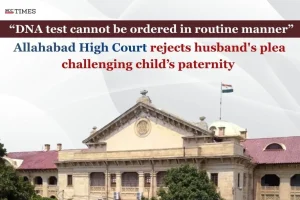
Allahabad High Court: In a revision filed by the husband against the order passed by the Additional Sessions Judge in a criminal appeal under Section 29 of the Protection of Women from Domestic Violence Act 2005 (‘Domestic Violence Act’) rejecting the DNA test, a Single Judge Bench of Chawan Prakash, J., held that it is settled principles of law that an order for DNA test could not be given in routine manner and could be directed in specific circumstances where any person proved that there was no chance for cohabitation between the parties during the relevant period. Thus, the Court upheld the impugned order.
Background
In the present case, the marriage was solemnized between the parties in 2008. The wife, a teacher at Inter College, allegedly lived at the matrimonial home for one week and thereafter stayed mostly at her parents’ house, visiting occasionally for short durations as she did not want to live with him due to his rural background. In December 2012, she gave birth to a daughter, and the husband alleged that she had last visited his home in May 2011.
Eventually, when the wife filed a case under Section 12 of the Domestic Violence Act, the husband challenged the paternity of the daughter and sought a DNA test which was rejected by the Trial Court and upon appeal, the rejection was upheld. Thus, he approached the High Court.
Analysis and Decision
Considering Section 112 of the Evidence Act 1872, the Court stated that a successive presumption was established in favour of the legitimacy of a child born during subsistence of a valid marriage and awarded presumption was a legal recognition that the husband was the father of the child. This presumption also operated against unwarranted intrusion into the illegally produced status of illegitimacy, thereby ensuring a familiar relationship and protection of the child.
The Court further stated that the said presumption operated as conclusive proof of legitimacy of the child born from a valid marriage, provided that the parties had access to each other at the relevant time. This presumption denoted affirmation established by evidence that the parties to the marriage had no occasion to remain away from each other at the time when the child could have been begotten. Since the law favoured legitimacy, the burden of proof was cast upon the person who disbelieved the presumption. Further, the Court stated that “Non-access denotes not merely absence of access but even where cohabitation existed, non-access may arrive due to impotency or absence during relevant period.”
Referring to Ivan Rathinam v. Milan Joseph, 2025 SCC OnLine SC 175, the Court held that it is a settled principle of law that an order for DNA test cannot be given in routine manner and can be directed in specific circumstances where any person proves that there was no chance for cohabitation between the parties during the relevant period.
In the present case, the husband had merely stated that his wife remained in matrimonial house for few days and that child was not his biological child. Noting that the trial court as well as the appellate court gave specific findings and that there was no illegality in the orders passed by both, the High Court dismissed the revision on the ground that it lacked merit.
[Ramraj Patel v. State of UP, 2025 SCC OnLine All 7849, decided on 21-11-2025]
Advocates who appeared in this case :
For the Revisionist: Virendra Singh and Virendra Singh Yadav
For the Opposite Party: G.A. and Shailesh Kumar Tripathi