


On Day 2 of the 5th ICA International Conference on “Arbitration in the Era of Globalization- Legal Technology, Economic Development & Cross-Border Disputes,” experts explored some key topics on the theme, such as harmonization of arbitration and mediation, Alternative Dispute Resolution (ADR) mechanisms as catalyst for economic growth and investor confidence, AI, anti-arbitration injunctions, and more.
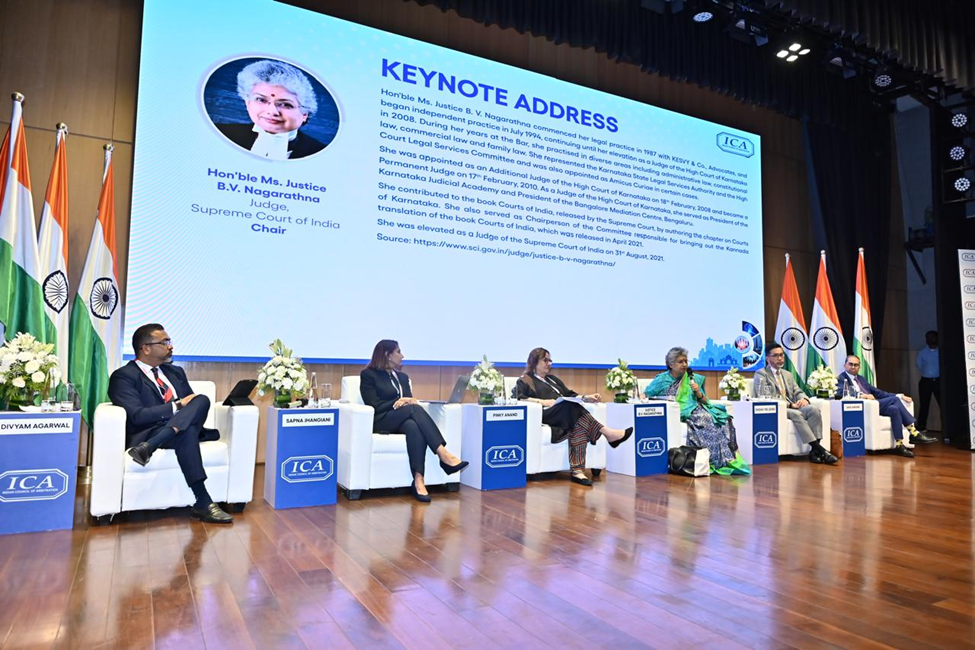
Keynote address by Justice B.V. Nagarathna, Judge, Supreme Court of India:
At the outset, Justice Nagarathna highlighted the growing transition from traditional litigation to ADR mechanisms such as arbitration and mediation, which offered flexibility, efficiency, confidentiality, and party-centric solutions. She emphasized that ADR reflects a broader shift in legal thinking about the nature of dispute resolution, recognizing disputes as not merely legal, but also social, commercial, and relational questions that need more voluntary solutions than litigation.
“Arbitration and mediation, therefore, are not merely alternatives to litigation but integral components of a modern and responsive justice system.”
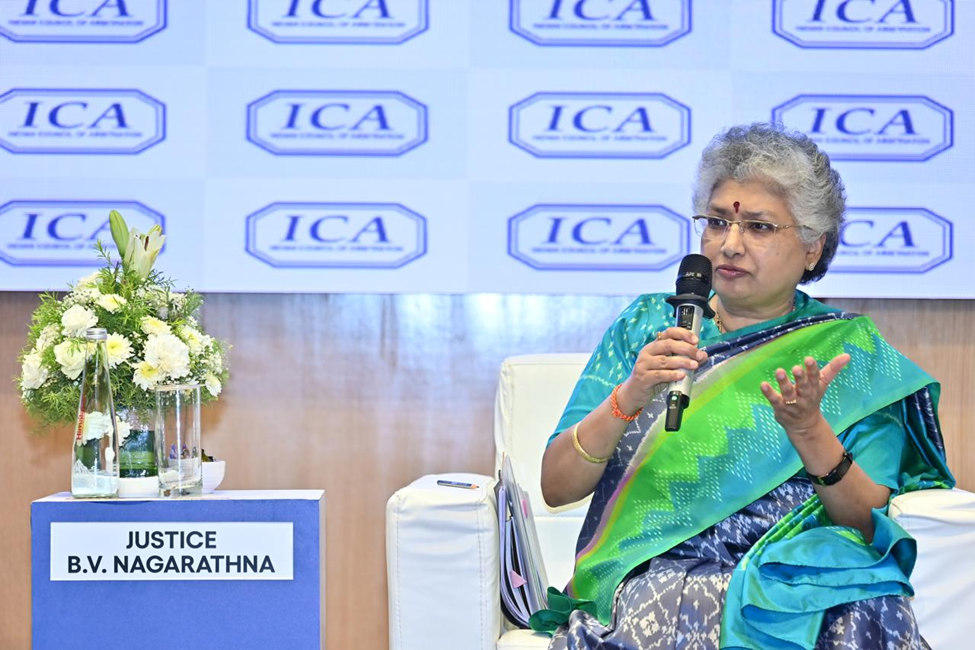

She mentioned how arbitration had become the preferred mechanism for cross-border disputes due to its neutrality, flexibility, confidentiality, expertise, party autonomy, and enforceability under the New York Convention, especially in certain sectors like technology, infrastructure and construction, telecom, etc. Furthermore, in the present economic system, international arbitration and investment arbitration have become significant, especially in bilateral investment treaties (BITs), as they provide foreign investors with fair and equitable treatment, protection against unlawful expropriation, and access to neutral dispute resolution mechanisms.
Regarding mediation, Justice Nagarathna distinguished between the two mechanisms, stating that mediation had a different philosophy, i.e., it facilitated dialogue between parties, preserved relationships, focused on interests rather than positions, and promoted durable and mutually acceptable settlements. While it was often used in family or community conflicts, she highlighted how it was proving effective in commercial relationships and intellectual property disputes.
“The increasing institutionalization of mediation in legal systems across the world reflects a recognition that consensus-based solutions often provide deeper and more sustainable justice than adversarial outcomes.”
She added that while the Mediation Act, 2023, was a significant step, it was yet to take off and lacked effective implementation, including non-notification of provisions and the absence of the Mediation Council of India.
On the aspect of various forms of ADR mechanisms, she briefly touched upon the following:
-
Mediation-Litigation (MED-LIT): She critically examined the implementation of Section 12A of the Commercial Courts framework, stressing that pre-litigation mediation must not become a mere procedural formality. She added that there must be synergy between mediation centers and legal services authorities to ensure the same.
-
Mediation-Arbitration (MED-ARB): She stated that in this process, the parties usually resolve their disputes in mediation and then go into arbitration to draw up the terms of the binding settlement. She noted its ability to balance flexibility with certainty, enabling parties to explore amicable settlement without forgoing the assurance of adjudication. She emphasized institutional design, party consent, and procedural safeguards for ensuring its success.
-
Arbitration-Mediation-Arbitration (ARB-MED-ARB): This mechanism, she stated, was an institutionally refined hybrid wherein the parties may first initiate arbitration, thereby securing jurisdiction and procedural certainty, after which the proceedings may be paused to allow for mediation. If the parties successfully settle, it may be recorded as an arbitral award under the Act. If not, they will arbitrate.
Justice Nagarathna advocated for a mature legal system with a multi-layered dispute resolution framework, where negotiation, mediation, and arbitration coexist and are applied at different stages of disputes to deliver efficient and context-sensitive solutions.
She underscored that though ADR had transformed the dispute resolution landscape, there were practical challenges such as enforceability issues, delays, rising costs in arbitration, lack of trust in arbitrators/mediators, adversarial mindset of parties and counsels, and the need for well-trained arbitrators.
“As India continues to refine its ADR framework, a nuanced and context-sensitive approach will be essential in realizing the full potential of these mechanisms and in fostering a more responsive and effective system of justice.”
In conclusion, Justice Nagarathna expressed hope for the insightful discussions that will unfold in the conference.
SESSION 1: Navigating the ADR Quagmire: Harmonizing Arbitration & Mediation
The first session of the conference consisted of esteemed professionals namely, Ms. Sapna Jhangiani, King’s Counsel (KC) England & Wales; Judge, DIFC Court, UAE & Chair of COMBAR India & Asia Committee; Mr. Chong Yee Leong, International Arbitration Practice, Co-head & Partner Allen & Gledhill & Vice Chairman SIAC, Singapore; Mr. Divyam Agarwal, Partner, ICA & JSA; and Mr. Sahil Narang, Partner, Dispute Resolution Practice, Khaitan & Co. Furthermore, the panel was moderated by Dr. Pinky Anand, Judge, Bahrain International Commercial Court; Senior Advocate, Supreme Court of India & Former Additional Solicitor General of India.
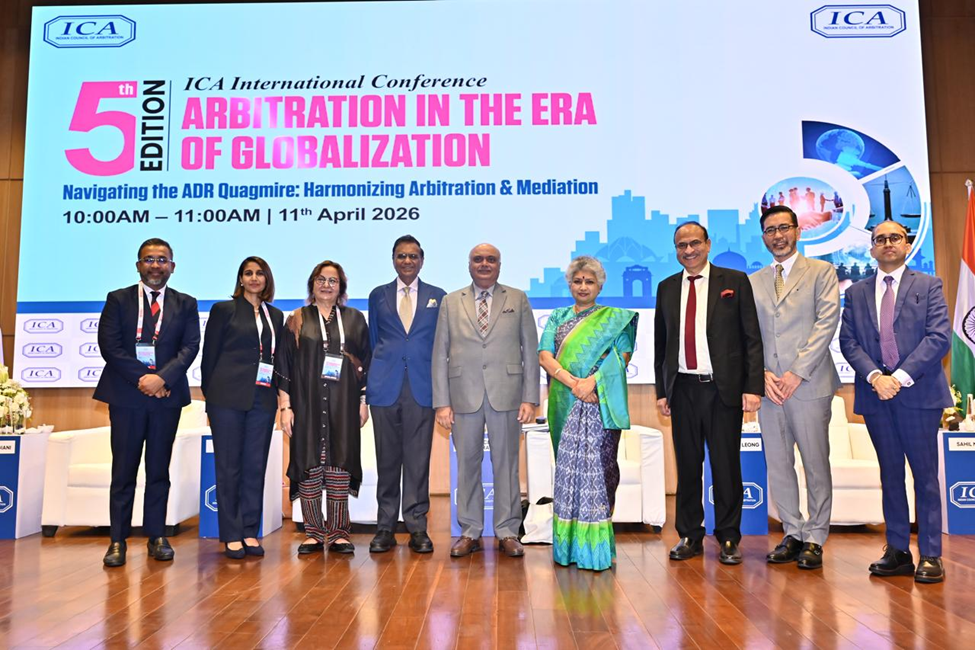
Taking over from Justice Nagarathna, Ms. Pinky Anand emphasized the urgent need for faster dispute resolution in a rapidly changing global economy and how litigation was expensive for both government and private actors. She advocated for integration of arbitration and mediation to reduce costs and improve efficiency, and raised key questions such as mandatory adoption of mediation, double hatting, etc.
Ms. Anand also agreed with Justice Nagarathna’s suggestions regarding a multi-stage dispute resolution mechanism and the need to kickstart the Mediation Act.
Thereafter, she opened the floor for opening comments.
Facilitating Mediation as Arbitrators: Ms. Sapna Jhangiani
At the outset, Ms. Jhangiani drew from ICC studies stating that users wanted dispute prevention tools, flexibility across ADR mechanisms, and arbitrators facilitating settlements. She stated that now arbitrators were increasingly expected to encourage mediation, including at early procedural stages. Several surveys revealed that nearly 80% of practitioners support arbitrators playing a role in settlement facilitation. In fact, users preferred to know their ADR options in the first case management meeting. Thus, this aspect was worth exploring.
Evolution of Arbitration–Mediation: Mr. Chong Yee Leong
Mr. Long reflected on the historical development of mediation and explained how it became integrated into arbitration through pre-arbitral multi-tier contracts, especially in infrastructure projects. He stated that though mediation had benefits like maintaining parties’ relationship, it also had a few issues like mediated settlements lacked direct enforceability. Thus, hybrid models like ARB-MED-ARB were introduced by institutes like Singapore International Arbitration Centre (SIAC) to address such deficiencies.
He remarked that this was how the relationship between mediation and arbitration had evolved, and arbitral institutes had started looking at mediation as a possible solution for their users, for example, the SIAC introduced its ARB-MED-ARB Rules, 2025.
Indian Market Realities: Mr. Sahil Narang
Mr. Narang began by providing some statistics. He stated that the current satisfaction rate for domestic arbitration among Indian businesses was a low 40 per cent and government was now removing arbitration clauses from their contracts or limiting their scope. This raised concerns about the future as well as the use of arbitration and underutilization of other mechanisms like negotiation, mediation, etc. Thus, he suggested that practitioners needed to advise their clients on choosing the most appropriate dispute resolution mechanism, not default to arbitration.
Regarding mediation, he stated that India was not yet at the level of the mediation protocols adopted by other countries, but the Mediation Act was a step ahead and it should be implemented soon. He also advocated for India to adopt the Singapore Convention on Mediation, which would address the issue of enforcement of mediation settlement agreements.
Practical Challenges & Harmonization: Mr. Divyam Agarwal
At the outset, Mr. Agarwal spoke about how there was a need to change mindset for harmonizing mediation and arbitration, mediation and litigation, or all three in a case. However, there were some key barriers such as clients equating mediation with weakness, tokenistic compliance with mediation requirements, lack of empowerment in government officers involved in arbitration, preference for adversarial “fight-it-out” approach, etc.
He suggested that one solution could be introducing mediation at the right time when the hostility on both sides had reduced and before sinking money fighting the dispute. Underlining the fact that one settlement mechanism is not sufficient for all disputes, he stated that these methods had to be harmonized rather than be treated as strict independent mechanisms.
Thereafter, the panel delved into an enriching discussion on the advantages of ADR mechanisms, educating clients on the best mechanism, code of conduct of arbitrators and mediators, flexibility between ADR options at different stages of dispute, and more.
SESSION 3: The Future of Arbitration: AI and Legal Technology in a Digital Era
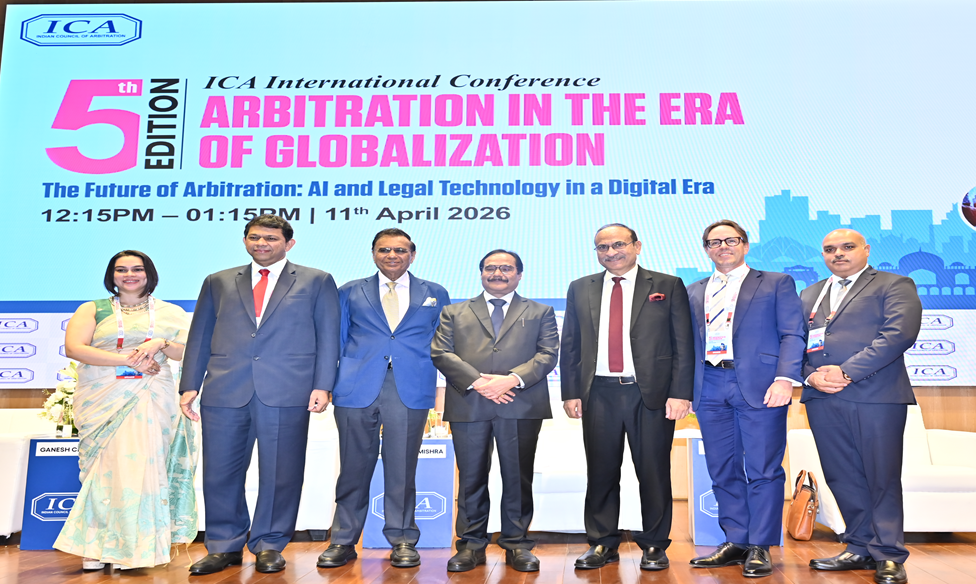

Delivering the keynote address, Justice Prashant Kumar Mishra, Judge, Supreme Court reflected on the changing landscape of arbitration in light of technological developments, particularly artificial intelligence and digital tools. He noted that arbitration is entering a new phase one driven by algorithms, data and digital intelligence, while also tracing the evolution of dispute resolution in India from traditional systems to modern statutory frameworks.
Referring to the dynamic nature of law, he cited:
“If the law fails to respond to the needs of the changing society, then either it will stifle the growth of the society and choke its progress, or if the society is vigorous enough, it will cast away the law which stands in the way of its growth.”
He observed that arbitration today is dealing with “complex commercial disputes, voluminous documentation, and cross-border challenges,” making the role of AI increasingly significant. According to him, AI “has the potential to revolutionize the field of online dispute resolution” by enhancing efficiency, reducing costs, and accelerating processes. At the same time, he cautioned against over-reliance on technology, highlighting concerns including data privacy, lack of human judgment, explainability, and cybersecurity risks. He noted:
“AI can assist, but it cannot be trusted blindly.”
He further stressed that arbitration inherently involves fairness and ethical reasoning that AI cannot replicate, emphasising that human judgment remains central. Referring to India’s evolving approach, he highlighted principles such as transparency, accountability, and protection of human values, concluding that technology must support, rather than replace, human decision-making.
Moderator Mr. Ganesh Chandru, Partner, Disputes Resolution Practice, Dua Associates, India contextualised the discussion by highlighting India’s rapid technological growth and its impact on dispute resolution. He emphasised that concerns surrounding time and cost continue to dominate arbitration discourse and illustrated this through a practical anecdote reflecting client concerns over legal fees.
He observed:
“Technology and AI can bridge in a great way so that the disputes are resolved in a cost-efficient manner.”
He also underscored that while technology is transforming processes, the core of dispute resolution, advocacy and persuasion, remains irreplaceable.
Counsel Perspective: Use of AI in Practice
From the perspective of counsel, Dr. Marc D. Veit, International Arbitration Practice, Partner LaLive, Switzerland provided a practical account of AI usage across different stages of arbitration, including client interactions, drafting, document management, and hearings. He highlighted tools that assist in transcription, summarisation, and document analysis, significantly improving efficiency in complex, document-heavy disputes.
At the same time, he cautioned against over-reliance on such tools, remarking:
“If you ask Copilot to improve rubbish, you will simply get beautifully looking and polished rubbish back.”
He emphasised that AI cannot replace structured thinking and legal reasoning, and that responsibility ultimately lies with counsel to verify outputs generated by such systems.
Arbitrator’s Perspective: Virtual Hearings and AI
Providing an international perspective, Ms. Olga BoltenkoFCIArb, Founder & Partner Boltenko Arbiters, Russia & Hong Kong discussed the growing prevalence of virtual hearings and the role of AI in arbitration proceedings. She noted that virtual hearings have become a “dominant fixture” due to their efficiency and cost advantages. While acknowledging that AI can assist in transcription, summarisation, and case management, she warned:
“Without human supervision, AI is very dangerous and it’s prone to mistakes.”
She also highlighted concerns relating to witness credibility, confidentiality, and procedural fairness in virtual settings, stressing the need for robust protocols and safeguards.
In-House Counsel Perspective: Changing Dynamics
From an in-house perspective, Ms. Mehak Oberoi, Head Legal, GE Vernova, Hydro APAC highlighted a significant shift in control within arbitration processes due to increased access to data and AI tools. She noted that companies are no longer entirely dependent on external counsel for strategy formation. She further observed that while technology may reduce reliance on external counsel for certain tasks, it does not necessarily reduce overall costs. Instead, costs are being redistributed through investments in internal capabilities and technological infrastructure. She also emphasised that data has become both “an asset and a liability” due to its accessibility and potential exposure.
Expert Perspective: Efficiency and Limits of AI
From the perspective of expert witnesses, Mr. Mayank Singh Thakur,Sr. Partner & Country Head, MASIN India, discussed the role of AI in handling voluminous documentation and complex datasets. He highlighted its effectiveness in document segregation, case mapping, and data extraction in large-scale arbitrations.
He stated:
“The question is no longer whether to use AI or not, what we have to answer now as an expert, how to use it.”
He emphasised that while AI enhances efficiency, it cannot replace expert judgment or decision-making. He cautioned against risks such as incorrect outputs and hallucinations, noting:
“AI may give incorrect information, one should be very careful and should not fall trap into the AI hallucination.”
He stressed that credibility and independence of experts must remain paramount, and that AI should assist, not determine conclusions.
In his concluding remarks, Justice Mishra reflected on the broader implications of integrating AI into arbitration, particularly from a judicial perspective. He raised an important question on whether AI would ultimately simplify or complicate judicial decision-making when arbitral awards are brought before courts.
He concluded:
“At the end of the day, it is the humans which will control the AI, which will guide the AI and which will decide which way the AI should go in future.”
The session concluded with a shared understanding that while AI and legal technology are reshaping arbitration, human judgment, accountability, and ethical reasoning will remain foundational.
SESSION 4: Policing Arbitration: Do Anti-Arbitration Injunctions Help or Hurt India’s Global Standing?
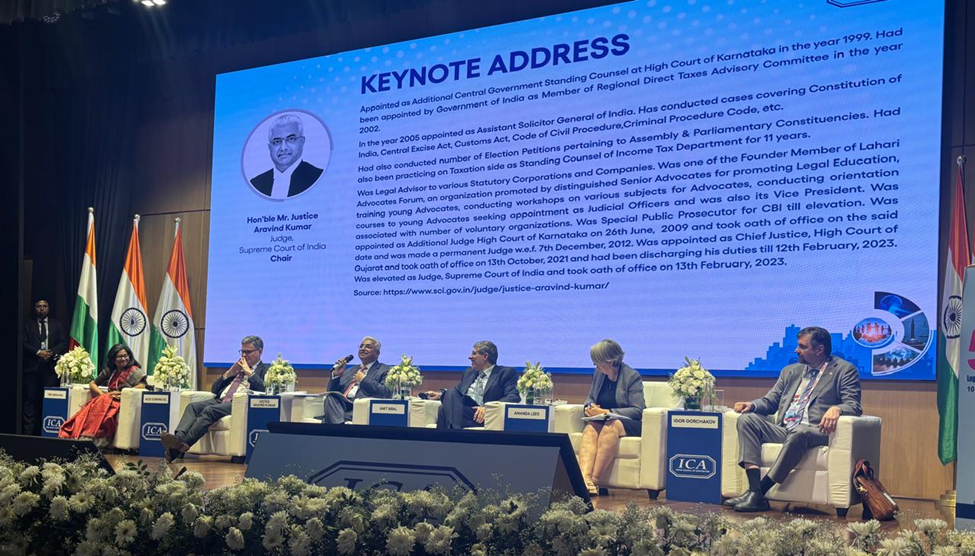
Opening the session, Mr. Amit Sibal, Senior Advocate, Supreme Court & Associate Member, 3VB, London framed the discussion as one extending beyond technical doctrine to a deeper inquiry into the balance between party autonomy and judicial intervention. He emphasised that anti-arbitration injunctions must be evaluated through the lens of legitimacy versus abuse.
He stated:
“A conventional view of party autonomy is that parties have chosen a particular mode of dispute resolution as arbitration, but when circumstances arise where the very integrity or fairness of the arbitration comes into question, then a court might take a view legitimately that even to promote party autonomy, it might be necessary, in very exceptional circumstances, to grant an anti-arbitration injunction.”
He further highlighted that cross-border disputes often involve multiple parallel proceedings, making such injunctions powerful practical tools rather than merely doctrinal constructs.
Indian Position on Anti-Arbitration Injunctions
Ms. Tine Abraham, Partner, Dispute Resolution & Arbitration, Trilegal explained that while Indian jurisprudence recognises a structured framework, its application remains uncertain.
She noted:
“There is a framework which is set, where you look at an anti-arbitration injunction, when it is vexatious or oppressive.”
However, she clarified that predictability remains elusive due to interpretative variations: She emphasised that the doctrine is inherently fact-sensitive and highlighted the need for consistency:
“The similar fact situation does not lead to a situation where you have an anti-arbitration injunction in one case, and in the other there is no such injunction being granted or vice versa.”
MSA Global and the Problem of Multi-Forum Litigation
The discussion on MSA Global revealed the complexities arising from parallel proceedings and conflicting judicial approaches. Ms. Abraham pointed out that the case involved institutional scrutiny, supervisory jurisdiction of the seat court, and intervention by a domestic court, all leading to divergent outcomes.
She observed:
“If you have enough checks and balances, do you need an anti-arbitration injunction to be granted by a foreign court?”
Her remarks underscored the importance of respecting the supervisory role of the seat court and maintaining comity between jurisdictions. She cautioned that interference by a foreign court risks undermining the arbitral process, especially where the seat court has already exercised jurisdiction.
Singapore’s Approach: Strict Non-Intervention
Providing the Singapore perspective, Ms. Amanda Lees, International Arbitration Partner, King & Wood Mallesons, Singapore, detailed how the Singapore High Court addressed the MSA Global dispute, highlighting Singapore’s strong pro-arbitration stance.
She explained:
“The Singapore Court held that the Delhi Court had very little residual jurisdiction and no jurisdiction to injunct the continuance of a validly commenced arbitration.”
Ms. Lees emphasised that Singapore courts adhere strictly to the Model Law framework, particularly Article 5, which limits judicial intervention. As a result they take a very dim view on anti-arbitration injunctions. She further clarified that while the possibility of such injunctions is not entirely excluded, it would arise only in extremely narrow situations, such as where the arbitration agreement is invalid or inapplicable.
UK Perspective: Deference to Arbitral Process
From an English law perspective, Mr. Alex Gunning KC, Barrister, One Essex Court, London, indicated that the English courts would likely have aligned with the Singapore approach. He explained that English courts would rely on statutory remedies, such as removal of arbitrators or challenges to awards, rather than granting anti-arbitration injunctions that disrupt the arbitral process. He characterised such injunctions as “vexatious and oppressive.”
Mr. Gunning also highlighted broader themes emerging from MSA Global, including issues relating to governing law of arbitration agreements, disclosure obligations of arbitrators, and the availability of injunctive relief, all of which continue to evolve in arbitration jurisprudence.
UAE Perspective: Pro-Arbitration but Enforcement Complexities
From the UAE perspective, Mr. Igor Gorchakov, Partner, Disputes Resolution, Al-Tamimi& Co., UAE described the jurisdiction as strongly pro-arbitration, particularly in its civil law courts where this concept simply doesn’t exist.
However, he introduced an important dimension by discussing the enforcement of foreign anti-arbitration injunctions, especially those originating from jurisdictions such as Russia. He noted that jurisdictions like UAE and India are increasingly becoming neutral forums for enforcement disputes, particularly in high-value international cases, highlighting how geopolitical considerations and sanctions regimes are influencing arbitration practice.
Global Conflicts: Coercive Power over Legal Principle
Expanding on cross-border conflicts, Mr. Gunning discussed the Unicredit case, illustrating how competing injunctions can create practical dilemmas.
He observed:
“The jurisdiction that is likely to prevail is the jurisdiction with the most effective coercive leverage.”
This insight underscored that in international disputes, enforcement capability and asset location often determine outcomes, rather than purely legal reasoning. The discussion highlighted the strategic use of injunctions as tools of pressure in multi-jurisdictional disputes.
Hong Kong and APAC: A Balanced Approach
Returning to APAC jurisdictions, Ms. Lees explained that Hong Kong adopts a more balanced position compared to Singapore. She noted that hey will exercise it only in exceptional circumstances.
Hong Kong courts recognise the power to grant anti-arbitration injunctions but apply strict conditions, requiring that:
“The continuance of the arbitration would be oppressive, vexatious, unconscionable, or an abusive process.”
She also referred to cases where courts partially restrained arbitration, allowing proceedings to continue for certain claims while preventing abuse in others, reflecting a calibrated balance between party autonomy and judicial oversight.
Closing Remarks by Justice Arvind Kumar
In his concluding remarks, Justice Arvind Kumar, Judge, Supreme Court reflected on the central tensions that had emerged during the discussion, particularly the balance between party autonomy and judicial intervention in arbitration. He noted that disputes such as MSA Global illustrate how unclear drafting and competing jurisdictional claims can lead to parallel proceedings and increased complexity, undermining the very objective of efficient dispute resolution.
Emphasising that anti-arbitration injunctions cannot be governed by any rigid formula, he observed that each case must be assessed on its own facts, guided by considerations of fairness, legitimacy, and abuse of process. He further underscored that while tools such as AI may assist in drafting and analysis, “it is ultimately the draftsman’s acumen which will prevail.” Concluding on a reflective note, he remarked that the discussions had provided significant food for thought, encouraging practitioners to engage deeply with these evolving issues and assist courts in navigating the fine balance between intervention and restraint.
Valedictory Session
The valedictory session of the 5th edition of the ICA International Conference on Arbitration in the Era of Globalisation commenced on a ceremonial note, marking the conclusion of two days of extensive deliberations.
The welcome address was delivered by Mr. Arun Chawla, Director General, Indian Council of Arbitration and Former Director General, FICCI, who reflected upon the conference as a packed journey of ideas, debates, and insights. He noted that the conference provided an opportunity to “pause and reflect on this rich tapestry” of discussions that had unfolded over the two days.
This was followed by the opening address by Dr. N. G. Khaitan, President, Indian Council of Arbitration and Senior Partner, Khaitan & Co., who emphasised the importance of the valedictory session itself, observing that “closing arguments are the best arguments and the most important session.” Drawing from the deliberations, he highlighted the collective sentiment within the legal and business community for strengthening institutional arbitration, ensuring time-bound proceedings, and reducing reliance on ad hoc mechanisms.
Dr. Khaitan further stressed the need for structural reforms, including mandatory mediation, limiting arbitrator appointments, encouraging third-party funding, and integrating arbitration frameworks within bilateral treaties and free trade agreements. He strongly reiterated the shift in approach towards dispute resolution, stating that arbitration must move from being alternative to becoming a preferred institutional mechanism.
The session then proceeded with the special address by Ms. Sapna Jhangiani, King’s Counsel (KC), England & Wales; Judge, DIFC Courts, UAE and Chair, COMBAR India & Asia Committee, who brought a global perspective to the discussions. She noted that the exchanges during the conference would generate ideas and propel the dispute resolution community forward. Emphasising adaptability, she highlighted the need for systems that offer both predictability and flexibility, while also responding to user demand for diverse mechanisms such as arbitration, mediation, and hybrid models.
The valedictory address was delivered by Shri Arjun Ram Meghwal, Minister for Law and Justice (IC), Government of India, who acknowledged the contributions of all speakers and participants. Reflecting on the discussions across sessions, he noted the evolving perception of dispute resolution, where it is no longer merely alternative but increasingly seen as appropriate dispute resolution. He highlighted key developments such as pre-litigation mediation and emphasized the need for trained professionals and robust institutional frameworks to support India’s ambition of becoming a global arbitration hub.
The session concluded with a vote of thanks by Ms. Geeta Luthra, Vice-President, Indian Council of Arbitration and Senior Advocate, Supreme Court, who expressed gratitude to all dignitaries, speakers, and participants. She appreciated the collaborative effort behind the conference and acknowledged the depth of discussions that contributed to its success.
The valedictory session brought the conference to a thoughtful close, reinforcing a shared commitment to strengthening arbitration as a robust, efficient, and globally aligned dispute resolution mechanism.