


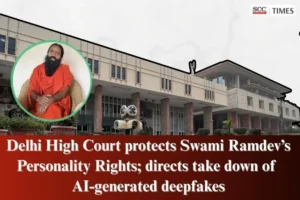
Delhi High Court: While hearing a plaint filed by the acclaimed yogic guru Swami Ramdev seeking protection of his personality rights, the Single Judge Bench of Jyoti Singh, J., held that the voice, name, likeness etc. of Swami Ramdev were exclusively attributable to him. Thus, the Court granted an ex parte ad interim injunction in favour of Sawmi Ramdev, restraining the defendants from creating or disseminating any AI-generated pictures, videos or merchandise that misuses and infringes upon the personality rights of Swami Ramdev.
Background
The plaintiff, Swami Ramdev is a renowned yoga guru and the founder of Patanjali Yogpeeth, Patanjali Ayurved Limited and several allied institutions for treatment and research in Yoga and Ayurveda in Haridwar with his ascetic discipline and leaning towards ancient culture and tradition. These institutions, under his leadership, have been instrumental in advancing public welfare, providing affordable Ayurvedic medicines, supporting rural employment and promoting Swadeshi (indigenous) entrepreneurship.
The plaintiff stated that by reason of his unparalleled contributions in the fields of yoga, Ayurveda, spirituality, public health and social reform, he has attained a unique and exclusive public identity recognised world over. The plaintiff’s name, appearance, voice, manner of speech, gestures and attire, particularly, his saffron robes, long beard, etc., have acquired distinctive characteristics, which the public instantly associates with him.
The plaintiff submitted that there is extensive and continuing instances of unauthorised digital use and misrepresentation as also exploitation of his name, image, likeness and persona across multiple online platforms, including YouTube, Facebook and e-commerce websites. The contents constitute a deliberate exploitation of the plaintiff’s persona for commercial gain, entertainment and viewership generation, without the consent, knowledge and authorisation of the plaintiff.
The plaintiff further averred that the infringing content poses a serious risk to public health and safety. Some of the infringing content falsely projects the plaintiff as endorsing medical or health-related products/advice, whereas the plaintiff has made no such endorsement and the people are naturally at risk by using the products and accepting the advice, if the products turn out to be of inferior quality and/or the advice is wrong.
Analysis, Law and Decision
Upon perusal of the record, the Court noted that there was exploitation and unauthorised use of plaintiff’s name, voice, image, likeness and other attributes of his persona, which was liable to be injuncted. The listings on e-commerce website “Amazon” reflect sale of diverse products bearing the plaintiff’s photographs giving an impression that the products are endorsed by the plaintiff, with the objective of unauthorised commercial gain. One of the videos available at YouTube by AI Short Video Channel features an AI-generated and morphed depiction of the plaintiff alongside another spiritual personality, presented in a meme format for amusement and online engagement. The Court noted that such video ridicules and trivialises the plaintiff’s persona and exploits his image. Another one of the videos uploaded on YouTube shows the plaintiff endorsing a liquor brand.
The Court opined that the impugned contents are not only violative of plaintiff’s rights to protect his image, voice, likeness and other attributes of his persona and personality but go a step further wherein, by use of modern technology such as AI, the images of the plaintiff have been modified and/or associated with people and products he has no connection with. The unauthorised creation and circulation of deepfake videos and social media webpages depicting the plaintiff as endorsing products, cures or medicines with which the plaintiff has no association, constitutes misappropriation and exploitation of his goodwill, amounting to passing off.
The Court further observed that some of the digitally created publications contain statements or messages, endorsements in the plaintiff’s name, likeness and voice, which affect his public image and may tarnish his credibility and undermine the trust reposed in him. The posts/uploads etc. have the potential to mislead the public into believing that the accounts are the authorised and official accounts of the plaintiff.
The Court also agreed with the plaintiff’s contention that some of the infringing content which falsely projects that plaintiff is endorsing medicines or health-related products and/or giving advice, can be detrimental not only to his reputation but the misinformation can lead to serious and adverse consequences to public interest, if the members of the public were to believe the endorsements or buy the products and/or follow the advice.
The Court opined that the plaintiff had made out a prima facie case for grant of ex parte ad interim injunction. Balance of convenience lay in favour of the plaintiff and he is likely to suffer irreparable harm in case ex parte ad interim injunction as prayed for, is not granted.
Accordingly, the Court directed that:
-
Defendants 1 to 10, and all persons claiming through them or under them were restrained from publishing any material or manufacturing, selling or advertising any merchandise which violates the plaintiff’s publicity/personality rights by utilising and/or in any manner, directly or indirectly, the plaintiff’s
-
name “Ramdev”, “Swami Ramdev” “Baba Ramdev”, “Yog Guru Ramdev”, “Yog Guru Swami Ramdev” and/or any abbreviation, moniker, title or variation thereof;
-
voice;
-
image;
-
likeness;
-
unique style of discourse and delivery; and
-
any other attributes which are exclusively identifiable/associated with him,
for any commercial and/or personal gain, without the plaintiff’s consent and/or authorisation in all formats and on all mediums, such as but not limited to AI-generated content, deepfake videos, voice-cloned audio, metaverse environments.
-
-
Defendants 2, 3, 4, 5 and 7 were directed to disable, block or take down the infringing URLs mentioned in the plaint.
[Swami Ramdev v. John Doe, 2026 SCC OnLine Del 771, decided on 18-2-2026]
Advocates who appeared in this case:
For the Plaintiff: Rajiv Nayar, Senior Advocate, Rahul S. Sahay, Simranjeet Singh, Rishabh Pant, Osheen Verma, Abhijeet Kumar Pandey, Apurbaa Dutta, Raghav Rajmalani, Prabhav Bahuguna, Naman Maheshwari, Pratham Arora, Advocates
For the Defendants: Mamta Rani Jha, Rohan Ahuja, Shruttima Ehersa, Ankit Tripathi, Ankit Parashar, Abhishek Kumar, Tejpal Singh Rathore, Tanish Gupta, Sanchli Sethi, Akshay Maloo, Vivek Ayyagari, Gynendra Rathore, Angad Singh Dugal, Govind Singh Grewal, Jagtej Singh Kang, Sanya Malik. Sahil, Satya Ranjan Swain, CGSC, Kautilya Birat, GP, Ankush Kapoor, Vishwadeep, Advocate