


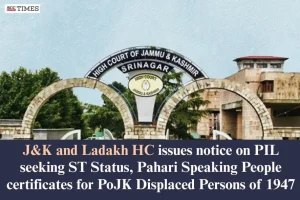
Jammu & Kashmir and Ladakh High Court: In a matter arising from a Public Interest Litigation (‘PIL’) seeking Scheduled Tribe status and Pahari Speaking People (‘PSP’) certificates for the Displaced Persons of 1947 (‘DPs of 1947’) who migrated from Pakistan-occupied Jammu & Kashmir (‘PoJK’), the Division Bench of Arun Palli, C.J., and Rajnesh Oswal, J., issued notice to the respondents so that a detailed response could be filed by the respondents and adjourned the matter to 10-02-2026.
Background:
The recognition of PSP and the Pahari Ethnic Group in Jammu & Kashmir began with the enactment of the J&K Reservation Act, 2004 [now J&K Reservation (Amendment) Act, 2019], aimed at providing equal opportunities to marginalized sections. In 2018, a bill was introduced to define eligibility for PSP, focusing more on the area rather than ethnicity or language, but it never received the statutory color. A significant development occurred in April 2020 with the issuance of SO 127, which formally incorporated PSP into the J&K Reservation Rules and laid down eligibility criteria. This culminated in March 2024 with SRO 176, officially recognizing the Pahari Ethnic Group under the Constitution (Jammu and Kashmir) Scheduled Tribes Order (Amendment) Act, 2024 (‘Act of 2024’) at Serial No. 14.
Subsequently, the DPs of 1947 who had initially migrated from PoJK to the areas of Poonch and Rajouri and identified with the Pahari Clan, began applying for PSP certificates. However, their applications were rejected by the Tehsildar of their area on the ground that they resided outside the officially recognised Pahari districts, despite their ethnic affiliation. But, in April 2025, this anomaly was cured when the Minister concerned stated that the status of Pahari Ethnic Group was not dependent on the area as the Act of 2024 did not prescribe ‘any area-based criteria’ for the issuance of PSP certificate.
The President of duly registered Jammu Kashmir Sharnarthi Action Committee (‘petitioner’) which raised voice for the displaced persons was aggrieved by the unjust treatment meted out to the DPs of 1947 who were illegally displaced from PoJK, particularly regarding their recognition as Scheduled Tribe under Pahari Ethnic Group in terms of the Act of 2024 and issuance of a PSP Certificate. Despite repeated representations by the petitioner, the authorities failed to extend the benefits to them. Eventually, the petitioner filed the present PIL on the grounds that:
-
The non-recognition of the DPs of 1947 as Pahari Ethnic Group and non-issuance of PSP Certificate was a prejudice towards the deprived section of the society as they could not benefit from the reservation provided to the community.
-
The DPs of 1947 were forced to leave their houses in PoJK, and they are entitled for reservation as Pahari Ethnic Group which is being denied to them and that defeats the principle of inclusive growth and development. The arbitrary action of the respondents was an attempt to create a class within a class which not only violated their fundamental rights but also disabled them from availing the benefits with respect to reservation in appointment and admission in professional institutions.
-
The rejection of PSP certificate applications based on area was de hors the actual position wherein such a criterion was not postulated by the legislature and the same was clarified by the Minister that the benefit was not area specific. Thus, the rejection was arbitrary and illegal.
On 24-11-2025, the Court granted the respondents time to seek instructions and submit their response, if needed.
Observations:
The Court, vide an order dated 22-12-2025, issued notice, as requested by the Senior Additional Advocate General, to the respondents to file a detailed response to the petition, and adjourned the matter to 10-02-2026.
[Jammu Kashmir Sharnarthi Action Committee v. State (UT of J&K), 2025 SCC OnLine J&K 1304, decided on 22-12-2025]
Advocates who appeared in this case :
For the Petitioner: Siddant Gupta, Advocate.
For the Respondent: Monika Kohli, Sr. AAG.