


Delhi High Court: In a significant pronouncement on the scope of criminal contempt, judicial independence, and the limits of public criticism against courts in the age of social media, in the backdrop of coordinated social media campaigns, edited videos, public speeches, and repeated allegations questioning the integrity and impartiality of a sitting Judge who rejected the prayer of the litigants, Arvind Kejriwal and others, in a proceedings arising out of the Delhi Excise Policy case, the Single Judge Bench of Swarana Kanta Sharma*, J., initiated the contempt proceeding against the respondents, holding that statements and conduct of the respondents, including Arvind Kejriwal, Manish Sisodia, Durgesh Pathak, Sanjay Singh, Devesh Vishwakarma, Saurabh Bharadwaj and others, prima facie amounted to scandalizing the Court, lowering its authority, and obstructing administration of justice and fell within the ambit of criminal contempt under Section 2(c), Contempt of Courts Act, 1971 (the Act).
Factual Matrix
In instant matter, the revision petition arising out of the Delhi Excise Policy case, was initially listed on 9 March 2026, when notice was issued and prima facie observations were recorded. Thereafter, some respondents addressed letters to the Chief Justice seeking transfer of the case to another Bench, alleging apprehension of bias. The Chief Justice declined the request administratively. Subsequently, recusal applications were filed before Justice Sharma herself.
The Court heard detailed submissions from all parties, including respondent 18, Arvind Kejriwal, who argued personally. The recusal applications were rejected by a detailed judgment dated 20 April 2026 in CBI v. Kuldeep Singh, 2026 SCC OnLine Del 1770. However, instead of challenging the rejection order before the Supreme Court, several respondents and political associates began publicly repeating allegations against the Court through speeches, social media posts, edited videos, and press conferences. The campaigns openly questioned the integrity, impartiality, and independence of the Court and portrayed the Judge as politically aligned and incapable of fair adjudication.
Present Proceedings: A Prelude
The present matter arose in extraordinary circumstances where proceedings before the Court transcended the confines of adjudication and entered the public domain through what the Court described as a “calculated campaign of vilification” conducted on social media platforms. The matter originally concerned with the criminal revision proceedings filed by the Central Bureau of Investigation (CBI) against Arvind Kejriwal and others. However, during the pendency of the proceedings, several respondents and political figures allegedly initiated coordinated campaigns targeting the Court, the presiding Judge, and the judicial institution itself. Even the family members of this Court were dragged into this manufactured narrative with a view to embarrass, defame, scandalise, lower the authority of this Court and ensure calculated humiliation through such false and motivated narratives.
The Court noted that the litigants, a politically influential accused, dissatisfied with the judicial order, instead of challenging the order before the Supreme Court, resorted to orchestrated intimidation and public campaigns on social media aimed at intimidation and destruction of public confidence in courts. While recusal applications were being heard judicially, a parallel narrative was simultaneously being constructed outside the courtroom through selective dissemination, edited videos, public speeches, and coordinated digital campaigns. Portions of videos were selectively edited and distorted, not to inform the public but to repeatedly spread falsehoods and undermine the authority of the Court. It remarked that “it was not merely the order passed by the Judge that became the target; it was the Judge herself.”
“While the course legally open to him was to challenge the order before the Hon‘ble Supreme Court, instead of doing so, he carried the dispute to social media platforms where truth became secondary and amplification and intimidation through orchestrated narratives, devoid of truth, were clothed as the democratic right to free speech.”
The Court noted that Respondent 18, Arvind Kejriwal though professed respect for the judiciary inside the courtroom, however, outside the courtroom he allegedly orchestrated a campaign intended to destroy the reputation of the Judge and undermine faith in the institution. The Court stated that videos were circulated with “theatrical aggression,” facts were distorted, and edited clips were weaponised to reduce the authority of the Court to ridicule.
“This Court did have the option of choosing silence and restraint over its duty to protect both itself and the institution. However, silence in such circumstances would amount to surrender before those who commit contempt to the extent of destroying the faith of the people in the judiciary.”
The Court emphasised that the campaign sought to send a dangerous message that if judicial orders did not conform to the expectations of powerful individuals or political forces, the Judge and her reputation would be publicly broken and vilified. The Court warned that if such conduct were tolerated in the name of judicial restraint, justice itself could become a casualty because judges may then begin deciding matters while anticipating retaliation from powerful litigants.
The Court described the attacks as not merely personal but “constitutional injuries” aimed at destabilising the institution itself and weakening public confidence in fearless and impartial adjudication. It rejected the assumption that intimidation through speeches, videos, or organised political campaigns could be “clothed in the garb of popular belief or public opinion”. The Court observed that “a lie spoken a thousand times does not become the truth” and that popularity or political influence cannot grant constitutional immunity.
“The popularity of a person also cannot bestow constitutional immunity. No individual, howsoever influential or powerful, is above the majesty of justice.”
The Court further observed that criticism of judgments is permissible and constitutionally protected, but there exists a clear distinction between fair criticism and a campaign intended to scandalise the judiciary and destroy public faith in the institution. The Court stated that judges cannot capitulate before power, popularity, or provocation and that choosing silence in such circumstances could amount to abdication of constitutional duty.
The Court further observed that the “robe worn by a judge demands, amongst many other things, calmness, patience, self-imposed silence, and above all, fortitude”, but there are moments when silence ceases to be judicial restraint and becomes surrender before a powerful litigant or an abdication of constitutional duty. According to the Court, that such a moment had arrived in the present case.
Law on Criminal Contempt
Discussing the statutory and constitutional framework governing criminal contempt, the Court referred to Section 2(c) of the Act and noted that criminal contempt includes any publication or act which scandalizes or lowers the authority of any court; interferes with judicial proceedings; or obstructs the administration of justice. It also referred to Section 15 of the Act which empowers High Courts to initiate suo motu contempt proceedings.
The Court referred to Brahma Prakash Sharma v. State of U.P., (1953) 1 SCC 813, wherein it was held that “the purpose of contempt jurisdiction is not to protect judges personally from criticism or defamatory allegations as individuals, but to preserve the authority of courts and maintain public confidence in the administration of justice.” Contempt arises where disparaging statements are “calculated to interfere with the due course of justice” and where they tend to create apprehension regarding the fairness and integrity of judges.
It referred to Haridas Das v. Usha Rani Banik, (2007) 14 SCC 1, wherein the Court reiterated that while judges are open to fair criticism, however, where criticism which lowers the dignity of courts or interferes with justice must be dealt with firmly. “Polluters of judicial firmament are, therefore required to be well taken care of to maintain the sublimity of court’s environment; so also to enable it to administer justice fairly and to the satisfaction of all concerned.”
Further in Prashant Bhushan, In Re, (2021) 1 SCC 745, it was observed that the judiciary is the central pillar of constitutional democracy and any attempt to shake public confidence in courts must be dealt with firmly. The Supreme Court warned that malicious attacks on courts cannot be tolerated under the guise of free speech and that magnanimity cannot be stretched to the extent of weakness.
Contemptuous Content Published by Respondents
-
Arvind Kejriwal
The Court examined posts published by Respondent 18, Arvind Kejriwal, on the social media platform “X.” He had publicly released a letter addressed to the Court and uploaded a video declaring that he would neither appear before the Court personally nor through counsel. In the letter, Kejriwal allegedly stated that “how can an ordinary citizen believe that this Court can rule against the Solicitor General, BJP or the Union Government?”; the proceedings appeared “strongly tilted in one direction irrespective of merits” ; participation in proceedings before the Court was “futile” and the outcome appeared “foretold.”
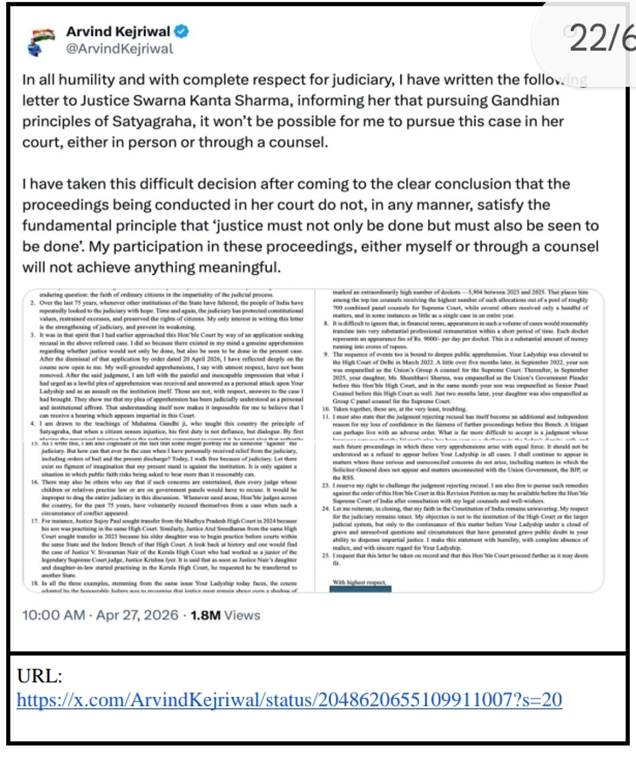

The Court asserted that these were not expressions of bona fide apprehension but direct imputations against judicial independence and fairness. It strongly objected to Kejriwal’s claim that “ordinary citizens” could not expect justice from the Court, observing that he had no authority to speak on behalf of the people of India or countless litigants who repose faith in constitutional courts daily.
The Court further observed that Respondent 8’s declaration of non-participation under the banner of “Satyagraha” went beyond a personal litigation strategy and publicly portrayed judicial proceedings as meaningless and predetermined. If litigants begin refusing participation after alleging bias publicly, the judicial system will descend into “anarchy” and “chaos”, thereby directly obstructing the administration of justice. Since respondent no. 18 is a political figure having considerable public reach and influence, such conduct is not merely an attempt to stall administration of justice before one Court but has the potential of putting the entire judicial system of the country in danger.
-
Manish Sisodia and Durgesh Pathak
The Court considered social media posts published by Respondent 8, Manish Sisodia and Respondent 19 Durgesh Pathak, and noted that both publicly endorsed Arvind Kejriwal’s stand and declared that they too would not appear before the Court either personally or through counsel.
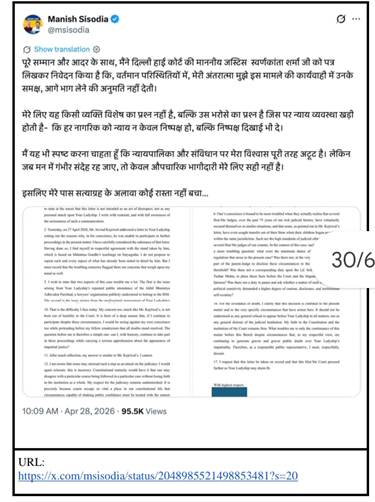
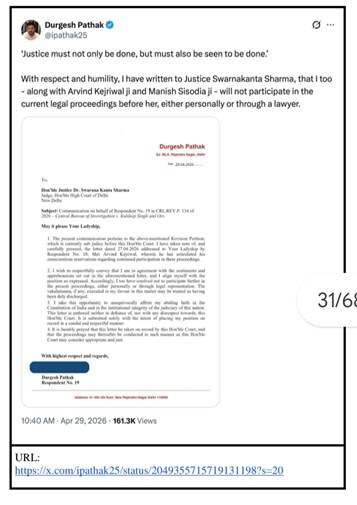


The Court held that their statements tends to scandalise and lower the authority of this Court and amounts to a serious and deliberate attempt to obstruct administration of justice by publicly portraying proceedings before the Court as biased, politically influenced and unworthy of participation.
-
Sanjay Singh
The Court then examined posts published by Sanjay Singh on “X.” He had reposted Kejriwal’s video and allegedly stated that when a Judge attends RSS programmes and claims promotions are received through such attendance, justice cannot be expected from that Judge.
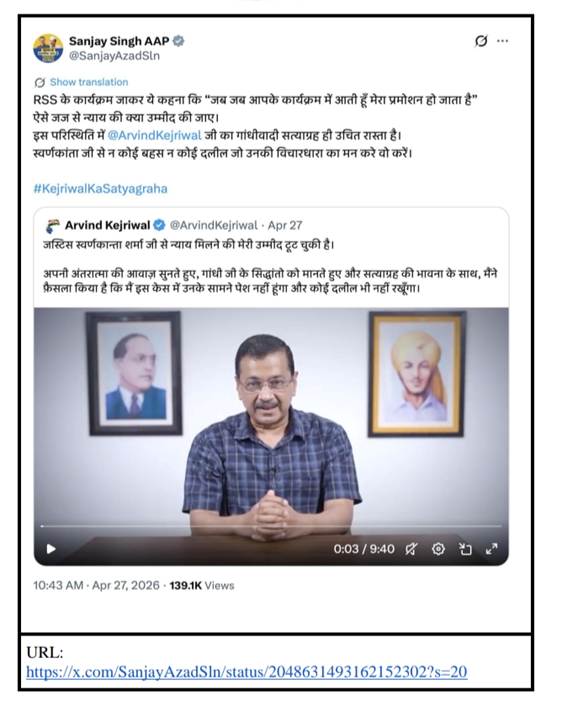

The Court found that the statements attempted to publicly portray the Court as ideologically aligned; suggest the Court could not decide matters independently; and convey that arguments before the Court were meaningless because outcomes were predetermined. The Court held that such allegations directly attacked the impartiality and independence of the Court and an attempted to delegitimise the judicial process itself in the eyes of the public.
“If such statements are to be considered a part of fair criticism, then every litigant dissatisfied with judicial proceedings, and those who are not even party to the proceedings pending before the Court, would publicly attribute ideological motives to Judges who visit or have visited such programmes, and call upon the public to distrust such Courts and judges.”
-
Devesh Vishwakarma
The Court further examined a social media campaign involving selectively edited clips of a lecture delivered by Justice Sharma at Mahatma Gandhi Kashi Vidyapeeth University during a workshop on new criminal laws.
The Court noted that a 59-second clip was extracted from a 6-minute-50-second lecture; the event banner and details were cropped; references to “Baba Vishwanath” and the spiritual significance of Kashi were falsely projected as references to RSS/BJP and the edited video misleadingly suggested the Judge admitted receiving promotions by attending ideological events.
The Court referred to fact-check reports published by PTI, Bar & Bench, Alt News, India Today and others clarifying that the clip was misleading and taken out of context. The Court held that “the selective clipping of the video and misleading portrayal — of the lecture delivered by this Court and reference made to Lord Shiva — is intended to create an impression in the minds of litigants, both present and prospective, that this Court is politically aligned or politically influenced while discharging judicial functions”.
The Court held that such statements clearly intended to create a perception amongst litigants and members of the public that proceedings before the Court are not being adjudicated independently and in accordance with law, thereby attempting to erode public confidence in the impartiality and independence of the judiciary and scandalise the institution of the Court itself.
-
Vinay Mishra
The Court next examined another social media post published by Vinay Mishra, former MLA from Dwarka and former Vice Chairman of Delhi Jal Board. In the post, dated 20 April 2026, he alleged that the Court repeatedly attended programmes of a political organisation and received honours from organisers associated with such ideology. The post sarcastically suggested that a Rajya Sabha seat for the Judge was “certain” and invited viewers to identify the face shown in the accompanying photograph.
The Court observed that the photographs and videos circulated with the post related to the lecture delivered by the Court at Mahatma Gandhi Kashi Vidyapeeth, Varanasi. The presentation of a memento during an academic event had been deliberately projected as though the Judge was receiving awards at programmes organised by a political organisation.
According to the Court, the portrayal was “clearly misleading” and designed to create a false perception of political proximity. It opined that such allegations conveyed to litigants and the public that judicial proceedings were being governed not by the Constitution and rule of law, but by political considerations.
-
Saurabh Bhardwaj
Thereafter, the Court dealt with a video relating to Saurabh Bhardwaj, State President of Aam Aadmi Party (AAP), which had been broadcast on the party’s official YouTube channel and shared on its official ‘X’ account.
During the press conference, conducted on 10 March 2026 titled “BJP ka High Court ki Judge se kya rishta hai?”, Saurabh Bhardwaj publicly questioned the integrity and impartiality of the Court by asking what relationship Justice Swarana Kanta Sharma had with the Bharatiya Janata Party (BJP) and asserting that the public deserved an explanation.
The Court noted that these allegations appeared to have been made solely because certain political leaders had publicly expressed confidence that the accused persons in the liquor policy case would eventually be punished once the matter proceeded before the High Court. The Court clarified that a political statement made by any leader regarding a pending case could never become a basis for attributing political connections or understanding to the Judge hearing the matter.
Rejecting the line of reasoning adopted in the press conference, the Court remarked that if such logic were accepted, every public statement made by politicians, litigants or supporters regarding expected outcomes of cases would become a pretext to publicly question the integrity of judges.
The Court held that publicly asking what “relationship” a sitting High Court Judge had with a political party, without any factual foundation, could never amount to fair criticism of judicial proceedings. The allegations, circulated widely through social media and digital platforms during the pendency of proceedings, would lower the authority of the Court and create distrust among litigants regarding the impartiality of judicial proceedings, particularly when the Court was dealing with criminal matters concerning sitting and former MPs and MLAs.
Decision
The Court asserted that the present case represented an organized attempt to achieve outside the courtroom what could not be achieved through judicial proceedings. The Court held that the campaign sought to intimidate judges and undermine public confidence in constitutional courts. The Court reiterated that constitutional courts survive on public confidence and any calculated attempt to destroy that confidence constitutes one of the gravest forms of criminal contempt.
The Court held that the necessity to take cognizance of the acts complained of was “far greater” than the need to continue hearing the main revision petition. While the revision petition could always be assigned to another Bench, the alleged acts directed against the Court and the institution of judiciary could only be noticed and addressed by the same Court. It also clarified that the present proceedings were not initiated to protect the ego of a Judge but to protect the institution of judiciary and public confidence in administration of justice.
“If a Judge commits an error in a judgment, or if a litigant is aggrieved by an order, the law provides remedies by way of appeal or challenge before a higher court. What law does not permit is malicious campaigns, false narratives and character assassination of judges through social media and public platforms.”
Accordingly, the Court held that the statements and conduct of the respondents, including Arvind Kejriwal, Manish Sisodia, Durgesh Pathak, Sanjay Singh, Devesh Vishwakarma, Saurabh Bharadwaj and others, prima facie amounted to scandalizing the Court, lowering its authority, and obstructing administration of justice and fell within the ambit of criminal contempt under Section 2(c), Contempt of Courts Act.
Consequently, the Court directed the Registry to assign an appropriate case title and number to the suo motu criminal contempt proceedings and place the matter before the Chief Justice on 15 May 2026 for assignment to an appropriate Bench, including issuance of show-cause notices to the proposed contemnors under the Contempt of Courts (Delhi High Court) Rules, 2025. It also directed that the main criminal revision petition be placed before the Chief Justice for assignment to another Bench.
Also Read: [Delhi Excise Liquor Policy] Supreme Court grants bail to Delhi CM Arvind Kejriwal in CBI case
[CBI v. Kuldeep Singh, RL.REV.P. 134/2026 & CRL.M.A. 6853/2026, CRL.M.A. 13409/2026, CRL.M.A. 13411/2026, CRL.M.A. 13737/2026, decided on 14-5-2026]
*Judgment authored by Justice Swarana Kanta Sharma
Advocates who appeared in this case:
Mr. Tushar Mehta, SG, Mr. S.V. Raju and Mr. D.P. Singh, ASG with Mr. Zoheb Hossain, Spl. Counsel for ED with Mr. Manu Mishra, Ms. Garima Saxena, Mr. Annam Venkatesh, Mr. Vivek Gurnani, Panel Counsels, Mr. Pranjal Tripathi, Mr. Imaan Khera, Mr. Bhuvan Kapoor, Mr. Digvijay Dam, Mr. Madhav Goel, Mr. Hitarth Raja and Mr. Digvijay Singh, Advocates with Mr. J.S. Randhawa-DIG, Mr. I.B. Pendhari-SP, Mr. Alok Shahi, ASP and Mr. Naveen, Sub-Inspector for CBI, For the Petitioner
Mr. Naveen Kumar, Mr. Tushar Agarwal, Mr. Arun Kumar, Mr. Abhishek Mahal and Ms. Rashi Choudhary, Counsel for the Respondent 1
Mr. Pradeep Rana and Mr. Tushar Rohmetra, Counsel for the Respondent 2
Mr. Shadan Farasat, Sr. Advocate with Mr. Harshit Anand and Ms. Varisha Sharma, Counsel for the Respondent 3
Mr. Sumer Singh Boparai and Mr. Surya Pratap Singh, Counsel for the Respondent 4
Mr. Nitesh Rana, Ms. Aditi Singh, Ms. Zainab Khan, Mr. Suyash Pandey, Ms. Aditi Singh and Mr. Aditya Narayan, Counsel for the Respondent 5
Mr. Shivendra Dwivedi and Ms. Onmichon Ramrar, Counsel for the Respondent 6 and 10
Mr. Dhruv Gupta and Mr. Anubhav Garg, Counsel for the Respondent 7
Mr. Adit S. Pujari, Mr. Shashwat Sarin, Mr. Shaurya Mittal and Ms. Dhanya Visweswaran, Counsel for the Respondent 9
Mr. Abhishek Singh, Mr. Talib Mustafa, Mr. Vishvendra Tomar, Ms. Shreya Singh, Mr. Ketan Kumar Roy and Mr. Shubh Mathur, Counsel for the Respondent 11
Mr. Rajat Bhardwaj, Mr. Dushyant Chaudhary, Mr. Tushar Garg and Mr. Vineet Singh, Counsel for the Respondent 12 to 15
Ms. Baani Khanna, Mr. Robin Singh, Mr. Kapil Balwani and Ms. Komal Thakkar, Counsel for the Respondent 16
Mr. Dama Seshadri Naidu, Sr. Adv. with Mr. Ramesh Allanki, Ms. Aruna Gupta and Mr. Sahil Sood, Counsel for the Respondent 17
Mr. Prabhav Ralli, Ms. Stuti Gupta, Mr. Dev Vrat Arya, Ms. Deeya Mittal and Mr. Samraat Saxena, Counsel for the Respondent 20
Mr. Gagan Minocha and Ms. Tusharika Mattoo, Counsel for the Respondent 21
Mr. Harsh Bora and Mr. Sahil Ghai, Counsel for the Respondent 22
Mr. Vikas Pahwa, Senior Advocate with Mr. Mayank Jain, Mr. Madhur Jain, Mr. Arpit Goel and Mr. Deepak Jain, Counsel for the Respondent 23
Dr. Farrukh Khan, Mr. Aditya Tyagi, Mr. Aryan Dev Pandey, Mr. Rashi Khandelwal and Mr. Amuldeep, Counsel for the Applicant in CRL.M.A. 13409/2026