


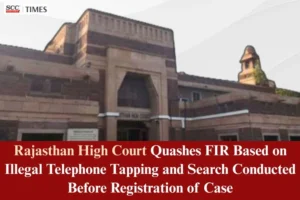
Rajasthan High Court: In a petition filed under Section 482, Criminal Procedure Code, 1973 (CrPC) for quashing of FIR and charge-sheet, filed by Anti-Corruption Bureau Jaipur, against petitioner, for commission of offenses under Sections 7, 7-A and 8, Prevention of Corruption Act, 1988 and Sections 201 and 120-B, Penal Code (IPC), a Single Judge Bench of Chandra Prakash Shrimali*, J., quashed the FIR and charge-sheet as it was filed on the basis of illegal telephone tapping and unauthorised search, which was conducted before registering the FIR. The arrest, also made before registration of FIR, was also found to be illegal and unconstitutional. Thus, the Court held that the FIR cannot be considered to be in accordance with law and hence, needs to be quashed.
Background
The petition was filed under Section 482 CrPC, to quash the FIR filed against the petitioner under Sections 7, 7-A and 8, Prevention of Corruption Act, 1988 and Sections 201 and 120-B IPC.
The petitioner was Financial Advisor in Jaipur Municipal Corporation who, along with other employees, was suspected of taking a percentage of the bill amount as commission in the form of bribe from contractors. So, the Anti-Corruption Bureau intercepted the mobile phones of petitioner and other employees and kept him under surveillance by clicking photographs at various locations. The order for recording the telephone conversations was passed by the Special Secretary (Home), who is subordinate to the Secretary (Home), Government of Rajasthan, Jaipur. The permission was sought on the grounds of public safety.
On such interception, it was found that the petitioner was carrying the bribe money to his house, so the police personnel from Anti-Corruption Department entered the petitioner’s house and conducted a search, where no amount was recovered, to which it was said that the amount had been destroyed or misappropriated by the petitioner. The said search was conducted without any search warrant, before filing the FIR. Lists containing details of pending bills of civil contractors for construction works and names and figures were seized without an order from competent authority.
The Anti-Corruption Bureau arrested the petitioner on the ground of offenses under Section 7, Prevention of Corruption (Amendment) Act, 2018 and Sections 201 and 120-B IPC even before the FIR was registered, i.e. on 7 January 2022, whereas the FIR was filed on 8 January 2022.
Contentions
The petitioner contended that the Special Secretary (Home) was neither competent nor legally authorised to pass the order for recording the telephone conversations. The order did not mention any details as to what public safety concerns existed and on the basis of which criminal act the order was passed. Multiple orders extending the permission for telephone tapping were void ab initio and liable to be dismissed under Section 5, Telegraph Act, 1885 read with Rule 419, Telegraph Rules, 1951 read with Section 69, Information Technology Act, 2000. Moreover, the act of telephone tapping amounts to offence under Section 25, Telegraph Act, 1885 and Information Technology (Procedure and Safeguards for Interception, Monitoring and Decryption of Information) Rules, 2009. Telephone tapping and surveillance without the competent authority’s permission amounts to violation of right to privacy under Article 21 of the Constitution and is punishable under Section 66-E, Information Technology Act, 2000. The witnesses during the search were the officers over whom the Bureau had supervisory and influential control, so they cannot be considered independent witnesses. As per the petitioner, such search and seizure were illegal under Section 165 read with Sections 100 and 102 CrPC. Provisions of notice before arrest under Section 41-A CrPC and grounds of arrest under Section 50(1) CrPC were also violated.
On the other hand, the respondents contended that the telephone tapping, search and seizure conducted and arrest and detention of the petitioner were as per law and no legal or fundamental rights were violated.
Issues
-
Whether conducting search of the house of the petitioner and seizure proceedings, without a search warrant, in the absence of any evidence against him, arresting him, and registering the first information report after his arrest, amounts to violation of the provisions contained in Section 165 read with Section 100 CrPC and whether the arrest and detention of the petitioner is illegal, unconstitutional and void ab initio under Sections 41, 41-A and 50 CrPC read with Articles 21 and 22 of the Constitution of India?
-
Whether the tapping of the telephone of the petitioner, taking his photographs and videos was in accordance with law under Section 5, Telegraph Act, 1885 read with Rule 419, Telegraph Rules, 1951 read with Section 69, Information Technology Act, 2000? And whether it amounts to violation of the right to freedom and privacy guaranteed under Articles 19 and 21 of the Constitution of India?
-
Whether the FIR registered against the petitioner, the charge-sheet filed on its basis and all the subsequent proceedings arising therefrom are liable to be quashed under Section 482 CrPC?
Analysis
With respect to Issue 1, it was the finding of the Court that the search of petitioner’s house was conducted without a search warrant from the competent authority and without any concrete evidence confirming the presence of bribe money. No bribe amount was recovered, however, the petitioner was arrested and produced before magistrate for obtaining police custody remand even before registering the FIR. No notice was given to the petitioner before arrest. The arrest memo showed that he was not informed of the grounds and reasons on which he was being arrested, nor was he informed of his right to consult a lawyer of his choice for his defence in the case. No evidence was collected regarding the misappropriation or destruction of the bribe amount. It was also not clear whether the seizure proceedings conducted in this case were forwarded to the Magistrate having competent jurisdiction or not.
The Court observed that the police personnel present during search cannot be considered independent witnesses for the purpose of search as they were not independent local persons from the vicinity of the residence of the petitioner, as required under Section 100(4) CrPC. Moreover, the lists and documents seized did not indicate commission of any offence. The case was built merely on the basis of the intercepted telephone conversations, which did not prima facie indicate the alleged offences.
In the light of such findings, the Court held that the search and seizure conducted by the Anti-Corruption Bureau was in violation of the provisions contained in Sections 100, 102 and 103 CrPC. On the question of notice and grounds of arrest, the provisions of Sections 41-A and 50(1) CrPC were violated. Therefore, the search and seizure proceedings and the arrest and detention of the petitioner, which also violated the rights of petitioner under Article 21 and 22 of the Constitution, were held to be illegal and unconstitutional.
With respect to Issue 2, Court analyzed Section 5, Telegraph Act, 1885, Section , 69, Information Technology Act, 2000 and Rule 419-A, Telegraph Rules, 1951 along with several judgments on same legal position.
The Court found that the bureau conducted surveillance and took photographs and videos of the petitioner without the permission of the competent authority. The phone tapping was done, again without the permission of competent authority as the Secretary (Home), Government of Rajasthan, Jaipur did not authorise the Special Secretary (Home), Government of Rajasthan, Jaipur to grant such permission and it violated the provisions of Section 5(2), Telegraph Act, 1885. Court observed that capturing, publishing or transmitting any private image of a person without his consent or without permission of the competent authority, amounts to violation of Section 66-E, Information Technology Act, 2000. Moreover, the orders granting permission of telephone tapping were not sent to the review committee within 7 days as required under Rule 419-A, Telegraph Rules.
Therefore, the Court held that the action of taking petitioner’s photographs and videos by the Bureau and telephone tapping was illegal and contrary to Section 5, Telegraph Act, 1885 read with Rule 419, Telegraph Rules, 1951 read with Section 69, Information Technology Act, 2000.
The Court emphasised that telephone conversation is a matter of privacy of an individual, and if such telephone conversation is intercepted contrary to the procedure established by law, without mentioning public safety or other specified grounds, it would amount to violation of the fundamental right to personal liberty and right to privacy guaranteed under Article 21 and 22 of the Constitution.
With respect to Issue 3, the Court held that since the search conducted at the house of the petitioner, the seizure of the documents and the arrest and detention of the petitioner was held to be illegal and unconstitutional, therefore, the FIR registered against the petitioner and chargesheet filed by the bureau cannot be held to be in accordance with law. Thus, the same deserved to be quashed.
Decision
The Court allowed the petition filed under Section 482 CrPC and quashed the FIR No. 05/2022 registered against the petitioner and Charge-sheet No. 64 /2022 filed on that basis, and all other proceedings arising out of the same to the extent of petitioner.
[Achleshwer Meena v. State of Rajasthan, 2026 SCC OnLine Raj 2408, decided on 17-3-2026]
*Judgment authored by: Justice Chandra Prakash Shrimali
Advocates who appeared in this case:
For Petitioners: Sudhir Gupta, Parth Gupta
For Respondents: Manvendra Singh PP, Devi Singh PP
Buy Prevention of Corruption Act, 1988 HERE

Buy Code of Criminal Procedure, 1973 HERE
Buy Penal Code, 1860 HERE
Buy Constitution of India HERE
