


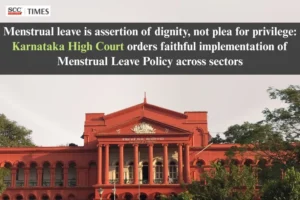
Karnataka High Court: While considering a writ petition filed under Articles 226 and 227 of the Constitution by which the petitioner, a woman working in unorganised labour sector, which sought complete and meaningful implementation of the menstrual leave policy of the State Government, a Single Judge Bench of M. Nagaprasanna, J., held that equality, as envisioned by the Constitution, demands a more compassionate and nuanced approach, one that acknowledges difference not as a ground for discrimination, but as a basis for accommodation, thus, the call for menstrual leave, is not a plea for privilege, but an assertion of dignity, fairness and humane understanding within the spaces women inhabit.
The Court orders strict and faithful implementation of the existing menstrual leave policy across sectors and stated that it becomes obligatory upon the State to undertake comprehensive measures aimed at sensitising all sectors, both organised and unorganised.
Also read: Karnataka Approves Monthly Paid Menstrual Leave for Women Employees
Background
In the present case, the petitioner asserted that she was employed in a small, local hotel, where her daily existence was marked by relentless physical exertion. Her duties included cleaning, washing of utensils, serving of food, and the performance of assorted menial tasks that demand sustained bodily labour from the early hours of the morning until late into the evening.
Her work environment was described as not only physically taxing, but also bereft of adequate standards of hygiene and dignity which bear with particular severity upon women workers, and more so during the period of menstruation, when the natural physiological processes of the body are accompanied by discomfort, fatigue, and pain, thereby rendering the performance of such arduous tasks exceedingly burdensome.
It was further averred that in 2024, State of Karnataka initiated a progressive step towards the formulation of a menstrual leave policy which received overwhelming response with a significant number of stakeholders expressing support for the introduction of a structured policy recognising menstrual leave as a facet of workplace justice and gender equity.
Thus, the petitioner approached the Court for the implementation and execution of the policy dated 20 November 2025, particularly in the unorganised labour sector where women workers like her work.
Analysis
Regarding the policy dated 20 November 2025, the Court stated that following Shailendra Mani Tripathi v. Union of India, 2024 SCC OnLine SC 1694, the State of Karnataka, embarked upon a deliberate and consultative journey towards formulating a menstrual leave policy. A dedicated Committee was constituted to examine the contours of such policy, inviting objections, eliciting expert opinions, and engaging in thoughtful deliberation. The recommendations of the Committee were subsequently placed before the Law Commission of Karnataka, which undertook exhaustive analysis of the issue resulting in a Government Order dated 20 November 2025. The said order elucidated as to whom the policy would become applicable, including other government organisations. Thereafter, Karnataka Menstrual Leave and Hygiene Bill, 2025 was also tabled before the legislature.
The Court stated that “The Policy, by the Government Order on 20-11-2025, and later the Bill did not spring from air. It has roots traceable to Article 21 of the Constitution. Apart from that, the Bill has taken birth from, the womb of the Constitution, particularly Articles 15(3), 39(e) and 42.” Further, the Court stated that the significance of menstrual leave policy is not merely administrative but deeply rooted in the constitutional promise of equality that embraces all citizens, beneath its expansive canopy.
The Court stated that while the law proclaims men and women as equals, nature, in its intricate design, has bestowed upon women, certain biological experiences that set them apart, menstruation being one such profound reality. “Menstruation, often referred to as periods, is not an aberration, but a natural and indispensable facet of women’s reproductive cycle. It is a recurring monthly phenomenon wherein, the body governed by delicate hormonal rhythms sheds the uterine lining resulting in bleeding, that typically endures for 3 to 7 days. Yet beyond its clinical description lies a lived experience, one that may be accompanied by discomfort, fatigue, and emotional upheavals.”
The Court opined that equality, as envisioned by the Constitution demands a more compassionate and nuanced approach, one that acknowledges difference not as a ground for discrimination, but as a basis for accommodation. Thus, the Court held that the call for menstrual leave is an assertion of dignity, fairness and humane understanding within the spaces women inhabit and not a plea for privilege.
The Court highlighted the problems faced by menstruating women due to the menstrual cycle, as under:
-
Dysmenorrhea, commonly referred to as menstrual cramps or painful periods. The said condition often manifests as acute discomfort in the pelvic region, abdomen, or lower back, and in certain instances, the intensity of pain can be profoundly debilitating. Accompanying symptoms such as backaches, headaches, nausea, light-headedness, and even fainting further compound the distress endured during this phase.
-
At times, irregularities in the menstrual cycle serve as harbingers of more serious underlying disorders. For instance, menorrhagia may signal hormonal imbalances or other medical complications that warrant careful attention.
-
Excessive menstrual bleeding also elevates the risk of iron-deficiency anaemia, a condition marked by profound fatigue, weakness, and dizziness.
-
The hormonal fluctuations intrinsic to the menstrual cycle extend their influence beyond the physical realm, giving rise to an array of emotional and psychological symptoms. While commonly classified under premenstrual syndrome (PMS), more severe and incapacitating manifestations are recognised as premenstrual dysphoric disorder.
-
Compounding these physiological challenges is the pervasive stigma that surrounds menstruation which is a stigma deeply entrenched in societal norms and cultural practices. Menstruating women are often deemed impure and subjected to exclusionary customs.
-
Several medical conditions associated with menstruation, such as endometriosis, polycystic ovary syndrome (PCOS), premenstrual dysphoric disorder (PMDD), and uterine fibroids present with diverse yet often severe symptoms, including heavy bleeding, unpredictable cycles, and chronic pain.
-
Menstrual health conditions may also adversely impact fertility and safe childbirth. Endometriosis, affecting approximately 10-15 per cent of women of reproductive age, stands as one of the leading causes of infertility.
Further, the Court highlighted the problems faced by menstruating women at the workplace, as under:
-
Workplaces are often not designed with the needs of menstruating individuals in mind, much like they frequently fail to accommodate pregnancy and childbirth. Thus, employees may find their productivity diminished or feel compelled to take leave during their menstrual cycles.
-
When individuals are unable to change menstrual products as required, they may resort to makeshift alternatives such as tissues or paper towels, increasing the risk of irritation, infection, and, in rare cases, toxic shock syndrome.
-
Insufficient menstrual hygiene facilities, lack of inclusive leave policies, social discomfort, limited access to menstrual products, pervasive stigma and likewise inadequate workplace support may also discourage individuals from pursuing professional opportunities or even compel them to exit the workforce altogether.
-
The absence of clean, well-equipped restrooms stocked with menstrual hygiene products places an undue burden on employees, who must often carry their own supplies.
The Court stated that providing free and readily accessible sanitary products, such as pads, tampons, or menstrual cups, can substantially alleviate the stress and foster a more supportive work environment. Further, the Court stated that to address these concerns, workplaces must ensure the availability of menstrual-friendly restrooms, secure storage spaces for personal items, and facilities for changing clothing when necessary. The Court stated that provisions such as access to quiet resting areas and flexible arrangements allowing employees to sit, stand, or stretch can help mitigate fatigue associated with hormonal fluctuations.
Considering the international position, the Court stressed that the World Health Organization (WHO) has emphatically advocated for the recognition of menstrual health as a fundamental health and human rights issue, rather than confining it merely to the domain of hygiene. Further, taking into account its evolution, the Court stated that several nations, such as Soviet Union, Japan, Indonesia, South Korea, Taiwan, Vietnam and Zambia, through legislative enactments, policy formulation or ongoing deliberative processes, sought to recognise and institutionalise menstrual leave. “This emerging international consensus, reflects a growing acknowledgment of menstruation, not merely as a private biological occurrence, but a matter warranting policy intervention within the realm of labour rights and human dignity.”
Issue
The Court stated that the issue involved was whether the government orders, presently confined to the organised sector, should also extend to the unorganised sector.
The Court referred to Ajay Malik v. State of Uttarakhand, 2025 SCC OnLine SC 185 and Hamsaanandini Nanduri v. Union of India, 2026 SCC OnLine SC 402 and stated that the Supreme Court has recognised the rights of those unorganised sector workers and the importance of social security benefits to female workers Thus, it is necessary for the State to tap the unorganised sectors to take the benefit of the government order or the Bill when it becomes an Act.
The Court stated that the unorganised sectors may be classified into two categories:
-
enterprises owned by individuals or self-employed persons, engaging fewer than 10 workers, and
-
daily wage labourers, who remain outside the purview of the said government orders.
The Court stated that “these distinctions are indicative of the necessity for the State for more inclusive and responsive approach”. Thus, it becomes obligatory upon the State to undertake comprehensive measures aimed at sensitising all sectors, both organised and unorganised. “While the organised sectors may be regulated through government orders and legislative intervention, the unorganised sector requires a more facilitative mechanism.” The Court further stated that beyond regulations, what is essential is a continuous and widespread effort to educate all sections of society, reaching every part of the State to build awareness, empathy, and compliance.
Decision
Hence, the Court directed for strict and faithful implementation of the existing policy until the formal enactment of the proposed legislation and upon such enactment, the State shall frame appropriate Rules to give full and meaningful effect to the statutory mandate, without undue delay. Further, the Court stated that the State shall be bound to ensure effective operationalisation of the policy through the issuance of suitable guidelines, circulars, and administrative instructions, as may be necessary to secure its uniform, consistent, and rigorous implementation across all sectors.
The Court emphasised that “Men and women stand equal in the eyes of the law; yet, they are biologically distinct. To acknowledge such differences, particularly in matters concerning health, dignity, and bodily autonomy, is not to transgress the guarantee of equality, but to give it substantive meaning.”
Accordingly, the Court disposed of the present petition and stated that it “would also observe that the State ought not to be deterred or constrained by misplaced apprehensions founded upon a superficial invocation of Article 14 of the Constitution”.
[Chandravva Hanamant Gokavi v. State of Karnataka, 2026 SCC OnLine Kar 2479, decided on 15-4-2026]
Advocates who appeared in this case:
For the Petitioner: Deeksha N. Amruthesh, Advocate
For the Respondent: Prathima Honnapura, AAG
Buy Constitution of India HERE
