


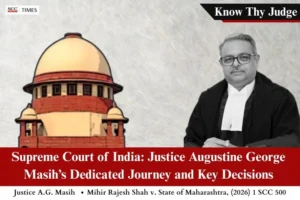
With roots across Punjab, Himachal Pradesh, and Uttar Pradesh, Justice Augustine George Masih brings a rich academic and professional foundation to the judiciary. His steady rise from advocate to High Court Judge and Chief Justice, and eventually Supreme Court Judge reflects his legal acumen, administrative strength, and dedication to diversity within the institution.
Justice Augustine George Masih’s Early Life
Born on 12 March 1963 in Ropar, Punjab, Justice Augustine George Masih completed his schooling from St. Mary’s Convent School, Kasauli, Himachal Pradesh and Saifuddin Tahir High School, Aligarh Uttar Pradesh.1
He completed his graduation in Science (Hons.) followed by LL.B.(Hons.) from Aligarh Muslim University, Uttar Pradesh.2
Career Trajectory of Justice Augustine George Masih
Justice Augustine was enrolled as an advocate with the Bar Council of Punjab & Haryana on 6 June 1987. Justice Augustine holds practical experience in Constitutional Law, Service Law, Labour Law, Civil Law, etc. on both Original and Appellate sides. He has appeared as an advocate before the Supreme Court, Punjab and Haryana High Court, Delhi High Court, Himachal Pradesh High Court, and various other Courts and Tribunals.3
Justice Augustine has also held the posts of Assistant Advocate General, Deputy Advocate General, Additional Advocate General in the office of Advocate General, Punjab.
Justice A.G. Masih’s years as an advocate allowed him to acquire a profound understanding of the legal system and the intricacies of a wide range of legal matters which eventually paved the way for his appointment as the Additional Judge of Punjab and Haryana High Court on 10 July 2008, followed by Permanent Judgeship on 14 January 2011.4
Did you know? Justice Masih ranks No. 7 in All-India High Court judge seniority and No. 1 among judges from the Punjab & Haryana High Court?5
Justice Augustine George Masih was elevated as the Chief Justice of Rajasthan High Court on 30 May 2023. It was a defining moment in his career as it marked a pivotal juncture in his judicial career. He took on a position of profound responsibility and leadership in the realm of the law.6
Justice Masih was recommended to the Supreme Court by the Collegium led by former CJI Dr D.Y. Chandrachud.7 Thereafter, he took oath as Judge of the Supreme Court of India on 9 November 2023. The Supreme Court Collegium while considering Justice Masih’s name for elevation as Supreme Court Judge, took note of his expertise in diverse fields of law, and that his inclusion to the Bench would strengthen the representation of minority communities in the Supreme Court of India. The Collegium, thus, recommended Justice Augustine George Masih’s name on 6 November 2023, and he took oath as the Judge of the Supreme Court of India on 9 November 2023.8
Did you know? While recommending Justice Masih for Supreme Court judgeship, the Collegium observed that his appointment willstrengthen Supreme Court’s commitment to diversity and inclusive representation.9
Notable Decisions by Justice Augustine George Masih
In Rajasthan Public Service Commission v. Yati Jain, 2026 SCC OnLine SC 80 batch of civil appeals raised an important question concerning the nature, scope and legal enforceability of a waiting/reserve list prepared in public recruitment. In the appeals filed by the Rajasthan Public Service challenging the judgments of the Division Bench of the Rajasthan High Court affirming the orders of the Single Judges directing the appointment or consideration of wait-listed candidates against vacancies arising on account of non-joining of selected candidates, a Division Bench of Dipankar Datta* and Augustine George Masih, JJ., allowed all three appeals and set aside the impugned judgments of the Division Bench and the Single Judges. The Court held that the RPSC had locus standi to maintain the writ appeals. A Wait-listed candidate has no vested right or indefeasible right of appointment. The six-month statutory validity period cannot be computed from the date of non-joining or cancellation of appointment beyond the prescribed period. In absence of requisition, no mandamus could be issued to recommend candidates from the reserve list.
While hearing a pending civil appeal in Gohar Sultan v. Sheikh Anis Ahmad, 2026 SCC OnLine SC 246, the Court’s attention was drawn to the provisions of the Muslim Personal Law (Shariat) Application Act, 1937, particularly Section 4 and the absence of compliance with the said provision. A Division Bench of Sanjay Karol and Augustine George Masih, JJ., impleaded the Union of India through the Secretary, Department of Legislation, and the State of Uttar Pradesh through its Chief Secretary as party respondents and issued notice, so that the appropriate governmental authorities before it could clarify the position regarding compliance. The Court directed the newly added respondents to file an affidavit indicating the latest status in the meantime. The Court requested the parties to file a convenience compilation within one week.
While considering the application in CBI v. Kuldeep Singh Sengar, 2025 SCC OnLine SC 2998, filed by Central Bureau of Investigation against Delhi High Court’s decision dated 23-12-2025 (impugned order), wherein it had suspended the sentence of Unnao Rape Case convict Kuldeep Sengar and directing conditional release; the 3-Judge Bench of Surya Kant, CJI., J.K. Maheshwari and Augustine George Masih, JJ., stayed the operation of the impugned order, thereby holding that the convict shall not be released from custody pursuant to the impugned order.
In XXX v. Union of India, 2025 SCC OnLine SC 1646, a petition filed by a sitting Judge of Allahabad High Court seeking declaration of Paragraphs 5(b) and 7 of In-House Procedure dated 15-12-1999 to the extent that it enables the In-House Committee to inquire and comment on the existence of ‘serious misconduct warranting removal’ and the CJI to intimate the same to the President and the Prime Minister for initiating proceedings for removal and other consequential action, as unconstitutional and ultra vires; and set aside the Final Report dated 03-05-2025 submitted by the Committee, and all consequential actions taken pursuant to the same. The Division Bench of Dipankar Datta* and A.G. Masih, JJ., dismissed the writ petition and opined that if indeed any fault were found in the Procedure and questions were to be raised, the Petitioner ought not to have waited for completion of the fact-finding inquiry set in motion by the CJI. The Court further held that the in-house inquiry or its report forming part of the Procedure in itself does not lead to removal of a Judge, unlike the constitutionally ordained procedure. Thus, the in-house inquiry is not a removal mechanism in the first place, much less an extra-constitutional mechanism.
In U.P. SRTC v. Kashmiri Lal Batra, 2025 SCC OnLine SC 2335, a civil appeal filed against the judgment and order of the Madhya Pradesh High Court , as well as in a writ petition filed under Article 32 of the Constitution seeking enforcement of the rights guaranteed under Article 19(1)(g) of the Constitution, the Court was concerned with the grant of permits on certain inter-State routes that overlapped portions of certain intra-State notified routes. Accordingly, Chapter V of the Motor Vehicles Act, 1988, titled Control of Transport Vehicles, and Chapter VI, titled Special Provisions Relating to State Transport Undertakings, along with the relevant forms, constituted the focal point of the Court’s consideration. The Division Bench of Dipankar Datta* and A.G. Masih, JJ. emphasised that, given India’s substantial progress in the road transport sector, the interests of passengers and commuters must remain of paramount concern for transport authorities, in this case, for both the States of Uttar Pradesh and Madhya Pradesh. Consequently, the Court held that no permission could be granted at this stage to any private operator holding a permit issued by the State Transport Authority (STA), MP, to operate a stage carriage on an inter-State route overlapping a notified intra-State route in Uttar Pradesh.
In Hansraj v. State of U.P., 2025 SCC OnLine SC 2193, while considering the writ petition filed by a murder convict who was in custody from 3 years, and thus sought release from prison after raising the plea of juvenility; the Division Bench of Dipankar Datta* and A.G, Masih, JJ., had to consider whether the petitioner (convict) is entitled to the benefit of the Juvenile Justice (Care and Protection of Children) Act, 2000, as amended in 2006 whereby Section 7-A was inserted.
A five-judge Bench comprising Sanjiv Khanna*, CJI., B.R. Gavai, Sanjay Kumar, Augustine George Masih, and K.V. Viswanathan**, JJ., with a ratio of 4:1, in Gayatri Balasamy v. ISG Novasoft Technologies Ltd., (2025) 7 SCC 1, held that the Appellate Courts may exercise limited powers to modify arbitral awards under certain specific circumstances:
-
Severability — When the invalid portion of the award can be separated from the valid part.
-
Apparent Errors — To correct clerical, computational, or typographical errors evident on the face of the record.
-
Post-Award Interest — To modify post-award interest where appropriate.
-
Article 142 Powers — The Supreme Court may exercise its special powers under Article 142 of the Constitution to modify awards, but such powers must be used sparingly and with great caution, in accordance with constitutional limits.
While considering T.N. Godavarman Thirumulpad v. Union of India, 2025 SCC OnLine SC 2463, pertaining to conservation of tigers and their habitat, restoration of Jim Corbett Tiger Reserve and permitting tiger safaris, the 3-Judge Bench of B.R. Gavai, CJI*, Augustine George Masih and A.S. Chandurkar, JJ., directed that Tiger Safari shall not be permitted in the core or a critical tiger habitat area.
While considering Mihir Rajesh Shah v. State of Maharashtra, 2025 SCC OnLine SC 2356, wherein the appellants raised concerns over violation of their rights Article 22(1) of the Constitution and Section 50 of the CrPC (Section 47 of Bharatiya Nagarik Suraksha Sanhita, 2023 [“BNSS”]) asserting that they were not informed of grounds of their arrest in writing, the Division Bench of B.R. Gavai, CJI., and Augustine George Masih*, J., held the following vis-a-vis communicating the grounds of arrest to the arrested person:
-
The constitutional mandate of informing the arrestee the grounds of arrest is mandatory in all offences under all statutes including offences under Penal Code, 1860 (now BNS, 2023)
-
The grounds of arrest must be communicated in writing to the arrestee in the language he/she understands;
-
In cases where the arresting officer/person is unable to communicate the grounds of arrest in writing on or soon after arrest, it be so done orally. The said grounds be communicated in writing within a reasonable time and in any case at least two hours prior to production of the arrestee for remand proceedings before the magistrate.
-
In case of non-compliance of the above, the arrest and subsequent remand would be rendered illegal and the person will be at liberty to be set free. “The ends of fairness and legal discipline therefore demand that this procedure as affirmed above shall govern arrests henceforth”.
In High Court Judges Pension Refixation Considering Service Period in District Judiciary & High Court, In re, (2025) 7 SCC 674 concerning the pension payable to retired Judges of the High Courts, including the payment of gratuity and other terminal benefits, a Three- Judge Bench of BR Gavai*, CJI., Augustine George Masih, and K. Vinod Chandran, JJ. issued the following directions: The Union of India was directed to pay the full pension of Rs. 15,00,000/- per annum to a retired Chief Justice of the High Court. The Union of India was directed to pay the full pension of Rs. 13,50,000/- per annum to a retired Judge of the High Court, other than a retired Chief Justice of the High Court. A retired Judge of the High Court was deemed to include retired Judges who had served as Additional Judges of the High Court. The Union of India was instructed to follow the principle of One Rank One Pension for all retired High Court Judges, regardless of their entry source (whether from the District Judiciary or the Bar) and irrespective of the number of years served either as a District Judge or a High Court Judge. All retired Judges were to be paid full pension as stipulated.
In May 2025 a five-judge Bench comprising Sanjiv Khanna*, CJI., B.R. Gavai, Sanjay Kumar, Augustine George Masih, and K.V. Viswanathan**, JJ., with a ratio of 4:1, in Gayatri Balasamy v. ISG Novasoft Technologies Ltd., (2025) 7 SCC 1, held that the Appellate Courts may exercise limited powers to modify arbitral awards under certain specific circumstances.
In Property Owners Assn. v. State of Maharashtra, 2024 SCC OnLine SC 3122 , the majority of 7:2 comprising of CJI Dr. DY Chandrachud, Hrishikesh Roy, J.B. Pardiwala, Manoj Misra, Rajesh Bindal, Satish Chandra Sharma and Augustine George Masih, JJ., held that all the ‘private properties’ cannot form part of the ‘material resources of the community’ under Article 39(b) of the Constitution. Justice BV Nagarathna partially concurred with the majority, however, on the aspect of Article 39(b) she opined that a private owned resource can be transformed and can indeed acquire the status of ‘material resource of the community’.
In Mineral Area Development Authority v. Steel Authority of India, 2024 SCC OnLine SC 1796, a matter concerning the distribution of legislative powers between the Union and the States on the taxation of mineral right came up, the Nine Judge Constitution Bench of Dr. DY Chandrachud, CJI, Hrishikesh Roy, Abhay S Oka, BV Nagarathna, JB Pardiwala, Manoj Misra, Ujjal Bhuyan, Satish Chandra Sharma and Augustine George Masih JJ. has held that royalty paid by mining operators to the Central government is not a tax and that States have the power to levy cesses on mining and mineral-use activities. Whereas, Justice BV Nagarathna, gave a dissenting opinion.
In Ashok v. State of U.P., 2024 SCC OnLine SC 3580, a criminal appeal was filed against the conviction order of a man accused of rape and murder of a ten-year-old minor, passed by the Trial Court and upheld by the Allahabad High Court, the three Judge bench of Abhay S. Oka*, Ahsanuddin Amanullah, and Augustine George Masih, JJ. set aside the conviction, as the accused was not provided with proper legal aid during the trial, which violated his fundamental right to a fair trial under Article 21 of the Constitution of India. Further, the Court issued a series of directives concerning the critical roles of the Public Prosecutor and Legal Aid Counsels in ensuring procedural fairness and safeguarding the fundamental rights of the accused in criminal trials.
In Chandigarh Housing Board v. Tarsem Lal, 2024 SCC OnLine SC 154an appeal was filed against High Court’s dismissal of appeal holding the migrant eligible for benefit of being member of Scheduled Tribe holding a certificate issued from Rajasthan State as per notification under Article 342 of Constitution, the Division Bench of BV Nagarathna and Augustine George Masih, JJ. set aside the High Court’s stance hinting towards Article 342 of the Constitution empowering the President of India to notify the Scheduled Tribes either for a State or for a Union Territory.
In Abhishek v. State of Maharashtra, 2024 SCC OnLine SC 155a petition for special leave to appeal was filed by Rohit Thakur and Abhishek Thakur (‘Thakur brothers’) who have been charged with over Rs 12.15 crore online ticketing fraud in Tadoba-Andhari Tiger Reserve, against the judgment and order dated by the Bombay High Court, wherein the Court rejected their anticipatory bail applications, the Division Bench of B.V. Nagarathna and Augustine George Masih, JJ. after considering the nature of the dispute between the parties and after pursuing the impugned order, refused to interfere in the matter. Thereby, refusing to grant them anticipatory bail. However, the Court allowed them to seek regular bail.
In Academy of Medical Sciences v. CIT, (2024) 460 ITR 592, an appeal challenging High Court’s dismissal of appeal in regard to exemption to Educational Institution wherein, it was held that exemption cannot be granted by the Court for earlier assessment years for which registration was unavailable, the Division Bench of BV Nagarathna and Augustine George Masih, JJ. dismissed the said SLP under Sections 12-AA and 260 of Income Tax Act, 1961.
In State of U.P. v. Vivo Mobile India (P) Ltd., (2024) 122 GSTR 236 an appeal against High Court’s decision in favour of Vivo Mobile India Pvt. Ltd for benefit of input tax credit late accrued to the transactions completed previously, by treating the entire period to be one, during which transactions were completed, against which all input tax credit stood accumulated as on the date of filing return, the Division Bench of BV Nagarathna and Augustine George Masih, JJ. Upheld the said stance holding that condition of month-to-month reconciliation of eligible input-tax credit was relaxed as per Rule 36(4) of the Central Goods and Services Tax Rules, 2017.
In Magenta Power (P) Ltd. v. Rajasthan Electronics & Instrument Ltd., 2023 SCC OnLine Raj 3391, an application under Section 11 of Arbitration and Conciliation Act, 1996 seeking reference of dispute to the sole arbitrator was filed, Augustine George Masih, CJ raised the fact that the three applications were all made for three identical agreements and accordingly appointed a High Court Retired Judge as the arbitrator.
In Kanta v. State of Rajasthan, 2023 SCC OnLine Raj 2034 an application was filed seeking condonation of delay of 1500 days in filing the appeal against a writ petition, with the reason of applicant’s family being extremely poor agriculturist, the Division Bench of Augustine George Masih, CJ and Vinit Kumar Mathur, J. clarified that “If there is no explanation for day-to-day delay, there has to be a reasonable explanation for the delay occurred with justifiable grounds for not approaching the Court within the time stipulated.”
In Bhim Singh v. State of Haryana, 2023 SCC OnLine P&H 84 a petition was filed seeking writ of mandamus directing the respondents to refund the entire amount of Rs. 19,19,700/- with interest at the rate of 12% per annum from the date of payment till realization as there has been forfeiture of Rs. 11,38,163/- out of the total amount and a refund of Rs. 7,81,537/- has been made to the petitioner on surrender of the plot which was allotted to him, the division Bench of Augustine George Masih and Vikram Aggarwal, JJ. held that the refund having been made as per the terms and conditions of the allotment letter cannot be faulted with.
In Paramjit Singh v. State (UT, Chandigarh), 2023 SCC OnLine P&H 416, a petition was filed seeking issuance of a writ of mandamus directing the Chandigarh Housing Board to issue an acceptance-cum-demand letter qua the allotment of 3BHK flat in the oustees category as per the Scheme dated 30-01-2017 and Rules under the Chandigarh Allotment of Dwelling Units to the Oustees of Chandigarh Scheme, 1996, the division Bench of Augustine George Masih and Harpreet Singh Brar, JJ. Directed the authorities to consider the petitioner’s representation regarding the instant matter rather than deciding the matter on merits.
In Satnam Singh v. Financial Commissioner, Punjab, 2019 SCC OnLine P&H 2260, the order upholding appointment of the respondent as the Lambardar of Village Basma was challenged, Augustine George Masih, J. disposed of the present petition on grounds of it being infructuous but clarified that in the light of the eligibility to be seen being the date of appointment on the post of Lambardar, the appointment of Jagtar Singh could not be said to be illegal as, on the said date, he was eligible for appointment to the post of Lambardar.
In Bhagwan Dass v. State of Haryana, 2019 SCC OnLine P&H 62 the petitioner had approached the Court before a Bench of Augustine George Masih, J., challenging order passed by the Financial Commissioner, Haryana, whereby the Commissioner had roceeded to set aside the mutation sanctioned in favour of petitioner and Respondent 7 as per their natural succession. Further ordered that the mutation be executed as per the registered Will in favour of Respondents 5 and 6 as the registered Wills were in favour of them.
In Punjab State Warehousing Corporation Limited v. Paramjit Singh, 2019 SCC OnLine P&H 1229, an appeal was made against the judgment and decree passed by the Additional District Judge whereby the suit filed by the appellant-plaintiff for recovery of the amount from the respondent-defendant had been set aside by allowing the appeal and dismissing the suit of the appellant-plaintiff. Augustine George Masih, J. upheld the decision of the lower court as there was no evidence on record to prove the contentions made by the appellant.
In Diocese of Amritsar of Church of North India v. Rashid Masih, 2011 SCC OnLine P&H 2731 an award passed by Labour Court, Amritsar, was challenged by which reinstating the respondent-workman in service with 50% back wages, the division bench of Ranjan Gogoi, CJ and Augustine George Masih, J. remanded the matter back to the single judge to determine whether it is an “industry” and the respondent “workman” falls within the meaning of the said expression as defined in the Industrial Disputes Act, 1947.
1. Justice Augustine George Masih | Supreme Court of India | India
2. https://mediationcentrephhc.gov.in/jjmc/
3. Justice Augustine George Masih | Supreme Court of India | India
4. Supra
5. Collegium-Recommendation-6-November-2023.pdf
6. SC Collegium recommends appointment of 3 Chief Justices of High Courts as Judges of Supreme Court of India | SCC Blog
7. Collegium-Recommendation-6-November-2023.pdf
8. https://main.sci.gov.in/pdf/Collegium/06112023_142822.pdf.
9. SC Collegium recommends appointment of 3 Chief Justices of High Courts as Judges of Supreme Court of India | SCC Blog