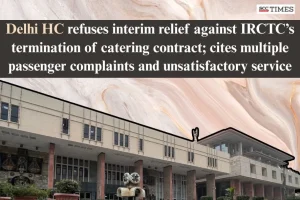
Delhi High Court: While hearing an appeal filed under Section 37(2)(b) of the Arbitration and Conciliation Act, 1996 (‘Act’) challenging the interim order dated 12-1-2026 (‘impugned order’) wherein the Sole Arbitrator in the Delhi International Arbitration Centre had dismissed the appellant’s application under Section 17 of the Act, the Single Judge Bench of the Mini Pushkarna, J, reiterated the limited scope of judicial interference under Section 37 of the Act and held that in view of the persistent passenger and consumer complaints against the appellant, IRCTC was prima facie justified in terminating the catering contract. Finding no perversity, patent illegality, or jurisdictional infirmity in the impugned order, the Court declined to interfere with the impugned order and dismissed the appeal.
Background
The respondent IRCTC had floated a tender for construction and operation of base kitchens (Part A) and provision of onboard catering services in certain cluster trains (Part B). The cluster included the Purushottam Express, running between New Delhi and Puri (‘subject train’). The contract period was five years, extendable by two years.
The appellant had been declared the successful bidder for the cluster and was granted the license to operate base kitchens and provide onboard catering services. Disputes subsequently arose between the parties. The appellant had complained about the presence of unauthorized food vendors on the train, which allegedly affected its contractual rights. IRCTC, on the other hand, had issued two show cause notices dated 3-4-2025 and 8-4-2025, alleging service deficiencies by the appellant. The appellant had submitted replies and sought a personal hearing.
Following the hearing, IRCTC had passed a termination order, terminating the appellant’s license for the subject train due to unsatisfactory responses and continued breaches. The appellant had challenged the termination by filing a petition under Section 9 of the Act. Vide the order dated 12-12-2025, the Court had dismissed the Section 9 petition and vacated the interim protection. The appellant had been granted seven days’ time to hand over the train and cease operations. On the same day, in proceedings under Section 11(6) of the Act, the disputes were referred to a sole arbitrator.
After expiry of the seven-day period, IRCTC had issued a termination notice directing the appellant to stop onboard catering services. The appellant had challenged the Section 9 judgment in appeal under Section 37 of the Act which was subsequently disposed of.
Consequently, the appellant had filed an application under Section 17 of the Act before the sole arbitrator who had granted limited interim protection, allowing the appellant to continue operations temporarily, without expressing any opinion on merits. After hearing the parties, the arbitrator, by the impugned order, dismissed the Section 17 application, holding that restoration of a terminated contract at the interim stage was neither justified nor in public interest.
Accordingly, the instant appeal had been filed.
Analysis, Law and Decision
At the outset, the Court reiterated that its power of interference under Section 37(2)(b) of the Act is extremely limited. It emphasized that where the view taken by the arbitral tribunal is plausible and free from perversity, the Court cannot interfere. The Act mandates minimal judicial intervention, and courts cannot substitute their own view for that of the arbitral tribunal unless the impugned order is patently illegal, perverse, or suffers from jurisdictional error.
Relying on settled precedent, the Court noted that orders passed by an arbitral tribunal under Section 17 of the Act are discretionary and interlocutory in nature. The same restraints that apply while examining a challenge to a final arbitral award under Section 34 of the Act equally apply to appeals under Section 37 of the Act. Interference at the interlocutory stage is discouraged, as it may disrupt ongoing arbitral proceedings.
On facts, the Court observed that the appellant’s license for onboard catering services was terminated due to persistent passenger complaints and unsatisfactory service. The termination was preceded by several show cause notices, penalty letters, and repeated communications highlighting service deficiencies. The respondent had placed on record multiple passenger complaints, including issues of hygiene, food quality, overcharging, and service standards, particularly in relation to the subject train. These complaints were also reflected on the Catering Service Information Management (‘CSIM’) Portal and were not disputed by the appellant.
The Court found that the appellant was repeatedly put on notice regarding deteriorating service standards. It noted that Clause 6.10 of the Master License Agreement (‘Agreement’) permitted termination without prior notice in cases of unsatisfactory service and persistent passenger complaints. The termination order specifically relied on this clause, and therefore, prima facie, the respondent’s action could not be faulted.
With respect to the appellant’s contention regarding the absence of a 15-day cure notice under Clause 8.2 of the Agreement, the Court agreed with the arbitral tribunal’s prima facie view that the intent of the clause stood substantially fulfilled. The appellant was continuously informed of deficiencies and complaints and was not taken by surprise.
The Court further held that at the interim stage, neither the arbitral tribunal nor the Court was required to finally decide the legality of the termination. The limited enquiry was whether the respondent was prima facie justified in terminating the agreement. It also accepted the respondent’s submission that courts should not direct continuation of a contractual arrangement that already stands terminated.
The Court noted that interpretation of contractual provisions lies primarily within the domain of the arbitral tribunal. The arbitral tribunal’s finding that granting interim protection would be against public interest, in view of persistent passenger complaints, was held to be a plausible and reasoned view.
Finding no perversity, patent illegality, or jurisdictional infirmity in the impugned order, the Court declined to interfere. The appeal was dismissed, with a clarification that the observations made would not affect the merits of the arbitral proceedings.
[R.K. Associates & Hoteliers (P) Ltd. v. IRCTC, 2026 SCC OnLine Del 212, decided on 19-1-2026]
Advocates who appeared in this case:
For the Appellant: Sandeep Sethi, Sudhir Makkar, Senior Advocates, Jasmeet Singh, Mahinder Singh Hura, Saif Ali, Pushpendra S. Bhadoriya, Vijay Sharma, Krisna Gambhir, Shreya Sethi, Riya Kumar, Akhilesh Kumar, Aadhya Shrotriya, Sanya C. Oberoi, Pranav Menon, Saurav, Ajith Willyams, Advocates
For the Respondent: Saurav Agrawal, Rajat Malhotra, Saksham Gupta, Madhu K. Singh, Kiran Devrani, Anshuman Chowdhary, Nikita Rathi, Parmeet Singh, Advocates
Buy Arbitration and Conciliation Act, 1996 HERE