


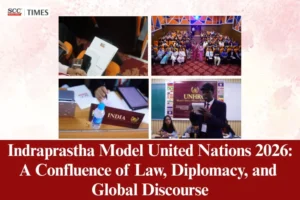
Indraprastha Model United Nations 2026 (IPMUN’26) was held on 29th and 30th April 2026 at the University School of Law and Legal Studies (USLLS), Guru Gobind Singh Indraprastha University. Conceived as the University’s flagship academic simulation under the guidance of Prof. (Dr.) Shivani Goswami (Dean, USLLS) and Prof. (Dr.) Gurujit Singh (Chief Advisor, IPMUN’26), IPMUN’26 was structured as a high-impact Model United Nations conference with a strong emphasis on international law, global governance, and contemporary policy challenges. The event was organised in academic partnership with SCC Online, which served as both the Knowledge Partner and Media Partner for the conference.
The nature of the event was academic, deliberative, and simulation-based, designed to replicate the functioning of United Nations bodies through structured debate, moderated negotiations, and consensus-building exercises. The conference aimed to bridge theoretical legal education with the practical realities of diplomacy, enabling participants to engage critically with pressing global issues while adhering to procedural discipline and diplomatic etiquette.
The primary objective of IPMUN’26 was to provide a credible platform for students from diverse academic backgrounds to deliberate upon urgent international concerns through the lens of law, policy, and multilateral cooperation. The conference sought to cultivate skills of research, negotiation, public speaking, and analytical reasoning, while fostering an understanding of global responsibility, inclusivity, and rule-based international order.
The conference witnessed the participation of approximately 110 delegates from across India, representing a wide range of institutions including National Law University, Delhi University colleges, private universities, and reputed schools. Delegates hailed from institutions such as Delhi University, National Law Universities, OP Jindal Global University, Galgotias University, Indraprastha College for Women, Gargi College, Hindu College, Miranda House, HPNLU, and several schools across Delhi, reflecting both disciplinary and regional diversity.
IPMUN’26 was formally inaugurated through an opening ceremony that set the tone for the two-day proceedings. The ceremony was graced by the Chief Guest, Smt. Meenakshi Lekhi, Senior Advocate and former Minister of State for External Affairs and Culture. In her address, she underscored the importance of informed youth participation in diplomacy, the relevance of international law in times of global uncertainty, and India’s evolving role in multilateral institutions. Her message emphasised that meaningful engagement, rather than passive observation, shapes the future of global governance. The formal declaration of the conference by the Secretary-General, Ms. Hitanshi Goel, marked the beginning of two days of intense engagement rooted in collaboration, compromise, and the pursuit of international peace.
The structure of the event comprised three United Nations committees, each addressing a distinct yet interconnected dimension of global affairs. The United Nations Human Rights Council (UNHRC) deliberated on the human rights implications of artificial intelligence, with a specific focus on child safety online, educational dependency, and digital inequalities. Discussions examined the balance between technological advancement and the protection of fundamental rights, highlighting concerns of data exploitation, unequal access, and ethical governance of AI.
The United Nations Security Council (UNSC) addressed threats to international peace and security posed by terrorism, with emphasis on counter-terrorism strategies amid the proliferation of ballistic missiles, drone warfare, and global militarisation. Delegates engaged in substantive discussions on state sovereignty, collective security, and emerging military technologies, reflecting a high degree of preparation and procedural awareness.
The United Nations Commission on the Status of Women (UNCSW) deliberated on strengthening women’s roles in peacekeeping and conflict resolution under the Women, Peace and Security Agenda. Comprising over forty women delegates and an all-women Executive Board, the committee focused on policy implementation, representation, and gender-sensitive peacebuilding mechanisms, reinforcing the normative commitments of the agenda.
The conference concluded with a Valedictory Ceremony held on 30th April 2026. The ceremony commenced with the invocation of the Preamble of the United Nations Charter, followed by addresses from the Dean of USLLS, Prof. Dr. Shivani Goswami, who appreciated the delegates, Executive Boards, and organising committee for maintaining academic rigour and decorum throughout the conference. Prof. Dr. Gurujit Singh was also specially acknowledged for his mentorship and guidance.
Awards were conferred to recognise outstanding performances across committees. Germany secured the Best Delegate award in the UNSC, India was awarded Best Delegate in the UNCSW, and North Macedonia received the Best Delegate award in the UNHRC. Several High Commendations, Special Mentions, and Verbal Mentions were also awarded, reflecting the overall high quality of debate and participation.
The conference concluded with a Vote of Thanks delivered by the Secretary-General, Ms. Hitanshi Goel, and the Director-General, Mr. Gopansh Sharma, who highlighted the success of IPMUN’26 as an inclusive, women-led, and academically enriching initiative. As the conference adjourned, IPMUN’26 stood affirmed as a meaningful exercise in legal education, diplomacy, and global engagement; one that transformed participants from students into aspiring statespersons and reinforced the enduring relevance of dialogue, law, and cooperation in international affairs.