


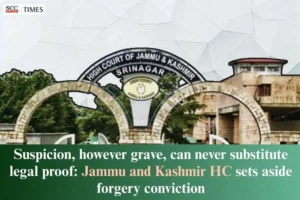
Jammu & Kashmir and Ladakh High Court: In the appeal filed against the judgement of conviction and order sentence dated 08-02-2008 passed by the Court of Anti-Corruption, Srinagar (‘Trial Court’), wherein the appellant was convicted under Section 5(2) of the Jammu and Kashmir Prevention of Corruption Act, 2006 and Sections 468 and 471 of the Ranbir Penal Code, 1989 (RPC), a Single Judge Bench of Sanjay Parihar J., stated that a finding of conviction and sentence recorded against the appellant is not only perverse but also unsustainable in law. The Court stated that the appellant could not have been convicted on mere suspicion, as suspicion, however grave, can never substitute legal proof. Accordingly, the Court set aside the conviction and acquitted appellant from all the charges.
Background
In the present case, the appellant, a public servant employed at Sher-i-Kashmir Institute of Medical Sciences, was convicted for securing promotions through fraudulent means. He was initially appointed as a Security Attendant in 1983 and subsequently promoted to Security Supervisor Grade-II in 1998. The prosecution alleged that the appellant produced forged documents to gain these promotions. The matriculation certificate was found to be invalid after verification with the Board of School Education. The appellant’s promotions were approved by a Selection Committee, but none of its members were examined in court.
This appeal challenges the judgment and sentence passed by the Trial Court on 08-02-2008, where the appellant was convicted for offences under the Jammu and Kashmir Prevention of Corruption Act, 2006, and the RPC for securing promotions by using forged documents. He had allegedly tampered with his Army Discharge Certificate, misrepresenting his rank as Naik instead of Rifleman, and produced a fake matriculation certificate to meet promotion requirements.
The prosecution argued that he forged these documents to gain promotions and illicitly drew excess payments computing to the sum of 2,19,757 between 1991 and 2000. The Trial Court convicted him, relying on testimonies from witnesses and the fact that the matriculation certificate was proven to be fake after verification.
However, the appellant’s stated no direct evidence of his involvement in the forgery. He argued that the promotion was approved by a Selection Committee, and there was no proof of him forging the documents. Additionally, the original forged documents were not seized, only photocopies, which the appellant argued lacked evidentiary value. The appellant now challenges the conviction before the High Court, contending that the evidence presented was unreliable and that the Trial Court misapplied the law.
Analysis, Law, and Decision
The Court stated that the Trial Court has erred in law and facts by failing to appreciate the evidence in its proper perspective. The findings recorded are contrary to the material on record and are based on misapplication of law. The evidence led by the prosecution is shaky, unreliable, and insufficient to sustain conviction. The Court further highlighted that, appellant had been convicted for using forged documents to secure promotions. However, the Court found that the prosecution failed to prove beyond a reasonable doubt that the appellant forged the documents or had exclusive control over them. The alleged fake matriculation certificate was not produced in original, and the claim of tampering with the Army Discharge Certificate lacked expert evidence.
The Court also highlighted that the Selection Committee, which approved the promotions, was not examined, and there was no direct proof of dishonesty or falsity in the appellant’s actions. The conviction was based on assumptions, and the appellant’s legal rights were upheld, leading to his acquittal and discharge from bail bonds.
In Mohd. Ibrahim v. State of Bihar, (2009) 8 SCC 751, the Supreme Court authoritatively explained that unless impersonation, unauthorized alteration, or fraudulent procurement is proved, execution of a document does not amount to forgery. Mere dishonest claim does not constitute a false document.
Similarly, the alleged interpolation in the discharge certificate was not shown to have been done by the appellant. In absence of proof of authorship, exclusive control, or mens rea, the prosecution case falls short of the standard of proof required in criminal law.
Therefore, the appeal was allowed and the conviction order against the appellant sentence dated 08-02-2008 was set aside and appellant was acquitted of all the charges.
[State of Jammu and Kashmir v. Gh Rasool Ganie, 2026 SCC OnLine J&K 110, decided on 27-01-2026]
Advocates who appeared in this case:
For the Appellant: G.A. Lone, Adv.; Mujeeb Andrabi, Adv.
For the Respondent: Mohsin Qadri,Sr. AAG.; Maha Majeed,Assisting Counsel.