


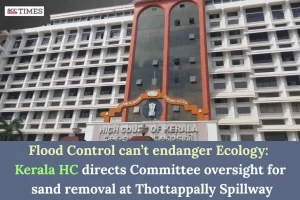
Kerala High Court: In a case revolving around the issue whether the order issued under Section 30 of the Disaster Management Act, 2005 (‘Act of 2005’), permitting removal of sand from the Thottappally Spillway for flood contol, could stand considering its ecological consequences, the Division Bench of Nitin Jamdar, CJ., and Syam Kumar V.M.*, J., held that although the District Collector indeed possessed the power to issue such directions, the implementation of flood-control measures must be balanced with ecological safeguards. Accordingly, after observing that Flood Control can’t endanger Ecology, the Court directed the constitution of a committee headed by the District Collector and including senior officers from the Departments concerned, to ensure that sand removal henceforth would only be carried out after due ecological assessment.
Background:
An order was passed by the District Collector as the Chairman of the District Disaster Management Authority, suggesting flood containment measures to address the perennial issue of flooding in the Kuttanad region during the monsoons. Among the measures was the removal of sand from the Thottappally Spillway and soil from the Thannirmukkam Bund, along with cutting of Casuarina trees obstructing water flow.
The petitioners contended that the sand removal was not an innocuous disaster prevention measure but a means to facilitate continuous and unregulated extraction of mineral-rich sand, devastating nearly 15 acres of ecologically sensitive area which was a ‘Turtle nesting Grounds’ protected under Para 7(1) CRZ-I A(g) of the Coastal Regulation Zone Notification, 2011 and was used by the Species of Olive Ridley and Hawksbill Turtle. They argued that the Kerala Coastal Zone Management Authority, upon whom the jurisdiction to decide the permitted and prohibited activities within the coastal zone was vested, had not been consulted, and no ecological and environmental impact assessment was undertaken.
However, the District Collector contended that the land accumulation and planting of trees were man-made and were not natural and hence an ecological and environmental study was not essential for removing the same. It was alleged that the presence of sand banks and trees inside the spillway channel negated the purpose of the spillway and obstructed the channel and thus the sand removal was a disaster management measure squarely falling within the ambit of the Act of 2005, regulated under the supervision of the Irrigation Department, with Monitoring Committees in place. They further explained that the sand containing mineral deposits was annually removed and entrusted to a public sector company under government oversight.
Upon Court’s direction, a joint report was submitted by the Assistant Conservator of Forest, Social Forestry, Alappuzha and the Member Secretary, Kerala Coastal Zone Management, Thiruvananthapuram, recommending that sand heaps leftover after mineral separation must be levelled, and the said activity, as it was crucial for protecting the endangered turtle species and promoting better nesting grounds to prevent their extinction, must be carried out with priority. Thus, the report affirmed the ecological disturbance caused due to sand mining.
Analysis and Decision:
The Court noted that the annual sand mining at the Thottappally Spillway was primarily an engineering-driven exercise, undertaken with the sole focus of flood control. It was conducted without any ecological impact assessment; no ecological experts were engaged in the process, and monitoring efforts were limited almost entirely to tracking the quantities of sand extracted. The Court opined that the matter was not about the existence of power to make such an order under the Act of 2005, but about the manner in which such power was exercised.
The Court emphasized that while the order did stipulate that removal of soil or sand should be ‘only as a measure of flood prevention action’, the modalities lacked ecological safeguards. The absence of ecological experts in the committee made the process of sand removal mere regulatory permission, ignoring the environmental consequences. The Court opined that flood-control needs were to be balanced by including an ecological impact monitoring mechanism that ensured compliance with environmental safeguards.
Accordingly, while disposing the writ petitions, the Court directed that a committee be constituted, headed by the District Collector, including senior officers or experts from the Irrigation/Water Resources Department, Forest and Wildlife Department, Kerala Coastal Zone Management Authority, local Panchayats, and a representative of an NGO, to suggest, determine, and monitor all aspects of sand removal after due ecological impact.
[Green Roots Nature Conservation Forum v. Union of India, 2025 SCC OnLine Ker 15093, decided on 17-12-2025]
*Judgment authored by: Justice Syam Kumar V.M.
Advocates who appeared in this case:
For the Petitioner: Thomas M. Jacob, Akhil K. Madhav, V. Prasanth, V. Mangala, Liju. V. Stephen, Indu Susan Jacob, Taj K. Tom, Abhijith U, Advocates.
For the Respondents: M.P. Sreekrishnan, P. Narayanan, Senior G.P., B. Pramod, Senior Panel Counsel, Nagaraj Narayanan, Spl. Government Pleader, M.P. Prakash, SC, C. Dinesh, CGC, Latha Anand, N. Manoj Kumar, State Attorney, M.N. Radhakrishna Menon, K.R. Pramoth Kumar, S. Vishnu (Arikkattil), Sidharth P.S., P.G. Pramod, Senior Government Pleader