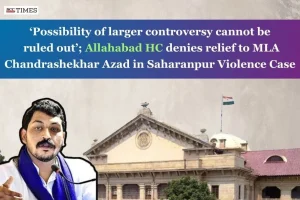
Allahabad High Court: In a batch of four applications filed by Chandrashekhar Azad, a politician and Member of Legislative Assembly (“MLA”), seeking quashing of FIRs filed against him in Saharanpur Violence Case, the Single Judge Bench of Sameer Jain, J., dismissed the applications, holding that the subsequent FIRs filed related to the case had different incidents and ambits, thus they were permissible. The Court also held that since the trials were midway, it was not desirable to invoke the inherent power of this Court to quash the proceedings.
Background
In 2017, allegedly, several accused persons, along with their unknown associates, approximately 250 to 300 people, were creating barriers (Jam) on the site of the incident. When the police arrived and tried to control the situation, the crowd became highly aggressive. On the alleged instigation of Former MLA Ravinder Molhu, the mob started using illegal weapons, including firearms, on the administrative officers. As per the FIR, the mob damaged the vehicles of reporters, other private persons, and police vehicles, and many police personnel, administrative officers, and private persons sustained serious injuries. Allegedly, the miscreants also entered the police station of Ramnagar and damaged the public property and documents, as well as the property of the public servants. They damaged the Maharana Pratap building and the park.
Therefore, the first FIR was lodged under Sections 147, 148, 149, 307, 332, 336, 427, 436, 353, 323 of the Penal Code, 1860, Section 7 of the Criminal Law Amendment Act, 1932, and Sections 3 and 4 of the Public Property Damages Act, 1984, against accused persons including Chandrashekhar alleging that the mob were the workers of Bheem Army and they were led by him and his associates. Subsequently, four other FIRs were filed regarding the same incident by different aggrieved persons.
Thus, Chandrashekhar filed the present applications seeking quashing of the other four FIRS as they related to events that occurred during the same transaction, and the proceedings were bad. Alternatively, those charge-sheets may be treated as supplementary charge-sheets in the main case, as in almost all the cases, the accused and witnesses were common.
Analysis
From perusal of all the FIRs, the Court noted that it appeared that though the alleged offences were committed by the mob in the incident mentioned in the first FIR, the time and place of the incidents mentioned in all other FIRs were different. In this regard, the Court referred to Babubhai v. State of Gujarat, (2010) 12 SCC 254, wherein it was observed that if both the FIRs relating to same incident in respect of same occurrence or regarding the incident which form two or more parts of transaction then second FIR should be quashed but in the same judgment Apex Court further observed that if second FIR is in respect of two different incident/crime, the second FIR is permissible.
The Court also placed reliance on Nirmal Singh Kahlon v. State of Punjab, (2009) 1 SCC 441, wherein it was observed that the second FIR would be maintainable not only because there were different versions but also when discovery is made on factual foundations. Discoveries may be made by the police authorities at a subsequent stage. Discovery about a larger conspiracy can also surface in another proceeding, as for example, in a case of this nature. If the police authorities did not make a fair investigation and left out conspiracy aspect of the matter from the purview of its investigation, in our opinion, as and when the same surfaced, it was open to the State and/or the High Court to direct investigation in respect of an offence which is distinct and separate from the one for which the FIR had already been lodged.
Therefore, the Court reiterated that a second FIR is permissible if that version was different, if a discovery was made on factual foundations, or if discovery about a larger conspiracy is disclosed.
The Court remarked that the case at hand reflected that the mob allegedly relating to the Bheem Army continuously for hours committed arson and damaged properties at different places at different times. Therefore, it appears to be a case in which it can be held that all the incidents are related to the same transaction.
The Court further stated that, considering that Chandrashekhar is a sitting MLA and the alleged offences were allegedly committed by his party workers, the argument that there might be a larger conspiracy could not be ruled out. Thus, the Court held that it was not desirable to quash the proceedings arising out of the subsequent FIRs.
In this regard, the Court also referred to the principles regarding the permissibility of the registration of a second FIR laid down in T.T. Antony v. State of Kerala, (2001) 6 SCC 181, and Babubhai(supra). In these cases, the Supreme Court categorically observed that if the ambit of two FIRs is different, then both FIRs can exist even if they arise from the same set of circumstances. Further, where incidents are separate, offences are similar or different, then a second FIR is permissible.
Thus, the Court held that in the case at hand, the ambit and incidents of all the subsequent FIRs were different, though they may have arisen in the same transaction. Accordingly, it could not be held that the subsequent FIRs were not permissible.
The Court further noted that the Court concerned had taken cognizance of all the cases and trials were at the evidence stage. Therefore, the Court held that since the trials were midway, it was not desirable to invoke the inherent power of this Court to quash the proceedings of these cases and to treat the respective charge-sheets as supplementary charge-sheets of the first FIR at this stage.
Therefore, the Court dismissed the applications, holding that they were devoid of merit and liable to be dismissed.
[Chandrashekhar v. State of U.P., 2025 SCC OnLine All 8087, decided on 17-12-2025]
Advocates who appeared in this case:
For the petitioner: Senior Advocate Sushil Shukla and Advocate Nidhi
For the respondent: Additional Advocate General Manish Goyal and Additional Government Advocate Roopak Chaubey
Buy Penal Code, 1860 HERE