


Disclaimer: This has been reported after the availability of the order of the Court and not on media reports so as to give an accurate report to our readers.
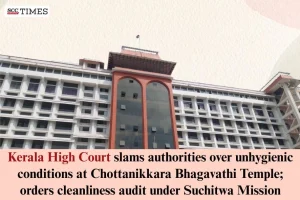
Kerala High Court: In a suo motu proceedings based on a complaint dated 24-04-2025 alleging maladministration and corruption at the Chottanikkara Bhagavathi Temple, a Division Bench of Raja Vijayaraghavan V.* and K.V. Jayakumar, JJ., orders comprehensive cleanliness audit and corrective measures in response to alarming sanitation failures at Chottanikkara Temple.
The core issue in the instant matter pertains to deficiencies in cleanliness, sanitation, and overall maintenance within the precincts of the Chottanikkara Bhagavathi Temple. The Court noted that the existing conditions do not conform even to the basic standards of public health, safety, or the level of upkeep ordinarily associated with a major place of worship.
The Court’s orders dated 19-09-2025, 24-09-2025, and 26-11-2025 recorded that the surroundings of the temple were totally unhygienic, with photographs revealing widespread filth, decay, and neglect, including in the kitchen and adjoining areas, places where the highest standards of hygiene are indispensable.
The Court noted that the Cochin Devaswom Board had sought assistance from the Suchitwa Mission; the file was recommended by the Secretary, Revenue (Devaswom), and forwarded to the Local Self Government Department (LSGD).
However, the State contended that under Swachh Bharat Mission (Grameen) Phase II, a conventional sewage treatment plant for an institutional facility such as a temple does not fall within the scheme, and that financial assistance cannot ordinarily be extended to religious institutions, the scheme being intended for LSGIs and households.
In compliance with earlier directions, the Health Inspector undertook multiple inspections on and found “significant accumulation of rubbish and filth, particularly near the incinerator and the ‘Aanakottil’,” and leakage of filthy water into adjacent areas and ponds. A notice under the Kerala Public Health Act, 2023 was issued to the Assistant Commissioner of the temple.
The Court found that systemic deficiencies plagued the maintenance of the temple premises, requiring urgent intervention. The Court expressed concern that the Temple Advisory Committee had permitted the situation to deteriorate. The Court was also expressed its displeasure with the conduct of the Devaswom Officers, who had allowed severe disrepair in a temple that generates one of the highest revenues for the Board.
The Court held that the conditions were unhygienic, unacceptable, and indicative of administrative failure. The Court recorded the limitations of the Swachh Bharat Mission but held that the Suchitwa Mission possesses the expertise necessary to recommend remedial measures. The Court cautioned that if immediate remedial measures are not initiated on a war-footing, it might be “constrained to issue adverse orders against both the Temple Advisory Committee and the Devaswom Officers.”
The Court issued following Directives —
-
Directed the Executive Director of Suchitwa Mission (Respondent 9) to depute two senior officers to conduct a detailed cleanliness audit of the temple and submit concrete, implementable measures to ensure permanent hygienic upkeep.
-
Suchitwa Mission officers must undertake a thorough and scientific assessment and specify the exact manner in which deficiencies can be addressed.
-
Allowed continued inspections by Health Inspectors.
-
Listed the matter on 17-12-2025 for further consideration.
[Suo Motu v. State of Kerala, 2025 SCC OnLine Ker 13934, Decided on 10-12-2025]
*Judgment by Justice Raja Vijayaraghavan V.
Advocates who appeared in this case:
Sri. S.Rajmohan, Senior Government Pleader, Sri. K.P.Sudheer, SC, Cochin Devaswom Board, M/S.T Madhu, C. R. Saradamani, B. S. Suraj Krishna, Avanthika R., Karthik Krishna M., Arunima A.R. and T.S. Davis, Counsel for the Respondent 6
Sri. Vineeth Komalachandran, Counsel for the Respondent 7