Disclaimer: This has been reported after the availability of the order of the Court and not on media reports so as to give an accurate report to our readers.
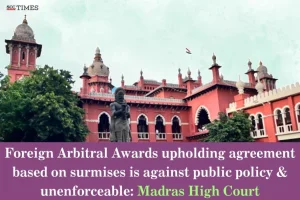
Madras High Court: In the execution petitions filed under the Arbitration and Conciliation Act, 1996 (the Arbitration and Conciliation Act) read with Order XXI Rule 46 CPC, seeking recognition and enforcement of two Federation of Oils, Seeds and Fats Associations (FOSFA) foreign arbitral awards, a single-judge bench of N. Anand Venkatesh J., dismissed the execution petitions and held that Arbitral Tribunal’s assumption of jurisdiction without a valid arbitration agreement violates Public Policy of India, making the award unenforceable under Section 48(2)(b) of the Arbitration and Conciliation Act, 1996.
Factual Matrix
In the instant matter, the parties had a “long standing business relationship” involving nearly 89 transactions between 2017 and 2019 relating to crude palm oil.
On 07-01-2020, the respondents’ agent indicated that “Yentop will need 8,000 MT RBD Olein every month”, initiating negotiations. On 13-01-2020, respondents’ agent sought confirmation for 8,000 MT crude palm oil for March 2020, to which petitioner confirmed. This led to a contract proposal for 4,000 MT at USD 779 per MT.
Draft contracts were exchanged on 20-01-2020, incorporating FOSFA 81 and an arbitration clause. However, the contracts were never signed by either party, which became central to the dispute. WhatsApp negotiations on 28-01-2020 culminated in respondents confirming 4,000 MT @ USD 779 CNF for March. Further WhatsApp exchanges on 05.02.2020 fixed the price for the second 4,000 MT at USD 755 per MT.
A crucial document was the internal email dated 05.03.2020 where the respondents stated that the LC would be opened only at USD 725.83 per MT.
The petitioner never confirmed acceptance of this price; nor were the draft contracts amended to reflect it. Despite the absence of a finalised price or LC, the petitioner nominated a vessel, shipped cargo, and issued reminders seeking LC opening.
Respondents did not nominate an arbitrator; hence FOSFA appointed one on their behalf under its rules. Respondents did not participate further, and two awards dated 04-02-2021 were passed in favour of the petitioner. Damages were computed taking USD 779 per MT as the contract price—further evidencing no acceptance of USD 725.83.
The execution petitions were filed under the Arbitration and Conciliation Act read with Order XXI Rule 46 CPC, seeking recognition and enforcement of two foreign arbitral awards dated 04-02-2021 rendered under FOSFA Rules of Arbitration and Appeal, and for attachment of properties belonging to the respondents.
A prior common order dated 28-08-2024 dismissing the petitions had been set aside by the Division Bench, and the matter was remanded for de novo consideration.
Moot Points
-
Whether there existed concluded contracts between the parties, including a valid and binding arbitration agreement?
-
Whether the foreign awards were enforceable under Sections 48 and 49 of the Arbitration and Conciliation Act?
-
Whether enforcement would be contrary to the Public Policy of India, particularly where the very “jurisdictional pre-condition for reference to arbitration,” a concluded contract was missing?
Court’s Analysis
-
Whether there was a Concluded Contract
The Court repeatedly emphasised that the primordial issue was the existence of a concluded contract. After carefully examining the communications including WhatsApp messages, emails, draft contracts, the Court observed the draft contracts “were not signed by either of the parties”, a fact of great significance given that the parties had signed all 89 prior contracts in similar transactions.
The Court noted that the petitioner relied entirely on WhatsApp and e-mail exchanges to establish contract formation. The Couet stated that while such modes can create binding agreements in law, but “the seminal question would be whether there was a concluded contract between the parties.”
The Court further noted that the price was never finally settled, the price later proposed by respondents was never accepted by petitioner and petitioner shipped cargo without LC and without contract price being finalised.
The Court also stressed on the contextual factor that negotiations occurred during the onset of the COVID-19 pandemic, however, clarified that business practices still mattered, especially the consistent requirement that both parties sign contracts in all earlier transactions.
The Court emphasised on the need for a clear meeting of minds and stated that “there is a vast difference between negotiating a bargain and entering into a binding contract.” The Court asserted that the Tribunal’s finding that contracts were concluded was “rendered in a casual manner” and “ran counter to public policy.”
The Court held that if the consideration has not been agreed between the parties, therefore, there was no concluded contract, and “this trite law does not require any substantiation by means of case laws.”
-
Arbitration Agreement can’t exist without Concluded Contract
The Court reaffirmed that the jurisdictional pre-condition for reference to arbitration is the concluded contract between the parties and since the contract itself was not concluded, no arbitration agreement existed.
The Court criticised the Arbitral Tribunal’s reasoning and stated that “the Arbitral Tribunal simply rendered a finding… that it was satisfied with the seller’s explanation… In the considered view of this Court, there is absolutely no discussion on this issue and such a finding has been rendered in a casual manner.” The Court held that the Arbitral Tribunal’s conclusion was unsupported by evidence and contradicted the communications on record.
-
Public Policy Violation
The Court observed that enforcement of foreign awards can be refused if they violate the Public Policy of India under Section 48(2)(b) of the Arbitration and Conciliation Act. The Court stressed that the court cannot re-examine the merits but can examine jurisdictional defects and fundamental policy violations.
The Court noted that the impugned awards rested on an assumption of contract formation without evidence and “a foreign award which upholds the existence of an agreement based on surmises is, obviously, opposed to public policy and unenforceable.” The Court opined that Section 48(2)(b) squarely applied in the present case.
The Court held that the arbitral tribunal had assumed the existence of binding contracts without clear proof, it failed to analyse the essential issue of concluded contract formation and the enforcement of such an award would be contrary to justice, fairness, and the fundamental policy of Indian law. Thus, the Court held that the impugned awards could not be recognised or enforced in India.
Court’s Decision
The Court refused the enforcement of both FOSFA foreign awards and held that —
-
No concluded contract existed.
-
Consequently, no valid arbitration agreement existed.
-
Enforcement would be contrary to the Public Policy of India under Section 48(2)(b).
-
The execution petitions were therefore dismissed.
[Olam International Ltd. v. Manickavel Edible Oils (P) Ltd., 2025 SCC OnLine Mad 11018, Decided on 25-11-2025]
Advocates who appeared in this case:
Mr. Amitava Majumdar for Ms. Deepika Murali, Counsel for the Petitioner
Mr. Srinath Sridevan, SC for Mr. Suhrith Parthasarathy, Counsel for the Respondent
Buy Arbitration and Conciliation Act, 1996 HERE