


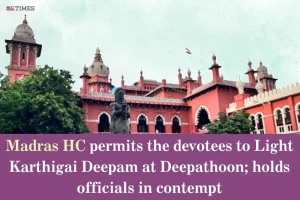
Madras High Court: In a contempt petition against the violation of earlier court’s order detecting the temple authorities to light the Karthigai Deepam at the lower peak of the hillock (Deepathoon) at Arulmigu Subramania Swamy Temple, Thirupparankundram, a single-judge bench of G.R. Swaminathan, J., held that the Executive officer had committed contempt and permitted the petitioner to go up the hill and light the Deepam at the Deepathoon.
In the instant matter, the petitioner, one of the litigants who had earlier secured directions in ‘Rama Ravikumar v. District Collector, Madurai, W.P(MD)No. 32317 of 2025, Decided on 01-12-2025’ for lighting the Karthigai Deepam at the lower peak of the Thirupparankundram hillock (Deepathoon), approached the Court under Section 11 of the Contempt of Courts Act, 1971.
The petitioner asserted that despite the Court’s order the authorities had made “no arrangement…for lighting the Deepam”, leading to violation of Court’s order. The event was scheduled at 6:00 PM on 03-12-2025, prompting the filing of this urgent contempt petition.
The Court noted that at 5:00 PM, the Additional Advocate General sought closure of the petition as premature, and the Court passed over the matter to 6:05 PM. However, by 6:00 PM, the Deepam at Uchi Pillaiyar Temple had been lit, but “there has been no lighting of the Deepam at the Deepathoon as directed by this Court.”
The Court stressed that its order was passed on 01-12-2025 and was immediately communicated and yet the authorities “made it clear that they would not implement the order of this Court.” The Court noted that the respondents had every opportunity to list the matter even before the Division Bench on 03-12-2025, instead, the temple management filed a defective writ appeal. The Court stated that the Court is “impelled to think that the filing of the appeal by the temple in a defective format is a ruse to disobey the order.” The Court stated that “Clock cannot be put back.”
Citing Tata Mohan Rao v. S. Venkateswarlu (09.05.2025), where the Supreme Court reiterated that “every person or authority regardless of rank, is duty bound to respect and comply with that order,” the Court stated that the authorities’ disobedience of court’s order “attacks the very foundation of the rule of law.”
The Court referred to Kerala High Court’s decision in Contempt Case (c) No.2615 of 2019 vide order dated 08.12.2020 and noted that judicial directions are of no use if “the State does not implement the directions of the court” and failure to comply with court’s order could lead to “a constitutional stalemate.”
The Court held that contempt power is inherent, summary, and cannot be whittled down by legislation subordinate to the Constitution. The Court relied on T. Sudhakar Prasad v. Government of A.P., (2001) 1 SCC 516; Elliot v. Klinger, (1967) 1 WLR 1165 and Howarth v. Howarth, (L.R.) 11 P.D. 95 and affirmed that the Court may restrain threatened contempts, and even compel performance by appointing another person to carry out the act.
“The High Court is the highest court in the State. The Constitution confers on the High Court vast powers to ensure that constitutional guarantee of justice to all is truly fulfilled. This depends on the respectful and faithful obedience of its commands by the executive.”
The Court stated that the contempt jurisdiction is not merely punitive but seeks to “efface the offending act.” The Court asserted that “contempt jurisdiction is not only about punishment but also about restoring the status quo that obtained following the judicial order.” The Court noted it can pass restorative or coercive orders, including injunctions or appointing persons to carry out the act in place of non-compliant officials.
The Court found it necessary to ensure compliance as “the Executive Officer has made his position clear by his conduct.” The Court authorised the petitioner himself to perform the act that the temple management had refused to carry out.
Invoking restorative contempt jurisdiction, the Court issued directions and remarked that “I am conscious that this is only a symbolic gesture. But the importance of symbolism cannot be lost sight of.” The Court’s issued following directions —
-
The petitioner is permitted to go up the hill and light the Deepam at the Deepathoon.
-
The petitioner may take ten persons, including other petitioners, to carry necessary materials.
-
The Commandant, CISF Unit, Madurai Bench of the Madras High Court, is directed to send CISF personnel to offer protection to the petitioner and his team in carrying out the order.
-
The matter is posted on 04.12.2025 at 1:00 PM for reporting compliance.
[Rama Ravikumar v. K.J. Praveenkumar, 2025 SCC OnLine Mad 11762, Decided on 03-12-2025]
Advocates who appeared in this case:
Mr. RM.Arun Swaminathan, Counsel for the Petitioner
Mr. J.Ravindran, Addl. Advocate General, Assisted by Mr. S.S.Madhavan, Addl. Government Pleader, Counsel for the Respondent No. 1
Mr. S.Ravi, Addl. Public Prosecutor Pleader, Counsel for the Respondent No. 2
Mr. V.Chandrasekar, Counsel for the Respondent No. 3