


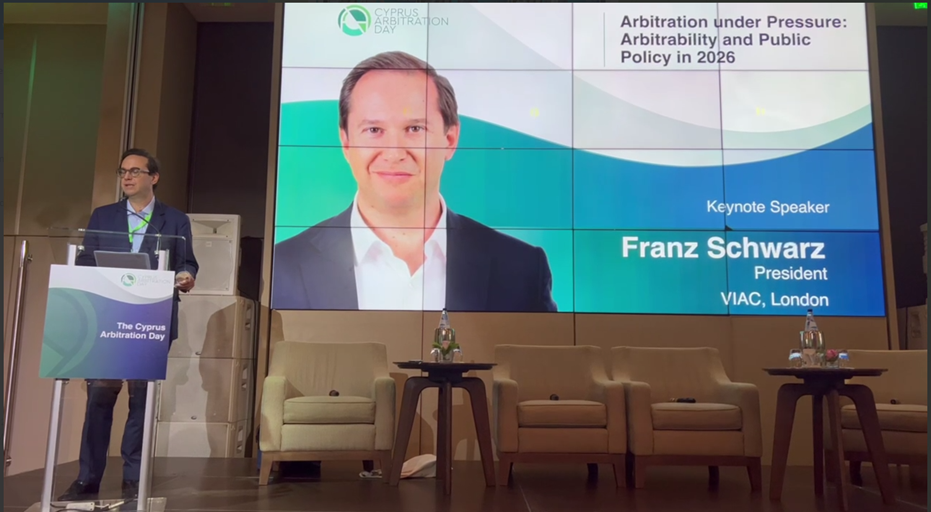

Mr. Franz Schwarz, President, Vienna International Arbitral Centre (VIAC), London expressed that international arbitration is increasingly confronting expansive judicial intervention, broader notions of public policy, and growing resistance from states and courts.
Opening his address on a warm note, Mr. Schwarz congratulated the organisers for assembling what he described as a “fantastic conference”, noting the remarkable international participation and the “vibrancy” of the Cyprus arbitration community.
Introducing the central thesis of his address he said,
“We are in a new era in arbitration, an era in which the general flair of arbitration friendliness, the enthusiasm of the last 20, 30 years … has subsided and we now are facing some headwinds.”
According to Mr. Schwarz, those headwinds are emerging through increasingly expansive interpretations of public policy and arbitrability that allow domestic courts to scrutinise arbitral awards more aggressively at the enforcement and setting aside stages.
New York Convention preserved national sovereignty, but expected restraint
Tracing the roots of the debate to the New York Convention1, Mr. Schwarz explained that Article V(2) deliberately preserves the power of domestic courts to refuse enforcement where the subject matter is considered non-arbitrable under national law or where enforcement would violate public policy.
Unlike the grounds contained in Article V(1), Mr. Schwarz noted that questions of public policy and arbitrability may be examined ex officio because they implicate sovereign interests and the integrity of a state’s legal order. Referring to the travaux préparatoires2, he observed that the drafters consciously rejected attempts to create uniform international standards for public policy and arbitrability, choosing instead to preserve domestic control over both concepts.
At the same time, Mr. Schwarz stressed that the Convention was built on an expectation of judicial restraint. According to him, courts across jurisdictions historically treated public policy as a narrow and exceptional defence confined to the “most fundamental notions of morality and justice.”
Referring to jurisdictions such as Switzerland, France, England, Hong Kong, Austria, Italy, and India, Schwarz noted that many courts voluntarily adopted particularly restrained approaches by applying concepts such as “international public policy” rather than broader domestic standards.
“No one was forcing or could have forced the courts of Switzerland to adopt that very narrow application of an international standard for public policy. That was self-restraint.”
“That era of self-restraint is gone”
According to Schwarz, states are now routinely invoking expansive notions of public policy to pursue national, political, constitutional, and regulatory objectives through arbitration-related proceedings. While acknowledging that such approaches may technically fall within the wording of Article V(2), he cautioned that they increasingly undermine the broader spirit and enforcement objectives of the New York Convention itself.
Greek Bitcoin enforcement decision reflects widening public policy objections
Illustrating the trend, Mr. Schwarz referred to a 2021 decision of the Court of Appeal of Western Central Greece concerning enforcement of a foreign arbitral award requiring payment in Bitcoin.
Mr. Schwarz explained that the Greek Court refused enforcement on public policy grounds after concluding that Bitcoin was not recognised as legal tender under Greek law and that cryptocurrency transactions raised concerns relating to tax evasion, money laundering, and financial stability.
Questioning the breadth of the court’s reasoning, Mr. Schwarz asked:
“Is this the sort of public policy exception that the drafters of the New York Convention had in mind?”
He further questioned whether sophisticated commercial parties exercising party autonomy should face refusal of enforcement merely because they agreed to cryptocurrency-based payment mechanisms.
Corporate disputes increasingly being recast as questions of arbitrability
Mr. Schwarz also referred to developments concerning shareholder and corporate disputes, observing that courts are increasingly elevating procedural issues, such as joinder and shareholder participation, into broader questions concerning arbitrability itself.
According to Schwarz, arbitration has historically developed mechanisms to deal with multi-party disputes, but courts are now increasingly examining whether the disputes are arbitrable at all and under what circumstances.
European Union jurisprudence has blurred the line between mandatory law and public policy
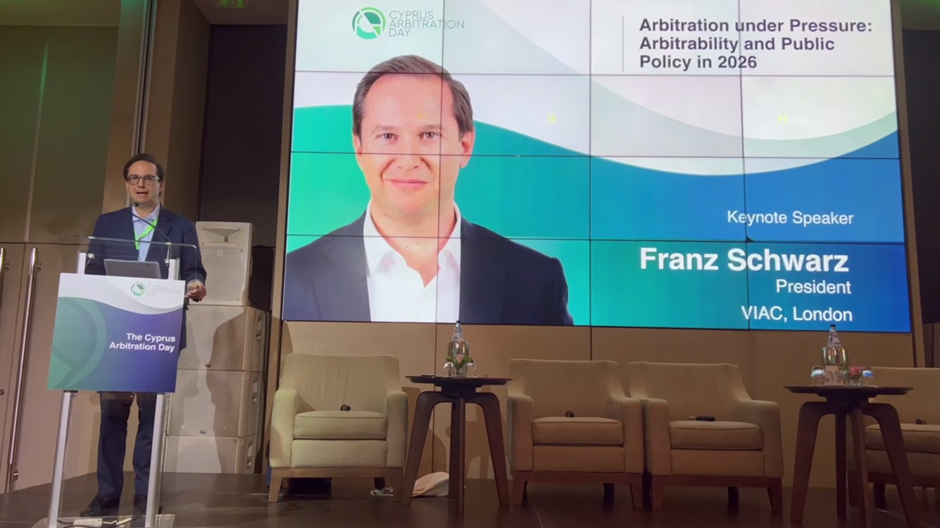
A substantial portion of Franz Schwarz’s keynote focused on developments within European Union law and the jurisprudence of the Court of Justice of the European Union (CJEU).
Mr. Schwarz referred first to Eco Swiss China Time Ltd v Benetton International NV3, where the CJEU recognised that arbitral tribunals may adjudicate disputes involving European Union competition law. According to Mr. Schwarz, the decision reflected an arbitration-friendly understanding that questions concerning contractual validity under competition law properly fall within arbitral jurisdiction.
He then contrasted this with subsequent decisions including Mostaza Claro v Centro Móvil Milenium SL4 and Asturcom Telecomunicaciones SL v Cristina Rodríguez Nogueira5, where the CJEU treated consumer protection provisions under Council Directive 93/13/EEC on Unfair Terms in Consumer Contracts as equivalent to public policy norms.
According to Mr. Schwarz, these decisions effectively require courts to independently examine consumer protection issues during annulment and enforcement proceedings even where parties themselves failed to raise such objections before arbitral tribunals.
“If you use that as the standard, you can very easily argue that any EU law, or indeed any law, rises to the level of public policy.”
Mr. Schwarz remarked that he found the European Union’s approach increasingly detrimental, especially because it came from a legal order built upon the rule of law and one that had historically supported arbitration. He further stated that such expansive reading of public policy to ensure its supervisory powers could be taken up by the states all over the world.
Reibel v Stankoimport6 may reshape the relationship between sanctions and arbitrability
Discussing Reibel v Stankoimport and the opinion delivered by Advocate General Biondi, Mr. Franz Schwarz stated that the Advocate General sidesteps a discussion of what arbitrability really means and instead proceeds on the basis that sanctions-related restrictions constitute substantive rules which don’t impede the forum, thereby permitting arbitral determination of such disputes.
Mr. Schwarz further observed that the opinion does not adequately engage with how Swedish arbitration law, being the law of the seat in Reibel v Stankoimport defines arbitrability as matters that can be settled by the parties. He cautioned that if the Court of Justice of the European Union ultimately concludes that sanctions law concerns matters incapable of settlement between parties, such disputes could potentially be classified as non-arbitrable.
Referring to prior arbitration-related disagreements between the Court of Justice of the European Union and opinions of Advocates General, Mr. Schwarz remarked, “The last time that in an arbitration-related matter the court disagreed with the Advocate General was of course at Achmea, and I hope we will not see this in this case either.”
A Call to Action for the Arbitration Community
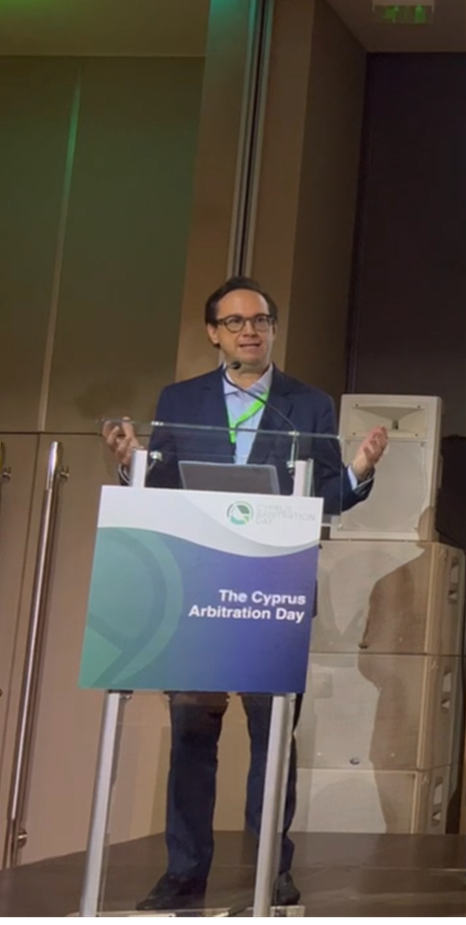

Concluding his keynote address at Cyprus Arbitration Day 2026, Mr. Franz Schwarz reflected on the implications of the expanding judicial scrutiny surrounding international arbitration, stating that “there is no doubt in my mind that we now live in an era of expansive review by the courts, based on such expansive notions of public policy and arbitrability.”
Mr. Schwarz observed that part of the current judicial scepticism towards arbitration is self-inflicted, particularly in cases where arbitral tribunals have failed to deal appropriately with allegations involving corruption and bribery. Referring to recent approaches adopted by French and English courts, Mr. Schwarz stated that some of the newly found vigor displayed by courts in revisiting factual findings underlying arbitral awards stems from concerns arising out of such cases.
Emphasising the responsibility borne by the arbitration community, Mr. Schwarz stated,
“That cannot happen. We have a responsibility as a community to make sure, as arbitrators, as institutions, and as counsel, that we don’t add fuel to the fire, that we don’t give grounds for our critics to use these cases against us.”
At the same time, Mr. Schwarz stressed that not all contemporary trends are attributable to failures within the arbitration community itself. According to him, some developments represent broader institutional and judicial grabs for power.
Calling for a more active and outward-facing approach from arbitration practitioners and institutions, Mr. Schwarz stated that while conferences and academic discussions remain important, the arbitration community has become too comfortable in its own bubble. He urged for greater engagement with governments, regulators, courts, and the wider public in defending arbitration and explaining its institutional value.
Mr. Schwarz, in closing, further advocated for greater use of amicus curiae interventions by arbitral institutions in important cases and emphasised the need for stronger cooperation among institutions themselves. Referring to an earlier discussion during the conference on the importance of arbitral institutions, Mr. Schwarz expressed that institutions need to cooperate more and speak with one voice in explaining to the public, to the governments, and to the European authorities, why arbitration is a good thing.
The full conference agenda is available at the Cyprus Arbitration Day website.
SCC Times is the sole media partner for this event.
1. United Nations Convention on the Recognition and Enforcement of Foreign Arbitral Awards (New York, 10 June 1958)
2. Official documents recording negotiations, drafting, and discussions during the process of creating a treaty
3. European Court Reports 1999 I-03055, judgment dated June 1, 1999
4. European Court Reports 2006 I-10421, Judgment of the Court (First Chamber) of 26 October 2006
5. European Court Reports 2009 I-09579, Judgment of the Court (First Chamber) of 6 October 2009
6. Joint Stock Company Foreign Trade Enterprise Stankoimport v. NV Reibel (II), Final Award dated December 5, 2021